Get Full Government Meeting Transcripts, Videos, & Alerts Forever!
Get email alerts on the Hotel Conversions topic
No spam. Unsubscribe anytime.
Building Inspection Commission grants, denies and continues multiple hotel amortization extensions; April 16 set as final continuance deadline
Summary
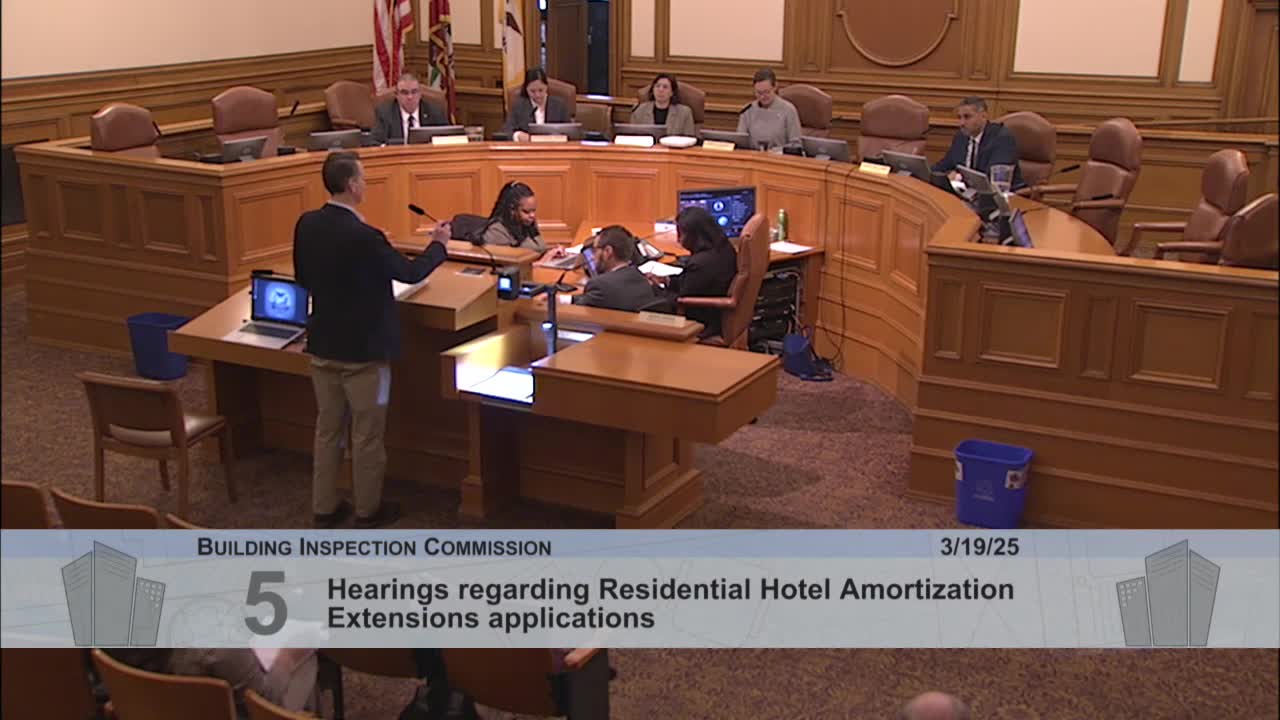
The San Francisco Building Inspection Commission on March 19 heard nearly a dozen applications for extension of amortization periods under the Hotel Conversion Ordinance (HCO), Administrative Code Chapter 41 (Ordinance 36-23).
The San Francisco Building Inspection Commission on March 19 heard nearly a dozen applications for extension of amortization periods under the Hotel Conversion Ordinance (HCO), Administrative Code Chapter 41 (Ordinance 36-23). The commission granted several extensions, denied a small number of requests where applicants did not provide required documentation, and continued many cases to the commission’s April 16 meeting — which the panel said will be the final date for continuances.
The matters matter for housing policy in San Francisco because Ordinance 36-23 shortens the definition of transient/tourist use and permits owners to request reasonable amortization periods to recoup investments made under the prior regulatory regime. Staff presentations described the rule set and advised the commission to weigh the total cost of investments, the length of time those investments had been in place, the suitability of investments for residential hotel use, and any other factors relevant to a reasonable return on investment. Matt Luton, senior housing inspector, summarized the ordinance and the staff’s analytical framework: “The hotel conversion ordinance or HCO is codified in chapter 41 of the Administrative Code. The continuing and primary purpose of the HCO is to preserve residential guest rooms, which provide crucial housing for elderly, disabled and people with low incomes.”
Commissioners and parties debated how to allocate costs between tourist and residential uses, how to account for investments made many years prior, and what documentary evidence was required. Several applicants asked for continuances to provide invoices, permits, photos, receipts or clearer breakdowns; staff repeatedly asked for specific descriptions of investments and their dates. Commissioners consistently emphasized the hearing rules and the narrow statutory scope, and reminded applicants that the commission could not consider some factors (for example, general pandemic impacts) if not within the ordinance’s enumerated criteria.
Votes at a glance (key outcomes)
- 54 Fourth Street — Continued to April 16, 2025. Motion to continue carried unanimously (mover: Commissioner Williams; second: President Alexander Toot).
- 80 Ninth Street — Extension granted for 3 years (staff recommendation). Motion carried unanimously (mover: Commissioner Williams; second: Commissioner Newman).
- 507 Bush Street — Continued to April 16, 2025 to allow the applicant to provide specific expenditure documentation. Motion carried unanimously (mover: President Alexander Toot; second: Commissioner Ming).
- 1507 California Street — Extension granted for 10 years (commission overrode staff’s 5‑year recommendation). Applicant said it bought the property for $6,200,000 in 2021 and cited roughly $3.4 million in prior improvements. Motion carried unanimously (mover: Commissioner Newman; second: Commissioner Williams).
- 935 Kearney Street — Continued to April 16, 2025 on condition the applicant provide invoices, photos and a revenue estimate. Motion carried unanimously (mover: President Alexander Toot; second: Commissioner Newman).
- 2160 Market Street — Application denied for lack of documentation; applicant not present. Motion carried unanimously to deny (mover: President Alexander Toot; second: Commissioner Ming).
- 2162 Market Street — Application denied for lack of documentation; applicant not present. Motion carried unanimously to deny (mover: Commissioner Williams; second: President Alexander Toot).
- 1906 Mission Street — Continued to April 16, 2025 after applicant submitted late materials and requested more time. Motion carried unanimously (mover: Commissioner Ming; second: Commissioner Newman).
- 240 O'Farrell Street — Continued to April 16, 2025 for additional documentation; staff flagged some items (restaurant operations) as not relevant to residential amortization. Motion carried unanimously (mover: President Alexander Toot; second: Commissioner Newman).
- 411 O'Farrell Street — Extension granted for 10 years (staff recommended 10 years; applicant had sought 12). Applicant representative said the owner would accept the staff recommendation. Motion carried unanimously (mover: President Alexander Toot; second: Commissioner Newman).
- 161 Powell Street — Continued to April 16, 2025 to allow additional documentation. Motion carried unanimously (mover: Commissioner Ming; second: Commissioner Williams).
- 242 Powell Street — Continued to April 16, 2025 to allow the applicant to submit further documentation. Motion carried unanimously (mover: President Alexander Toot; second: Commissioner Newman).
- 2263 Sacramento Street — Extension granted for 10 years (staff recommended 10 years; applicant proposed longer). Motion carried unanimously (mover: President Alexander Toot; second: Commissioner Ming).
- 717 Sutter Street — Extension granted for 3 years (staff recommendation). Motion carried unanimously (mover: Commissioner Newman; second: unspecified in transcript; roll call recorded unanimous yes).
What commissioners and staff emphasized
Staff and commissioners repeatedly asked applicants to show documentary support — permits, invoices, receipts, photos and dates of expenditures — and asked applicants to apportion costs that were building-wide (for example window replacement) between residential and tourist portions. Matt Luton told applicants the commission’s scope is narrow: show "what investments did you make? What was it that you bought?" and prepare summaries that make the math clear.
Applicants’ positions
- Some owners sought long amortization periods (requests of 10, 20 or even 25 years appeared in applications); their representatives argued that prior investments and lost revenue (including post‑COVID market changes) make shorter amortization periods insufficient. John Lee, owner of 1507 California Street, said: “We purchased the property for $6,200,000 in 2021.” He told the commission his firm spent roughly $3.4 million on upgrades and said 30‑day minimum stays would reduce achievable monthly revenue.
- Several applicants asked for continuances to provide documentation. Mark Mason, representing ownership for 507 Bush Street, said: “We're prepared to continue to next meeting and come back with additional information specific to improvements, tourist versus residential.”
- Counsel for multiple owners, including for 1906 Mission Street and several Powell/Market properties, submitted legal objections to process dates and asked for continuances so late materials could be considered; the commission allowed continuances but reminded parties of the April 16 final‑continuance deadline.
Commission directions and follow-ups
Commissioners directed staff to send notice of deadlines and to specify what supporting documents are due 14 days before the April 16 meeting. The commission secretary was directed to prepare written findings for decisions, and commissioners repeatedly warned that no continuances would be allowed after April 16.
Why this matters
Ordinance 36-23 changes the city’s tourist/transient-use definition and will reduce the window for short-term renting in affected rooms. The commission’s decisions affect owners’ ability to recover investments and, in some cases, the financial viability of residential hotels that house elderly, disabled and lower‑income residents. Many applicants argued the change will substantially reduce revenue and required extended amortization timelines; commissioners balanced those claims against the ordinance’s narrow factors and the documentary evidence provided.
What to expect next
The commission continued many matters to its April 16 meeting and ordered staff to notify applicants of filing deadlines. For cases continued to April 16, applicants were told that 14 days’ pre-hearing materials are required and no further continuances will be granted after that date.