Get Full Government Meeting Transcripts, Videos, & Alerts Forever!
Get email alerts on the Long Range Planning topic
No spam. Unsubscribe anytime.
Joint planning staff warn county and town are nearing 7% growth trigger; recommend scoping for next comp‑plan review
Summary
Joint long‑range planning staff presented the annual indicator report and FY26 work plan, saying residential growth is near the 7% trigger that would prompt a comprehensive‑plan review, while calling for targeted scoping, more monitoring of water and natural resources, and a prioritized work program given limited staff capacity.
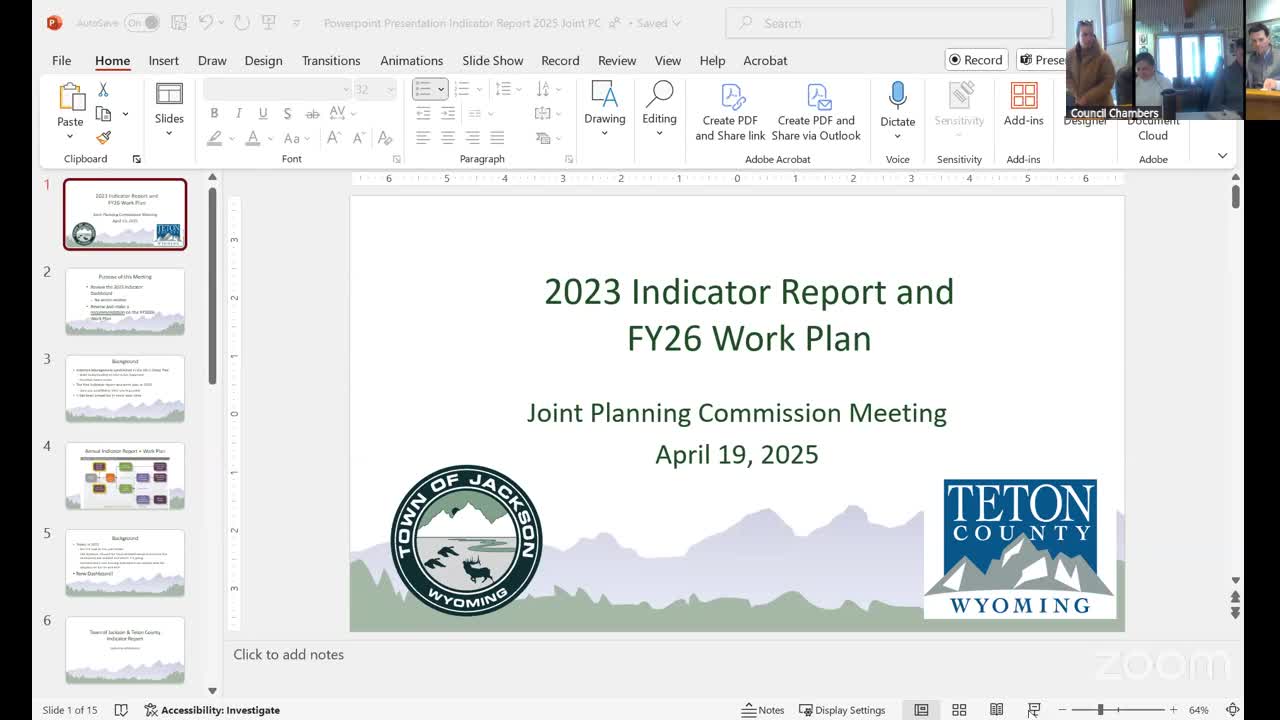
Ryan Costner, a joint long‑range planner for the Town of Jackson and Teton County, told the joint planning commissions on March 19 that the community’s indicator report and a new interactive dashboard show the county is approaching a 7% residential growth trigger that would prompt review of the joint comprehensive plan.
"We are just about there. We are at 6.7% now," Costner said, explaining the trigger is tied to residential unit growth and not commercial development. He said most recent units are deed‑restricted housing in town and that the location of growth — within complete neighborhoods rather than rural areas — is meeting a key policy goal of the plan adopted in 2012 and updated in 2020.
The indicator report, Costner said, also shows rising vehicle miles traveled and greenhouse‑gas emissions, and continued job growth that is outpacing housing production. He described the new interactive dashboard, now available at JacksonTetonPlan.com, as a way for commissioners and the public to examine trends over more than 20 years of data.
Why it matters: the comprehensive plan includes an adaptive‑management program that uses monitored indicators to trigger further planning if metrics move beyond stated thresholds. Commissioners were asked to weigh in on a recommended FY26 work plan and on whether staff should begin scoping the next comprehensive‑plan revision to limit unnecessary consultant expense and better define the scope of any amendment.
Staff and commissioners discussed several resource and policy follow‑ups. County planner Erin Monroe (county long‑range planning) and other staff described recent work including the County Natural Resources Overlay update, review of the Scenic Preserve Trust, and the Smith‑Collins LDR amendments. Costner and Monroe said staffing capacity is limited after the long‑range team lost a planner position last year, and that programmatic items may need to be prioritized.
County staff and commissioners flagged water quality and monitoring as a top new program need. Chris Peltz, a county staffer, said the county has set aside funds for monitoring and is partnering with state and federal groups and university researchers. "We have in our capital budget as well as our ongoing budget, half a million dollars directed toward monitoring over the next several years," Peltz said; he called monitoring complex and noted some measures require laboratory analysis.
Commissioners pressed staff about whether new or different indicators should be added to the dashboard — for example, tracking renewable energy production or groundwater metrics — and how indicators connect to the work plan and to allocation of staff time and public dollars. Costner and others said indicators come from the comprehensive plan’s policy priorities and adding indicators or changing them would generally require a plan amendment or a separate policy decision.
On specific program priorities, staff recommended: (1) scoping a possible comp‑plan amendment now so elected officials can decide how big a rewrite, if any, is needed; (2) advancing water‑quality‑related LDR amendments on the county list; (3) continuing to resource conservation programs and the dashboard; and (4) asking the commissions to advise elected officials on which town and county LDR items to prioritize.
Action taken: the Teton County Planning Commission voted to recommend that the Board of County Commissioners adopt the proposed FY26 implementation work plan dated April 15, with suggested conditions and follow‑up (motion carried). The town planning commission separately discussed and prioritized several town projects for referral to town council, including a workshop on town LDRs scheduled for April 21.
What’s next: staff will carry commission comments into a staff report to elected officials and return later with scoped proposals for any comp‑plan work, formal LDR amendments and associated monitoring plans that would set technical details for water‑quality and other environmental metrics.