Get Full Government Meeting Transcripts, Videos, & Alerts Forever!
Get email alerts on the Infrastructure Sewer Maintenance topic
No spam. Unsubscribe anytime.
Carlsbad planning commission approves manhole rehabilitation in Poinsettia Station preserve
Summary
On March 19, 2025, the Carlsbad Planning Commission voted 6-0 to adopt a mitigated negative declaration and approve permits for the Ponce Seward Manhole Rehabilitation Project, a maintenance program to repair nine aging sewer manholes within the North County Transit District right-of-way and adjacent vernal-pool preserve.
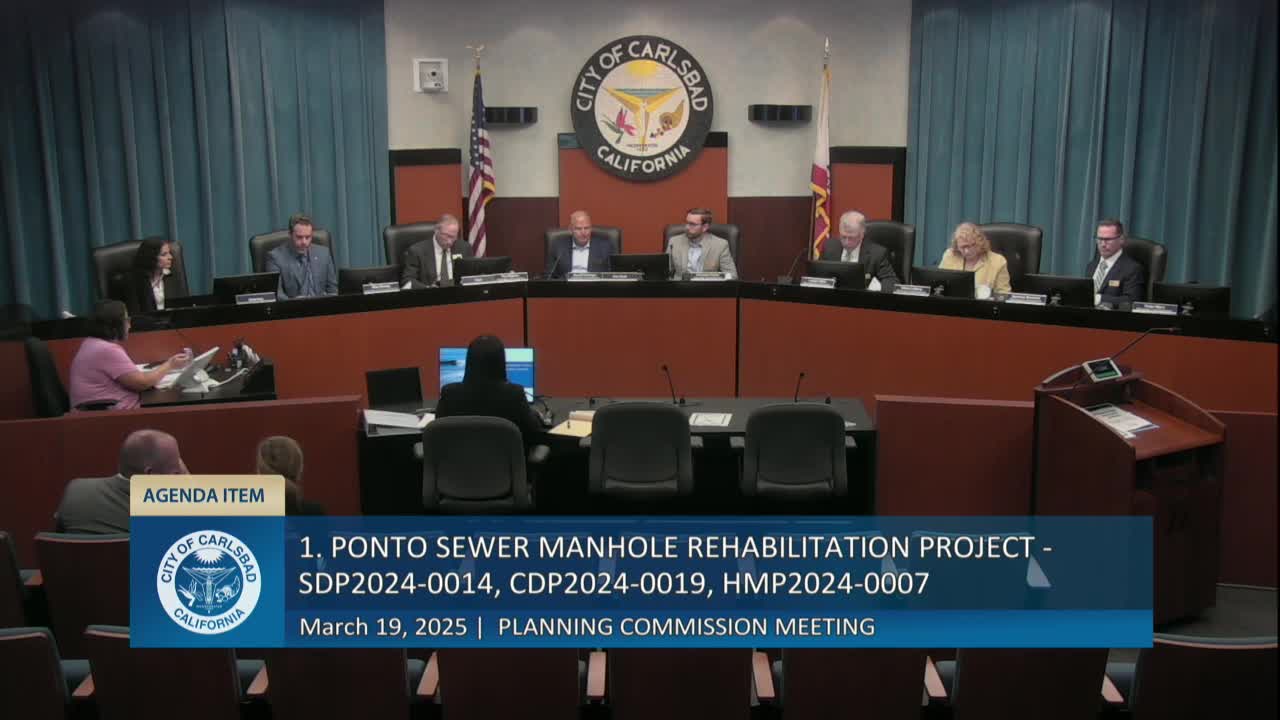
The Carlsbad Planning Commission on March 19 approved two resolutions — adopting a mitigated negative declaration and granting permits — for the Ponce Seward Manhole Rehabilitation Project, a maintenance effort to rehabilitate nine sewer manholes in the North County Transit District right-of-way near Poinsettia Station. The commission voted 6-0 (one commissioner absent) to approve the project.
City staff told the commission the project is aimed at preventing potential sewer leaks, spills or structural failure. "The 9 existing sewer manholes are approximately 50 years old and have been assessed by wastewater operations to be rehabilitated," Associate Planner Shelly Glennon said during the staff presentation. Staff recommended approval after concluding the project would be consistent with the General Plan, zoning, the local coastal program and the California Environmental Quality Act with mitigation measures incorporated.
The project covers work at nine manhole locations across four parcels totaling about 3.29 acres; temporary construction impacts are limited to about 0.13 acres, staff said. Most work will be performed inside the existing manholes: interiors will be pressure-washed, internal cracks repaired and walls relined with a spray liner. Aboveground changes will be limited. "There is no vertical development being proposed," Glennon said. "It's just the existing sewer manholes being replaced, with manholes that meet the current standards."
City engineers said the work will include replacing deteriorated manhole covers and frames and installing five-foot-square concrete pads around the manholes where required by current standards. Utilities project manager Carrie Martinez described protections for sensitive habitat: plywood will be placed along access routes and around work areas to limit trampling in the Poinsettia Station Vernal Pool Preserve, tribal and cultural-resource monitors will be on site during ground-disturbing work, and work is proposed for the dry season to avoid vernal-pool wet-season impacts. Martinez said temporary vegetation trimming of up to an 8-foot-wide access corridor per location may be needed to move tools by hand; the concrete pads are slab-on-grade and do not require extensive excavation.
Staging is proposed at two off-site locations: the North County Transit District (NCTD) parking lot and the Sand Shell Sewer Lift Station, with access also from the adjacent pedestrian trail. Staff said the rehabilitation does not include upsizing the sewer and is intended as maintenance; construction is expected to take about six to eight weeks and to occur in the dry season between mid-August and October.
During discussion commissioners asked about prior inspections and alternatives. Staff said the manholes are approximately 50 years old, that inspection frequency varies across the system, and that these locations had been difficult to maintain because of access constraints and habitat concerns; they estimated it had been about five years since utilities last entered some of the manholes. On alternative technologies, staff said polymer-concrete inserts and other larger replacements exist but require heavy equipment and cranes, which are not appropriate in the sensitive preserve; the proposed spray-liner approach was favored to limit disturbance.
Glennon said the draft mitigated negative declaration received two letters during review: one raising bidding-process questions and one from a water district stating it had no jurisdiction. Staff reported no letters of opposition and no public speakers at the hearing. Commissioner Stein called the project "an easy yes," saying it appeared overdue and that the aboveground impacts would be minimal. Commissioner Lafferty moved to approve the resolutions; Commissioner Burrows seconded. The motion passed 6-0.
City staff and commissioners noted the project underwent extended interagency coordination, including consultation with resource agencies and tribal consultation under AB 52, which contributed to the multi-year schedule to reach the commission. Assistant Director Strong and utilities staff said the work is part of the city's capital improvement program and that some scheduling and funding steps are governed by broader master-planning and permitting processes beyond immediate city control.
The approvals include a site development permit (for work within an environmentally sensitive area and transportation corridor), a coastal development permit (the site lies within a segment of the local coastal program and portions are within Coastal Commission appeal jurisdiction), and a Habitat Management Plan permit (for work inside the preserve). Staff added that Coastal Commission appeal rights remain available for the CDP decision.
Votes at a glance: Motion to adopt the Mitigated Negative Declaration and to approve resolutions authorizing the site development plan permit, coastal development permit and habitat management plan permit for the Ponce Seward Manhole Rehabilitation Project; mover: Commissioner Lafferty; second: Commissioner Burrows; vote: 6 yes, 0 no, 1 absent (Peter Mears); outcome: approved.
The commission closed the public hearing with no comments from members of the public; staff said they will work with city communications to notify trail users in advance of work and staging that may temporarily affect trail access. The project record includes mitigation measures for biological and cultural resources and stipulates work timing and monitoring to limit impacts to vernal-pool species and migratory birds.