Get Full Government Meeting Transcripts, Videos, & Alerts Forever!
Get email alerts on the Municipal Transit Miami Beach topic
No spam. Unsubscribe anytime.
Miami Beach presents trolley ridership, micro‑mobility counts; city supplements service with local funds and pilot programs
Summary
City of Miami Beach Assistant Director O'Neil Rodriguez told the Citizens Independent Transportation Trust that the city's free trolley carried about 3.4 million riders annually, micro‑mobility counts will be included in PTP ridership totals and the city funds roughly half the trolley budget with PTP, local transportation funds and grants.
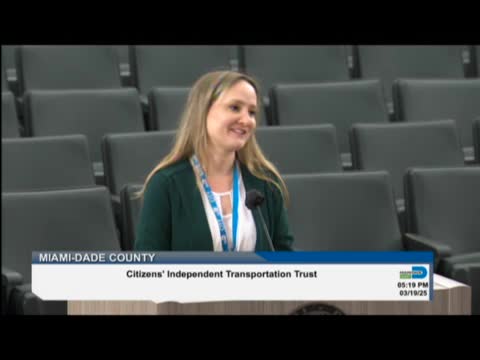
The City of Miami Beach presented a municipal update to the Citizens Independent Transportation Trust on March 19, describing its citywide trolley system, ridership, funding and pilot programs for on‑demand service and water taxis.
"We have, about 3.4, almost 3,500,000 riders, per year," said O'Neil Rodriguez, assistant director for the City of Miami Beach, describing annual trolley ridership and the city's decision to include micro‑mobility (bikes and scooters) in ridership accounting.
Micro‑mobility and ridership accounting Miami‑Dade staff Mariana Price told the trust that the county will begin counting micro‑mobility trips in its fixed‑route ridership totals; she said the first quarter's micro‑mobility total exceeded 500,000 trips and that Miami Beach alone accounted for more than 400,000 of those rides in the reported quarter.
Service levels and costs Rodriguez said the city operates a fleet of 33 trolley vehicles (21 in service, 12 spare) on four routes (including two loops for the South Beach route and a Collins Express) with typical service from 8 a.m. to 11 p.m. daily at an average 20‑minute frequency. He said pre‑pandemic service hours were longer and that the daily ridership fell from about 14,500 pre‑pandemic to about 10,500 today.
On costs, Rodriguez said the annual cost of the trolley service is now roughly $9.3 million, down from about $11.8 million before the COVID‑19 pandemic. He described the city's funding mix: roughly $5.1 million from PTP surcharge distributions, about $2.8 million from the city's transportation funds (part of resort tax collections) and about $1.3 million in state grants.
On‑demand service and Mount Sinai Link Rodriguez outlined the city's experience with an on‑demand service ("freebie") trial in Middle and North Beach. That service struggled with long waits and low efficiency in some areas; the city and county negotiated funding to replace a low‑demand fixed route (Route 115) with a higher‑capacity fixed Mount Sinai Link that launched on Oct. 1, 2024, using a StarCraft van with roughly 22 seats and about seven‑minute frequency.
Capital projects and future services The city is negotiating a new solicitation for next‑generation circulator services (including more eco‑friendly vehicles), plans to deploy 200–250 new bus shelters with saltwater‑resistant materials, and has drafted an RFQ for a future water taxi service to connect Miami Beach with neighboring municipalities and relieve causeway congestion. Rodriguez said the RFQ draft was approved by the commission that day and that route details and vessel specifications will be developed with a water‑transport consultant and a selected vendor.
Quotes "If you're right within the geographic area, you automatically get upgraded to the premium service," Rodriguez said, describing the city's paid premium transit app membership that integrates trolley tracking and the freebie on‑demand request function and which the city currently pays for with city funds.
Ending Trust members asked questions about altered service hours, the cost and role of the freebie on‑demand service, bus shelter deployment and water taxi routes. Miami Beach said it plans to expand some freebie coverage and to negotiate a new municipal circulator contract with multiple vendor options to improve reliability and environmental performance.