Get Full Government Meeting Transcripts, Videos, & Alerts Forever!
Get email alerts on the Payroll Cards Wage Payment topic
No spam. Unsubscribe anytime.
Committee hears testimony on payroll‑card bill; lawmakers set Senate Bill 79 aside for later consideration
Summary
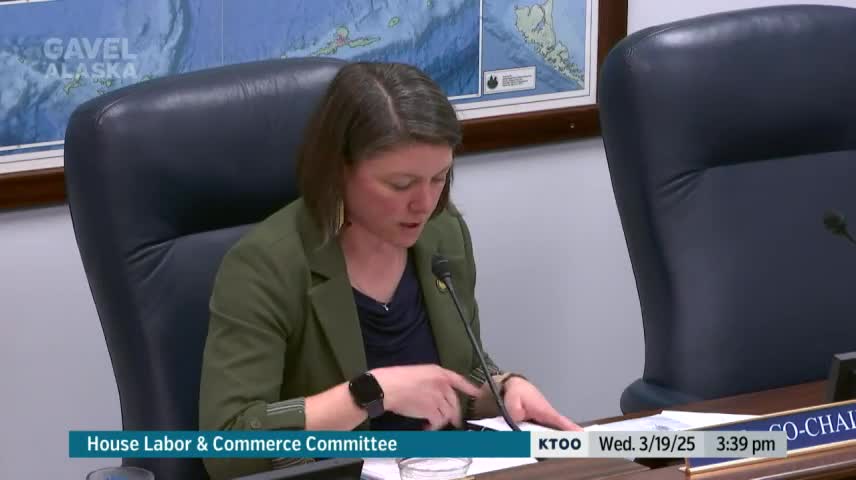
The House Labor and Commerce Committee heard testimony March 19 on Senate Bill 79, which would permit employers to pay wages using payroll‑card accounts under specified consumer protections and would allow limiting mandatory paper checks.
The House Labor and Commerce Committee took testimony March 19 on Senate Bill 79, which would permit employers to pay wages to employees via payroll card accounts under specified consumer protections and would allow employers to stop offering paper paycheck options in certain circumstances.
Senator Jesse Bjorkman, sponsor of SB 79, said the bill allows payroll cards as an option if an employee voluntarily authorizes the card or if an employee has not authorized direct deposit to a bank account. He said payroll cards can be less expensive for employers, avoid the logistical issues of paper checks, and provide a mechanism for unbanked employees to access wages.
Amy Miller, senior director of government relations at ADP, testified in support, saying payroll cards and direct deposit reflect how most wages are already paid nationally, and that the bill includes consumer protections such as at least one cost‑free withdrawal per pay period and free balance inquiry mechanisms. Miller said the bill preserves collective‑bargaining rights and does not prevent employers from offering paper checks if they choose.
Committee members questioned who would pay various fees, whether ATM access would impose costs, how protections work in rural areas with few in‑network ATMs, and the role of federal regulators. Sevea Bieber (trustee staff for Senator Bjorkman) noted the bill requires that wages credited to payroll‑card accounts be insured on a pass‑through basis by the FDIC, NCUA, or another entity that insures deposits.
Committee members asked ADP for a list of fees and for information on federal regulation; Miller said she would follow up. Representative Nelson described personal experience using a payroll card as a teenager and supported options for unbanked workers.
After questions the committee did not take a final vote and set SB 79 aside for future consideration.
Why it matters: The bill would modernize wage payment options for Alaska employers and employees, affect unbanked workers' access to wages, and raise questions about fees, federal insurance, and consumer protections in rural areas.
What’s next: The committee set SB 79 aside and intends to take it up at a later date; sponsors and ADP staff indicated they will provide follow‑up information on fees and federal regulatory oversight.