Get Full Government Meeting Transcripts, Videos, & Alerts Forever!
Get email alerts on the Rental Car Tax Platforms topic
No spam. Unsubscribe anytime.
House committee advances fix to Alaska vehicle rental tax after debate over Turo, platform reporting
Summary
The Alaska House Labor and Commerce Committee voted March 19 to report House Bill 123 out of committee with individual recommendations after debate and a rejected amendment that would have set a single 9% rate for all vehicle rentals.
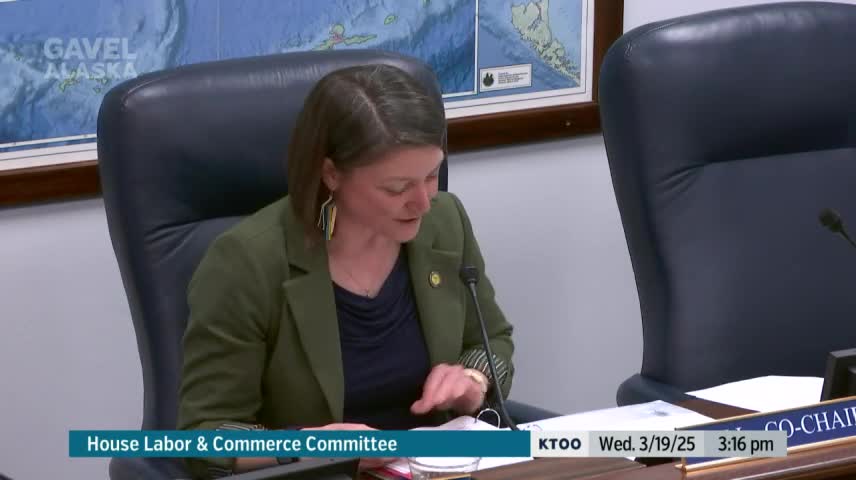
The Alaska House Labor and Commerce Committee voted March 19 to report House Bill 123 (work order 34 LS0551i) out of committee with individual recommendations after testimony and debate over how to tax vehicle‑rental platforms such as Turo.
Representative Kevin McCabe, sponsor of HB 123, told the committee the bill is intended to fix “Alaska's broken vehicle rental tax system” and to protect Alaskans from retroactive tax liability he said could result if courts find platform operators owe taxes. McCabe said he supports a percentage approach negotiated with industry and that the bill’s reduction in the retail tax rate is intended to protect hosts and customers while resolving legal exposure.
The committee considered an amendment (I.2) from Representative Kerrick that would have removed the bill’s tiered structure and set a single 9% rate for all vehicle rentals, including peer‑to‑peer platforms. Kerrick said the amendment was intended to preserve revenue for state park and DOT funding and to ensure parity between traditional fleets and platform hosts. Co‑chair Fields objected to the amendment on grounds of legal uncertainty and urged advancing the underlying bill to avoid litigation. The roll call on amendment I.2 was 1 yea, 6 nays (Representative Carrick was recorded as the sole yes), and amendment I.2 was not adopted.
Department of Revenue staff joined online and described the fiscal note as indeterminate. Revenue analyst Brandon Spanos told the committee the fiscal note shows a reduction from a rate change for current retail taxpayers (from 10% to 9%), while the net effect from collecting tax from platform companies is unknown because the state cannot yet estimate the size of that taxable base. Representative Colomb and Representative McCabe noted Anchorage’s practice of taxing Turo gives some data but the statewide amount is uncertain.
Representative McCabe told the committee he is focused on preventing retroactive liabilities that could financially harm Alaskans and said the percentage split in the bill was agreed to by some industry participants. He also said, based on prior presentations, roughly 1,500 platform hosts could be implicated and that outstanding liability might be on the order of $600,000, though he said a full accounting had not been provided to him.
After debate the committee chair called for the bill to be reported out; there was no further recorded objection and HB 123 was reported out of committee with individual recommendations and accompanying fiscal notes.
Votes at a glance: Amendment I.2 (Kerrick) — moved, objected to by Co‑chair Fields; roll call 1 yea, 6 nays; amendment not adopted. Final committee action — HB 123 reported out of committee with individual recommendations (no objection recorded).
Why it matters: Changes in how platform‑mediated vehicle rentals are taxed could shift who remits tax and when, affect collections that support DOT and state parks, and limit potential retroactive liability for Alaskans who have used peer‑to‑peer platforms.
What’s next: HB 123 was reported out of committee with individual recommendations; any further amendments or floor action will be determined by the sponsoring members and leadership.