Get Full Government Meeting Transcripts, Videos, & Alerts Forever!
Get email alerts on the Colr Debate topic
No spam. Unsubscribe anytime.
Industry and consumer advocates clash at Assembly hearing over carrier-of-last-resort reform
Summary
Industry witnesses urged modernizing networks and loosening COLR obligations; the CPUC public advocate, unions, consumer groups and many public commenters warned that deregulation risks abandoning rural, low-income and disabled Californians unless strict conditions and verified replacements are required.
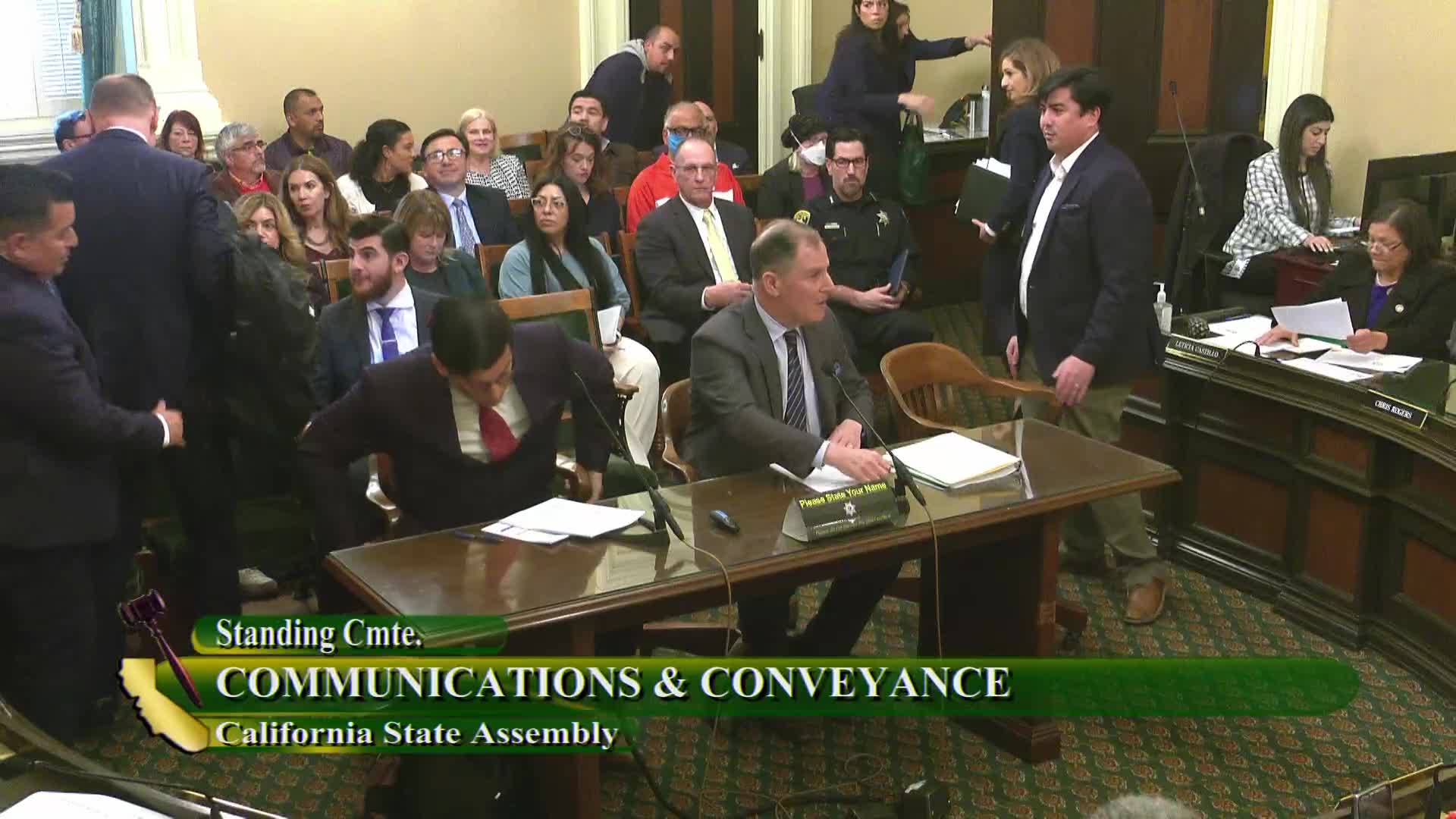
At an Assembly informational hearing on carrier-of-last-resort (COLR) rules, industry and public-interest witnesses presented starkly different views about whether and how California should allow carriers to withdraw COLR obligations.
Jonathan Spalter, president of US Telecom (the Broadband Association), told the committee that COLR rules were written for a voice-only era and now force carriers to maintain aging copper networks. "Copper-based technology was considered innovative 150 years ago," Spalter said; he argued that shifting to modern networks (fiber, fixed wireless, satellite and VoIP) would improve emergency communications over time and reduce the substantial annual maintenance costs carriers currently face. Spalter said reforms can be phased by geography and by validated alternatives so that customers are not left without service.
Opposing that view, CPUC Public Advocates Office representative Ernesto Falcon said the public must not be left worse off during any transition. "Any transition should keep people connected with equivalent service or improve their service," Falcon said, and he proposed a condition-based approach: permit withdrawal only after the carrier deploys verified broadband (he cited the FCC 100/20Mbps standard in his presentation) and retains public-safety, disability-access and low-income protections. Falcon and other witnesses reiterated that much of historical copper infrastructure was built with public and customer funds and that regulatory relief should produce public benefit, not private windfalls.
Unions and consumer advocates reinforced those concerns. The Communications Workers of America (CWA) said COLR is essential to preserve service guarantees and prevent market-driven abandonment of less-profitable rural and low-income communities. TURN (The Utility Reform Network) warned that allowing carriers to walk away without enforceable, verified replacements risks service loss for people who rely on landlines for 911, disability access and captioning. Law-enforcement representatives and disaster-response groups repeatedly stressed that some areas have no reliable wireless coverage during emergencies and that landlines can be easier for dispatch to locate.
Industry witnesses and businesses emphasized the potential upside: modern networks can support economic growth, lower long-term operating costs, and expand broadband-driven opportunities for small firms. Spalter and business representatives argued the transition will spur investment and that buyers would acquire stranded networks if carriers abandoned markets, keeping infrastructure in play rather than leaving customers disconnected.
Public comment was strongly represented during the hearing. CPUC staff reported more than 5,000 written comments in the AT&T application docket and about 400 oral commenters during in-person hearings; dozens of commenters at the Assembly hearing urged the committee and the CPUC to prioritize 911 reliability, Lifeline affordability, and protections for people with disabilities. Commenters included county officials, police chiefs, rural residents who recounted losing life-saving wired service during emergencies, labor representatives, and community organizations representing people with disabilities and low-income Californians.
Committee members repeatedly asked for clarity on what protections would follow deregulation and whether the Legislature should set statutory guardrails. Several legislators urged a regulatory bargain in which any company allowed to withdraw from COLR must invest in or enable verified broadband alternatives that meet public-safety and affordability standards before customers lose access to existing protections.
Ending: The hearing did not produce binding decisions but laid out the principal points of conflict: industry emphasis on modernization and cost efficiency versus advocates' demand for enforceable safeguards ensuring any transition preserves or improves 911 reliability, affordability, and access for vulnerable populations. The CPUC rulemaking will be the forum to develop technical verification and consumer-protection measures; the Legislature signaled interest in crafting complementary statutory guidance.