Get Full Government Meeting Transcripts, Videos, & Alerts Forever!
Get email alerts on the Parole Board Confirmations topic
No spam. Unsubscribe anytime.
Senate Rules Committee advances four Board of Parole Hearings nominees after confirmation hearings
Summary
The Senate Rules Committee heard four reappointment hearings for the Board of Parole Hearings and approved three nominees in a 3-2 vote and the remaining nominee unanimously, after questions about early risk assessments, remote hearings and elderly-parole factors.
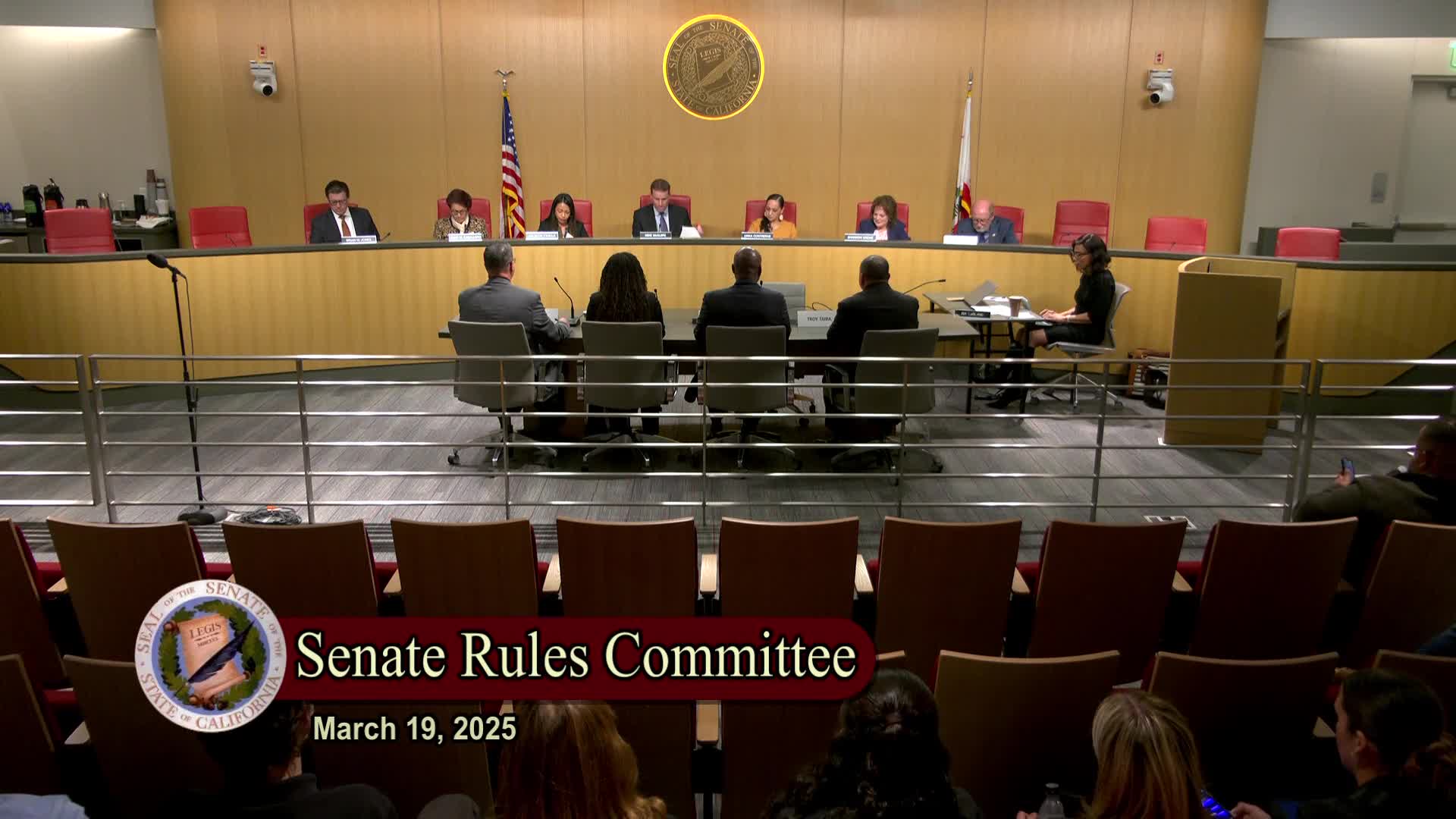
The Senate Rules Committee of the California State Senate held reappointment hearings March 19 for four commissioners of the Board of Parole Hearings and approved the nominees for referral to the full Senate following public testimony and questioning.
The committee approved a motion to advance three nominees (items A, C and D) by a 3-2 roll call and approved the remaining nominee (item B) in a separate, unanimous 5-0 vote.
The nominees appeared before the committee in three-minute remarks and described their years of public service and work on parole hearings. Commissioner Tyra thanked the governor for the reappointment and the Board staff for support during “these difficult proceedings.” Commissioner Sharif said, “I would like to thank the governor for the reappointment and the opportunity to continue to serve the state of California,” and described the role of psychologists and staff attorneys in producing risk assessments and review materials. Commissioner Long, a U.S. Marine Corps veteran who retired from CDCR in 2016, reviewed his work on rehabilitative programming, including early college programs and a prison-based rescue-dog program.
Committee members questioned the nominees on several topics that have drawn public attention. Senator Grove asked whether the board had received guidance after a March 10 Los Angeles Times report about Governor Newsom’s directive to develop an early risk-assessment process tied to high-profile cases. Commissioner Tyra said he had seen only public materials and an FAQ on the board’s website and that a conceptual paper was publicly available; he added he had not seen operational details. Commissioner Sharif acknowledged a misstatement reported to the committee about victim impact statements, saying, “If that was said by me, it was a misstatement. … we do utilize it in our decision, but it’s not sworn testimony.”
Members also asked about remote hearings and victim participation. Several commissioners told the committee that conducting hearings by Microsoft Teams has increased victim participation and allowed family members and victims who could not travel to participate on video. One commissioner said the platform’s “pinning” feature and audio controls make the remote interaction feel close to face-to-face, and that some victims join from other countries.
Senators pressed the nominees on the board’s role in considering elderly-parole requests and sexually violent predator (SVP) referrals. Commissioners said the SVP process is handled separately and that elderly-parole considerations are one factor among many; they described the board’s use of structured risk domains and individualized review of commitment offense, in-prison behavior, programming and current physical and cognitive status.
Votes at a glance — The committee recorded the following roll calls: a 3-2 vote (Maguire Aye; Grove No; Caballero Aye; Jones No; Laird Aye) to advance items A, C and D; and a 5-0 vote (Maguire Aye; Grove Aye; Caballero Aye; Jones Aye; Laird Aye) to advance item B. Earlier, the committee also recorded a series of procedural 5-0 roll-call approvals for housekeeping and committee business.
The committee chair congratulated the nominees and said the confirmations will next appear on the Senate floor for a final vote. The public portion of the hearing closed before the committee recessed into executive (closed) session.
The hearing record shows nominees thanking family and colleagues, and senators expressing appreciation for the complexity of parole work while pressing the nominees for details the committee said remain under development or are described only in public FAQs. No formal changes to board procedures were adopted at the hearing; the committee’s actions were limited to advancing the reappointments to the Senate floor.