Get Full Government Meeting Transcripts, Videos, & Alerts Forever!
Get email alerts on the Cpuc Rulemaking Colr topic
No spam. Unsubscribe anytime.
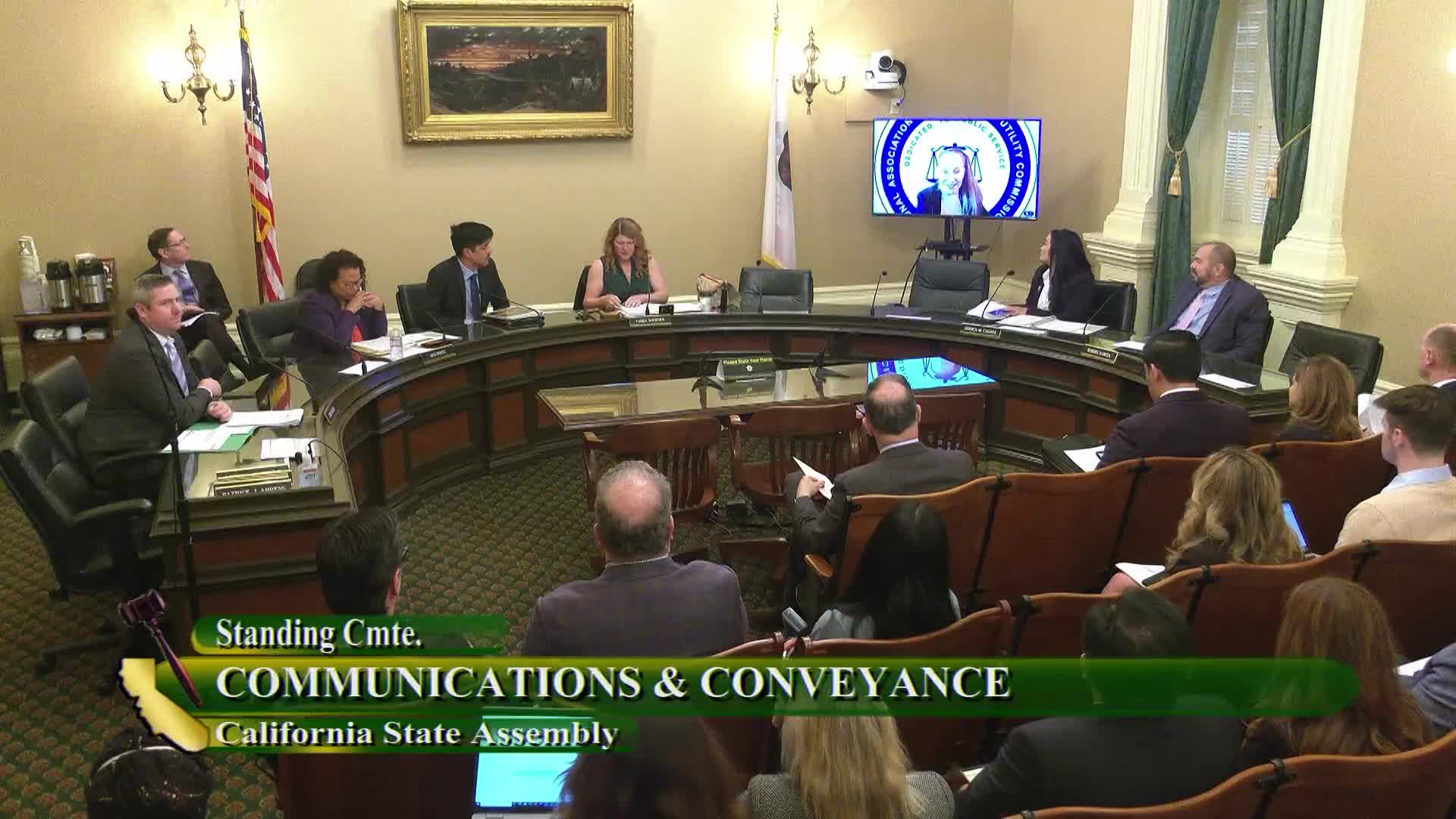
Assembly informational hearing lays out CPUC rulemaking after AT&T carrier-of-last-resort application
Summary
The Assembly Communications Committee held an informational hearing on carrier-of-last-resort (COLR) rules, hearing a CPUC update on AT&T's 2023 request for relief, public participation, and an open CPUC rulemaking to reconsider COLR policy and the definition of basic service.
The California State Assembly Communications Committee convened an informational hearing on carrier-of-last-resort rules (COLR) to review the history of the obligation, AT&T's 2023 application asking for relief in most of its territory, and a CPUC-led rulemaking to revisit how California defines and enforces COLR.
CPUC staff told the committee that COLR is intended to guarantee universal basic service and that California treats COLR as technology-neutral. "Basic service" was described as a package of elements last revised in 2012; CPUC staff listed nine core elements that include voice-grade calling, access to 911, access to relay services for people with disabilities, and Lifeline participation. Anna Maria Johnson, Deputy Executive Director for Broadband and Communications, said COLR gives "a guarantee to all customers in the service territory of a carrier company that they can obtain access to what is called basic service when they request it." Director Rob Osborne summarized the AT&T request: the company sought relief for census blocks with a demonstrated voice alternative (AT&T characterized that as more than 99% of its territory) and an ability to opt out in remaining blocks via an advice letter once alternatives were shown. AT&T proposed continuing service for at least six months following approval and said any discontinuance would follow the FCC discontinuance process.
The CPUC reported wide public interest during the AT&T proceeding: staff described eight in-person and remote public participation hearings with about 2,000 participants and roughly 400 oral commenters, and more than 5,000 written comments in the docket. Staff shared anecdotal testimony that underscored public safety concerns where wireless coverage is weak: for example, a Kern County resident testified that a landline outage left the household unable to reach emergency services, and another speaker in Fresno County described surviving a stroke after a landline 911 call.
The committee heard that the administrative law judge issued a proposed decision dismissing AT&T's application for technical noncompliance; the CPUC later dismissed the application with prejudice in June 2023. CPUC staff said the dismissal reflected that the application did not meet existing COLR withdrawal rules and that no alternative carrier applied to replace AT&T in the proceeding.
Because COLR rules date to 1996 and the CPUC's definition of basic service was last updated in 2012, the commission has opened a separate, broader rulemaking to examine whether and how to update COLR rules. Staff described the scope as including: revising the definition of basic service; identifying which communications activities must continue to be covered by COLR; considering conditions under which withdrawal could be permitted; specifying customer-notification and transition requirements; and clarifying how to measure competition and effective alternatives. The CPUC said parties filed initial proposals and reply comments in late 2024, a scoping ruling issued in February 2025, and staff planned public participation hearings and three workshops in spring 2025. Staff estimated a staff proposal in the third quarter of 2025 with a proposed decision later in 2025 or into mid-2026 depending on the proceeding timeline.
CPUC staff also reviewed planned outreach: an April tribal workshop in Lake County (Middletown Rancheria) will include tribal, public-safety and rural-county panels; an in-person workshop in Los Angeles (staff and carriers/advocates) is scheduled for April 11; and a fully remote workshop will focus on the COLR ecosystem and devices that depend on telephone lines. Staff emphasized that the commission will consider technology-neutral alternatives — fiber, wireless, VoIP, and satellite — only insofar as they meet the elements of basic service.
Staff presented an overview of current market coverage: AT&T was estimated to serve roughly 75% of California households, Frontier about 24%, and consolidated and 13 small rural local exchange carriers combined about 1% of the state's population. Staff cautioned that available wireless coverage maps can overstate true address-level coverage and that questions about whether alternatives meet the nine elements of basic service remain central to the rulemaking.
Committee members asked about geography of hearings, FCC versus CPUC roles, how to measure competition, and how to protect vulnerable customers in emergencies. CPUC staff said the CPUC will take public input, workshops, and technical evidence as it develops proposals but declined to comment on potential legislative actions. The committee discussed whether the Legislature should provide statutory direction on COLR policy rather than leaving the whole process to the commission.
No formal vote or legislative action was taken at the hearing. The committee scheduled further oversight and indicated lawmakers want to consider whether a legislative framework should guide the CPUC's rulemaking.
Ending: The hearing framed the CPUC rulemaking and the AT&T application as separate but linked processes: the dismissed AT&T withdrawal petition prompted a broader CPUC rulemaking on whether and how COLR should evolve. The CPUC will continue outreach and technical workshops in spring 2025; the commission signaled staff will circulate a proposal later in 2025 with a proposed decision expected afterward.