Get Full Government Meeting Transcripts, Videos, & Alerts Forever!
Get email alerts on the Bond 2026 topic
No spam. Unsubscribe anytime.
Watershed Protection presents equity-focused scoring for proposed 2026 bond projects
Summary
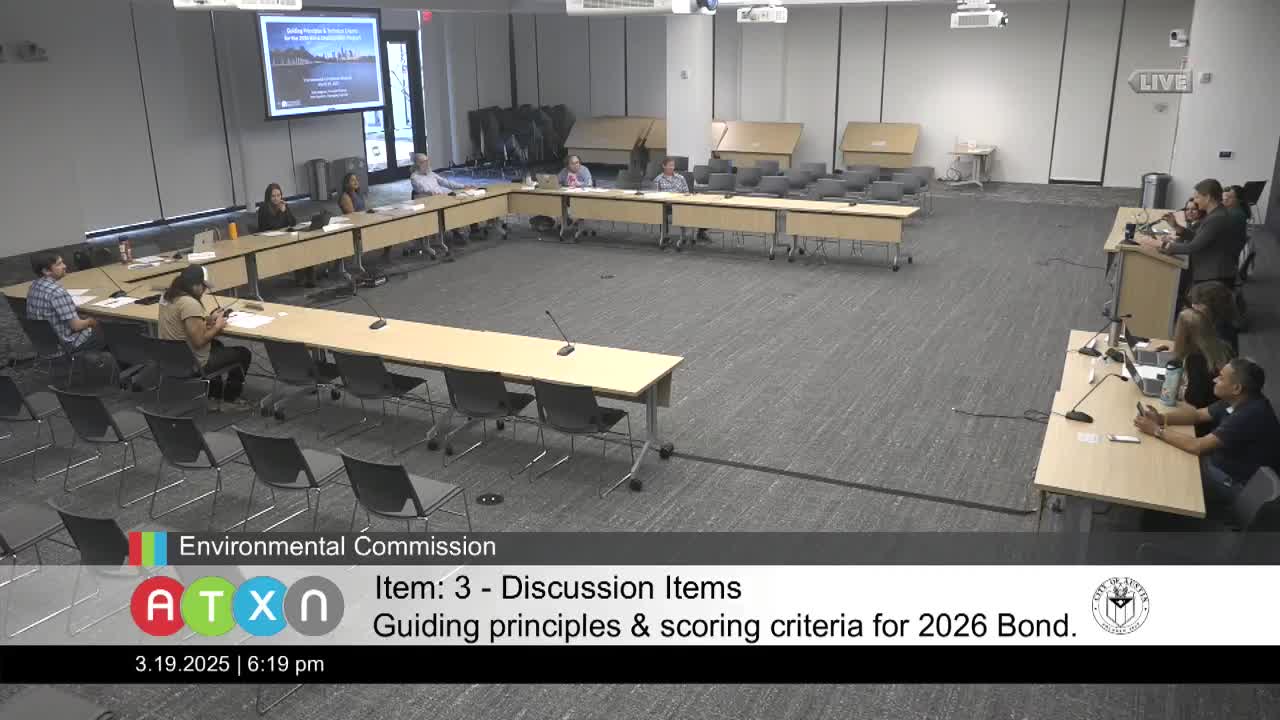
The Watershed Protection Department on March 19 presented draft guiding principles and a technical scoring matrix it intends to use to prioritize drainage and stormwater projects for a potential 2026 general obligation bond.
The Watershed Protection Department on March 19 presented draft guiding principles and a technical scoring matrix it intends to use to prioritize drainage and stormwater projects for a potential 2026 general obligation bond.
The department told the Environmental Commission that Capital Delivery Services has set implementation rules: projects selected for bond funding must result in a public asset placed “in the ground” within a six-year spending window (January 2027 through FY32) and be expected to function for the 20-year repayment period. Kelly Gagnon, principal planner for the department, said those constraints shaped how staff weighted the criteria.
Gagnon said the department assigned a 100-point scale across six pillars: equity; affordability; innovation; sustainability and resiliency; proactive prevention (the department’s strategic-priorities score); and community trust and relationships. She described that distribution as a reflection of Watershed’s portfolio and of overlaps between goals rather than a ranking of importance.
Under the equity component (top score 15 points), Watershed plans to use a geographic analysis based on a principal-component analysis of several social indicators. That combined analysis will include the CDC’s Social Vulnerability Index, a race/language theme, measures of displacement risk and proximity to environmental hazards; the highest-ranked areas would receive the full equity points.
For affordability (15 points), Gagnon said projects will score higher when they reduce net cost to the city and ratepayers by leveraging external funds or partnering with other departments (for example, a Dig-Once coordination that pairs stormwater work with a utility trenching project). Innovation points are reserved for novel, evidence-based approaches or new trusted technologies that fit the bond’s delivery constraints.
Sustainability and resiliency points were structured to reward projects that pursue recognized sustainability ratings (for example, Envision or the SITES initiative) and those that benefit communities with higher community health risk scores. The department proposed 40 points for “proactive prevention,” a category linked directly to Watershed’s strategic plan problem-score methodology; projects that solve the highest-severity, top-ranked problems would receive the most points.
Gagnon also emphasized “community trust and relationships” points aimed at feasibility and implementability: projects that are likely to be completed by FY32 and that demonstrate transparent plans to meet community expectations would score higher.
Commissioners and staff discussed schedule and next steps. Commissioner Dave Sullivan, who serves on the Bond Election Advisory Task Force, told the commission the task force and work groups are still assembling eligible project lists and that community engagement is planned before final recommendations. He said Capital Delivery Services has suggested a likely bond package size in the range of “about $600 million” as a starting point, while noting citywide needs total in the billions.
Gagnon said the department will apply the criteria to a subset of projects already screened as eligible and that Watershed is coordinating with the City’s Environmental Investment Plan and other departments on land-acquisition proposals, which will be evaluated through a separate, citywide process.
The department asked commissioners for feedback on the weighting and on the datasets used to measure social vulnerability and displacement risk. Gagnon said staff will return with refined language and with project lists once Capital Delivery Services and legal review confirm eligibility.
More information and materials are posted at the Watershed site (RainToRiverATX.com) and will be presented to the task force and working groups in coming months.