Get Full Government Meeting Transcripts, Videos, & Alerts Forever!
Get email alerts on the Agriculture Taxation topic
No spam. Unsubscribe anytime.
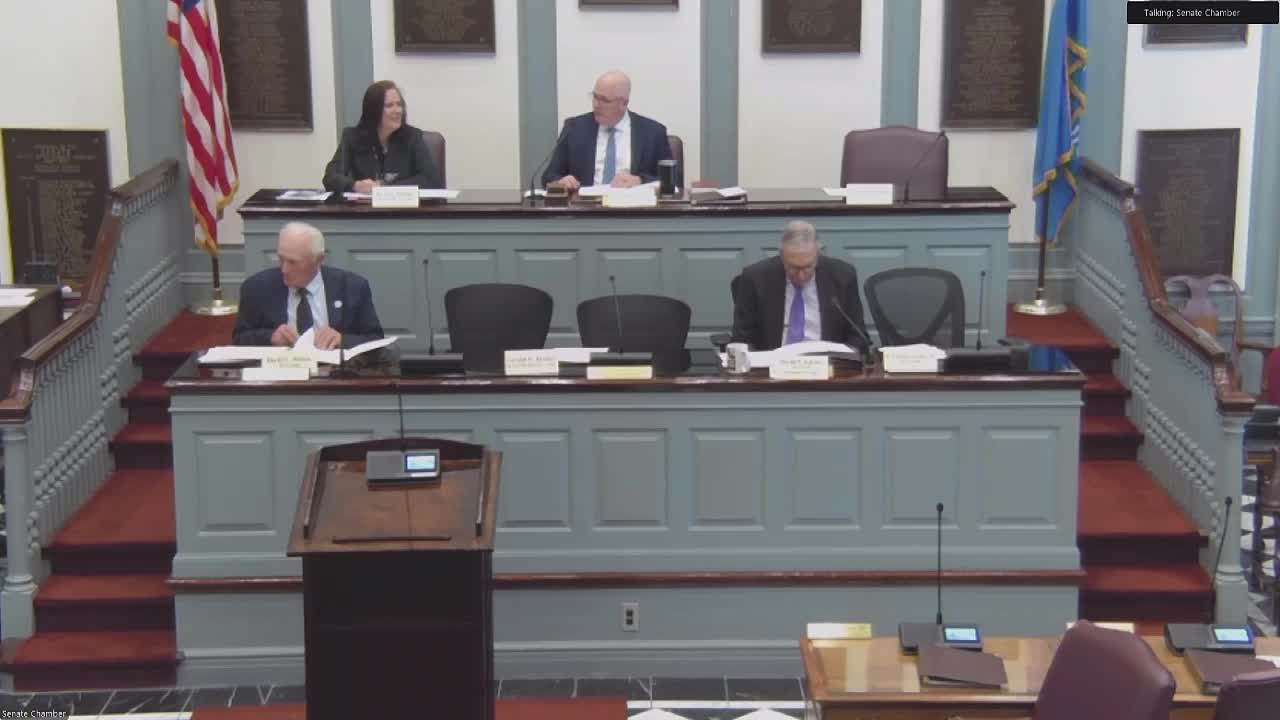
Senate Agriculture Committee hears SB 35 to ease reassessment tax on farm structures
Summary
Senate Agriculture Committee members heard testimony and public comment on Senate Bill 35, which would apply the Farmland Assessment Act's valuation approach to qualifying farm structures in order to reduce school property tax burdens on farmers.
Senate Agriculture Committee members heard testimony and public comment on Senate Bill 35, which would apply the Farmland Assessment Act's evaluation approach to qualifying farm structures in order to reduce school property tax burdens on farmers.
Supporters told the committee recent county reassessments produced large and uneven tax increases for farm operations, and they urged a committee report so the Legislature can act this session. Secretary of Agriculture Don Clifton told the committee there were "clearly inequities in the Kent County process that were inadvertently created" and said his department would provide analysis to help identify appropriate formulas and methodology.
SB 35 would add "qualifying farm structures" to the state's farmland-evaluation review done by the Farmland Evaluation Advisory Committee, using that committee's methodology to set taxable value rather than full market rates for many agricultural buildings. Proponents said many farm buildings are not residential or commercial structures, often lack finishes such as floors or heat, and therefore produce lower returns on investment than nonfarm buildings.
Senator Kira Hoffman, who introduced the bill during the hearing, framed the proposal as targeted relief for small and midsize family farms facing rising costs and development pressure. "This bill will help local farmers remain in business and support the availability of fresh and locally grown food for Delaware residents," Hoffman said.
Witnesses included Bill Powers, president of the Delaware Farm Bureau, who described how the proposal would fold building valuation into the existing farmland assessment process and noted the statutory rollback tax that attaches if land is later sold for development: "If you sell it for development, you'll owe 10 years back rollback tax," Powers said. Farmers who testified described steep individual increases in assessments after Tyler Technologies' county revaluations; one grower, Tom Pugliese of Pugliese Farms, said, "My initial assessment ' was 15 times the previous assessment."
Several representatives of poultry interests and county farm bureaus said the structure of modern Delaware agriculture'with heavy investment in poultry houses and other production buildings'means extending the farmland assessment to structures is necessary to preserve viable farms. Grayson Middleton of the Delmarva Chicken Association noted the changing industry mix: "The broiler industry accounts for over 73% of agricultural sales in this state," he said, arguing the assessment regime should reflect contemporary farm investments.
Committee members asked about the fiscal note and local school-tax impacts; staff confirmed the fiscal note pertains to school property taxes. Committee discussion also covered the counties' reassessment timelines and appeals: witnesses said Kent County had completed reassessments with relatively few appeals, while New Castle had thousands of appeals pending and Sussex had not finalized bills. Speakers described examples of assessment increases ranging from roughly 37% reductions to 80% or higher increases in specific cases, and one witness said some individual assessments rose as much as 500% in extreme instances.
Secretary Clifton told the committee his office and the University of Delaware's Farmland Evaluation Advisory Committee chair could assemble technical staff to analyze valuation formulas and provide follow-up answers: "I will commit that my staff and myself will expedite the process of answering any questions that you have about methodology and process," he said.
No committee vote was taken on SB 35 during the hearing. The panel closed with public comment from a cross-section of farmers, county Farm Bureau leaders, youth agricultural groups and new/urban farmers who described how buildings such as hoop houses, containers and fertilizer barns factor into modern farming practices and investment decisions.
The hearing concluded with a procedural motion to adjourn. Senator Hocker asked to be added to the bill before adjournment; the committee adjourned shortly thereafter.