
House Resources questions RCA appointees on gas shortages, transmission and rate notices
Get AI-powered insights, summaries, and transcripts
Sign Up Free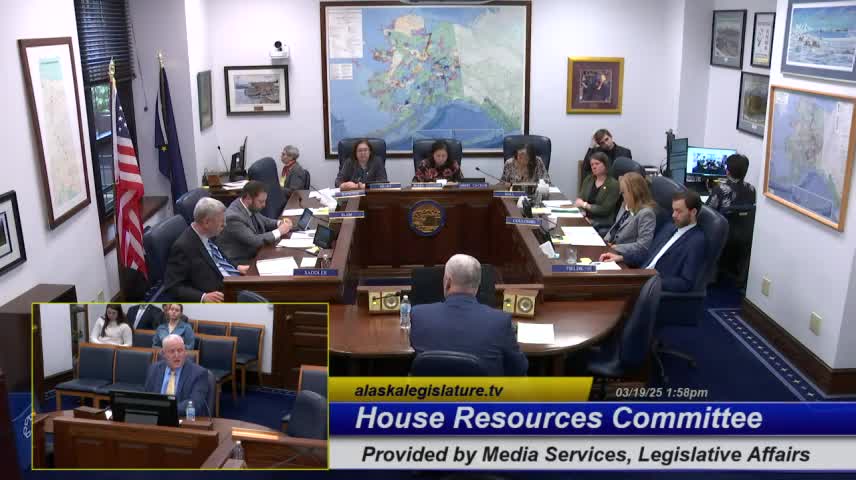
Summary
Three governor's appointees to the Regulatory Commission of Alaska (RCA) appeared before the House Resources Committee on March 19, 2025, to describe qualifications and answer questions about energy supply, transmission and consumer notice after abrupt rate increases.
Three governor's appointees to the Regulatory Commission of Alaska (RCA) appeared before the House Resources Committee on March 19, 2025, in Juneau to describe their qualifications and answer lawmakers' questions about energy supplies, transmission constraints and consumer protections.
The committee heard from Steven DeVries, Mark Johnston and John Springsteen, each identified in the hearing as commissioners or commissioner-appointees to the RCA. The appointees described the commission's statutory role — reviewing utility filings and tariffs — and outlined current challenges the commission faces, including a looming natural gas shortfall in Cook Inlet that officials said threatens supply to Railbelt utilities.
Why it matters: Lawmakers pressed the appointees about the commission's ability to protect ratepayers in rural and Interior communities, how the RCA enforces orders, and whether the agency has the staff and statutory tools to respond to rapidly changing energy technologies and potential abrupt price spikes.
“The duties of the commission include making sure that rates that are requested by a utility are fair and reasonable,” said Steven DeVries, who identified himself as a commissioner with the Regulatory Commission of Alaska. “That requires an evaluation of the facts that are presented to the commission about what revenues a utility requires to do its job effectively.”
DeVries and his colleagues described the RCA as largely reactive: it evaluates filings and requests that utilities bring to it. DeVries told the committee the commission has an “open docket” on gas supply and declined to discuss pending matters in detail. He said the commission must balance protections for consumers with utilities’ obligations to provide safe, reliable service.
Natural gas and Railbelt impacts
The appointees warned lawmakers the Cook Inlet gas outlook is a pressing issue. DeVries said the shortage affects Railbelt utilities and can influence the statewide Power Cost Equalization (PCE) program: “As costs go up on the rail belt, PCE levels go down,” he said, describing the link between Railbelt wholesale cost changes and the program that helps lower energy costs in rural communities.
Transmission and regional coordination also drew sustained attention. Commissioners described work on an organized transmission framework — a Railbelt transmission organization (RTO) and a Railbelt reliability committee — intended to improve access and reduce costs caused by “pancaking” (charging multiple transmission fees to move power across territories). DeVries said a single load-balancing area created by Chugach Electric and Matanuska Electric Association was a recent compliance result from the commission’s orders.
Enforcement tools and notice for rate spikes
Lawmakers asked how the RCA enforces orders when utilities fail to meet deadlines or commitments. DeVries said the commission’s coercive remedies are limited: fines are small and management-audit findings can be difficult to translate into immediate remedies because removing a certificate raises the question of who would then provide service.
More effective measures, he said, include periodic reporting requirements, compelled joint reporting where utilities disagree, and face-to-face hearings to require utilities to explain delays. DeVries said those reporting and accountability steps were used to push Chugach and Matanuska toward forming a joint load-balancing area.
Representatives also raised a 2023 Alaska Federation of Natives (AFN) resolution asking the state to investigate RCA operations related to power prices in rural Alaska and a specific abrupt price increase referenced in the hearing. DeVries and other commissioners said the commission has tightened notice practices since the incident so communities are not taken by surprise.
Staffing and resources
All three appointees said the commission is coping with a high vacancy rate and staff attrition that limits the agency's bandwidth. DeVries called the vacancy factor “very high,” and John Springsteen and Mark Johnston echoed that recruiting and retaining experienced staff is a statewide challenge that affects the RCA’s ability to move proceedings quickly. DeVries and Johnston noted a recent salary increase for commissioners (referenced in the hearing as HP 307) has helped recruitment but is not a complete solution.
Technological change, generation and conservation
Lawmakers asked whether the RCA can evaluate alternative technologies such as heat pumps, distributed resources, batteries, virtual power plants and demand-side management. Commissioners said the agency typically sees projects after utilities have elected a path and seek cost recovery, but it also uses public presentations, informational dockets and preapproval requests in limited cases to ask questions about proposed technologies.
Johnston described instances where the commission invited renewable developers and project sponsors for extended presentations and follow-up questioning. He also described past utility practices — including sale of economy energy and use of investment structures to reduce rate impacts — and said there is no single “silver bullet” for high rates, urging a mix of approaches (energy efficiency loans/grants, renewables, transmission solutions and other measures).
Questions from Interior and Fairbanks representatives focused on high retail costs there; the appointees pointed to a combination of generation mix (diesel, coal and limited gas), potential renewables and efficiency measures, and the need for potential gas supply or transmission solutions.
Committee procedures
Committee members repeatedly set each appointment “aside” after questioning, and the committee chair said public testimony on the appointees will be taken at a later date, likely the following Friday. No formal confirmations or votes were recorded during this hearing.
What lawmakers heard and did not hear
The hearing provided an overview of the RCA’s statutory role, current staffing constraints, and the major energy issues the commission faces — Cook Inlet gas availability, transmission constraints on the Railbelt, and community notice for fuel- or market-driven price spikes. Commissioners emphasized the commission’s reactive role and described the limited coercive penalties available, while also outlining noncoercive enforcement tools such as reporting requirements and audits.
The committee did not take votes or confirm the nominees in this session. Committee members asked the appointees to consider the AFN 2023 resolution and to press for improved notice and consumer protections where the RCA has authority.
Ending
The House Resources Committee concluded the hearing after setting each appointment aside for further consideration and scheduled public testimony on the governor’s appointees for a later date. No formal outcomes on appointments were recorded in this session.