Get Full Government Meeting Transcripts, Videos, & Alerts Forever!
Get email alerts on the State Budget topic
No spam. Unsubscribe anytime.
House Finance reviews governor's Department of Revenue budget; lottery and iGaming notable revenue drivers
Summary
House Finance heard an overview of the governor's fiscal 2026 recommendations for the Department of Revenue, including lottery projections, new revenue initiatives, DMV fee proposals and staffing pressures tied to recent federal developments.
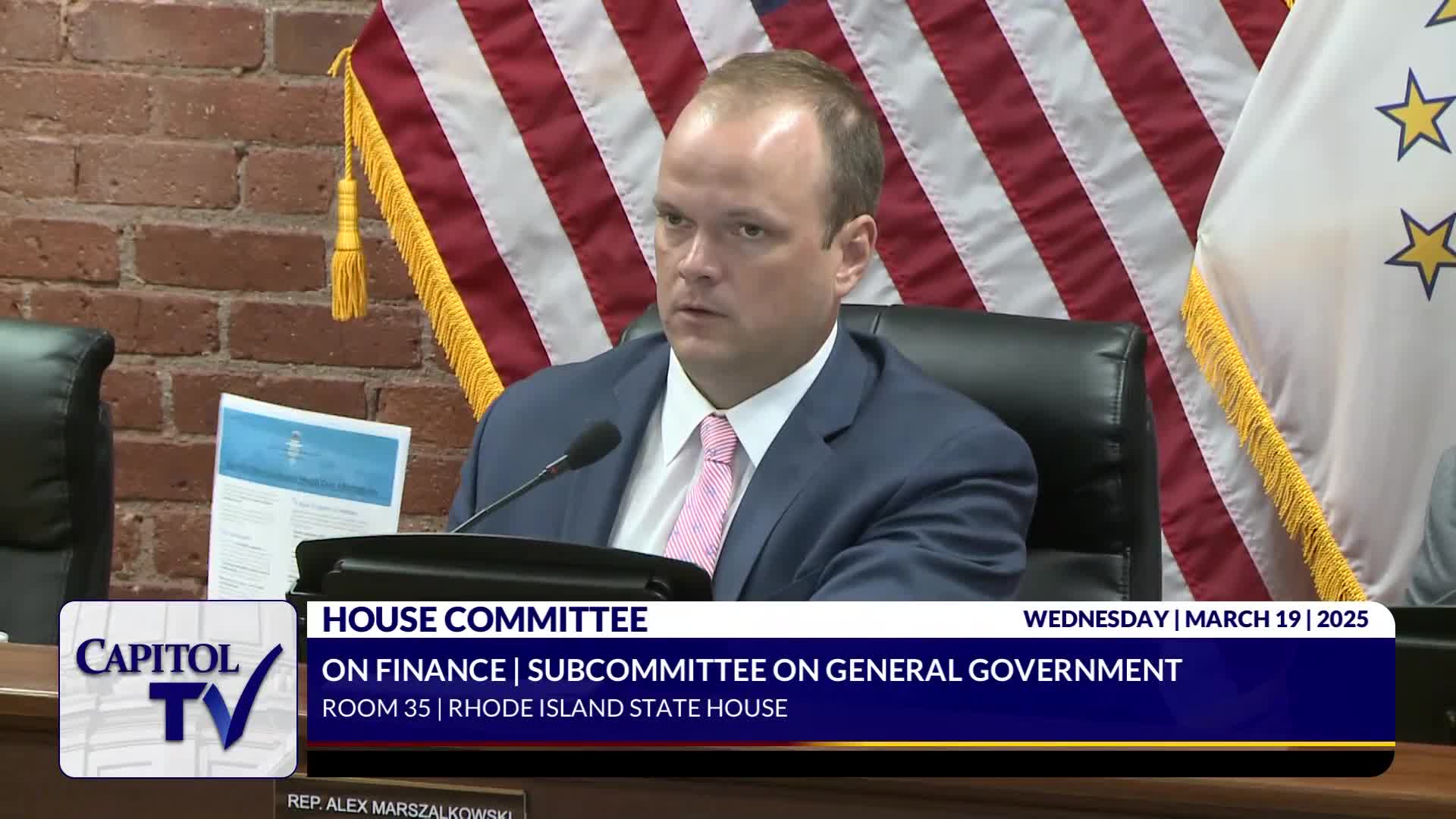
Chairman Mozakowski convened the House Finance subcommittee on general government for a briefing on the governor's fiscal 2026 recommendations for the Department of Revenue. House fiscal staff provided an overview of the department's programs and the governor's proposed adjustments to staffing, fees and revenue initiatives.
The nut graf: The Department of Revenue collects the bulk of state receipts and the governor's budget packages modest staff increases and fee shifts intended to support operations while assuming several legislative changes that would generate or redirect revenue. Lottery activity, the administration told the committee, is a large and changing component of projected general revenues.
House fiscal staff told the subcommittee the department accounts for roughly 600 authorized positions but is operating with about 508 filled positions and roughly 90 vacancies. Tom Verdi, director of the Department of Revenue, told the committee the department "collect[s] almost $6,000,000,000 annually, for the state of Rhode Island," underscoring why staffing and systems were focal points of the briefing.
Lottery and gaming: The fiscal presentation detailed how the state's lottery programs — video lottery terminals (VLTs), sports betting, table games, iGaming and instant tickets — flow into general revenues. The November revenue estimating conference projection cited in the briefing assumes about $432 million in lottery-derived revenues in fiscal 2026, with VLTs the largest single component at about $300 million, iGaming at roughly $24.2 million and sports betting at about $23 million. Fiscal staff cautioned that published gaming figures sometimes describe total wagering activity rather than the net revenue that accrues to the state.
Taxation and new revenue proposals: The governor's recommendation includes five new positions tied to proposed revenue initiatives. Staff reviewed two of the larger proposals the administration has already discussed with the committee: extending the 5% state hotel tax to whole-home short-term rentals (projected to generate about $4 million in 2026, with larger receipts in 2027) and statutory authority for an automated financial-institution data match to improve collection of delinquent liabilities (the budget assumes roughly $5.3 million in 2026, rising toward $8 million in later years). The committee was reminded these projected amounts depend on later legislative changes and on operational implementation.
Collections and compliance: House fiscal staff and department witnesses described ongoing efforts to improve collection outcomes. The department reported using automated address matches, bank levies and other enforcement tools; fiscal staff and department officials said collections and enforcement improvements are already raising returns year to date.
DMV and fees: The Department of Motor Vehicles was described as a sizable operating division (about 213 positions and roughly $100 million flowing through annually, largely to transportation). The governor proposes increasing a technology surcharge used for DMV systems (the briefing reviewed a proposal to raise the surcharge by $1 from the current $2.50), and staff noted new EV fees and ongoing mobile-DMV projects to serve Warren and Westerly. Committee members asked about service improvements; DMV leadership reported average wait times have fallen to about 21 minutes and that roughly 42–44% of transactions are now being handled online.
Staffing and hiring context: Committee members pressed whether the department could recruit recently laid-off federal tax employees. Verdi and department hiring staff said the department has been recruiting actively and had seen federal applicants for tax positions; they said hiring remains competitive given Rhode Island's low unemployment.
What wasn't decided: The briefing was informational. No formal votes or committee actions on the budget were taken during the session.
Ending: Committee members asked for follow-up materials on several items — the revenue assumptions for individual proposals, the DMV technology surcharge analysis, and staffing and recruiting plans — which department staff said they would provide to the subcommittee.