Get Full Government Meeting Transcripts, Videos, & Alerts Forever!
Get email alerts on the Employee Ownership topic
No spam. Unsubscribe anytime.
Committee hears bill to require notice to employees when a small business is for sale; proponents and business groups clash
Summary
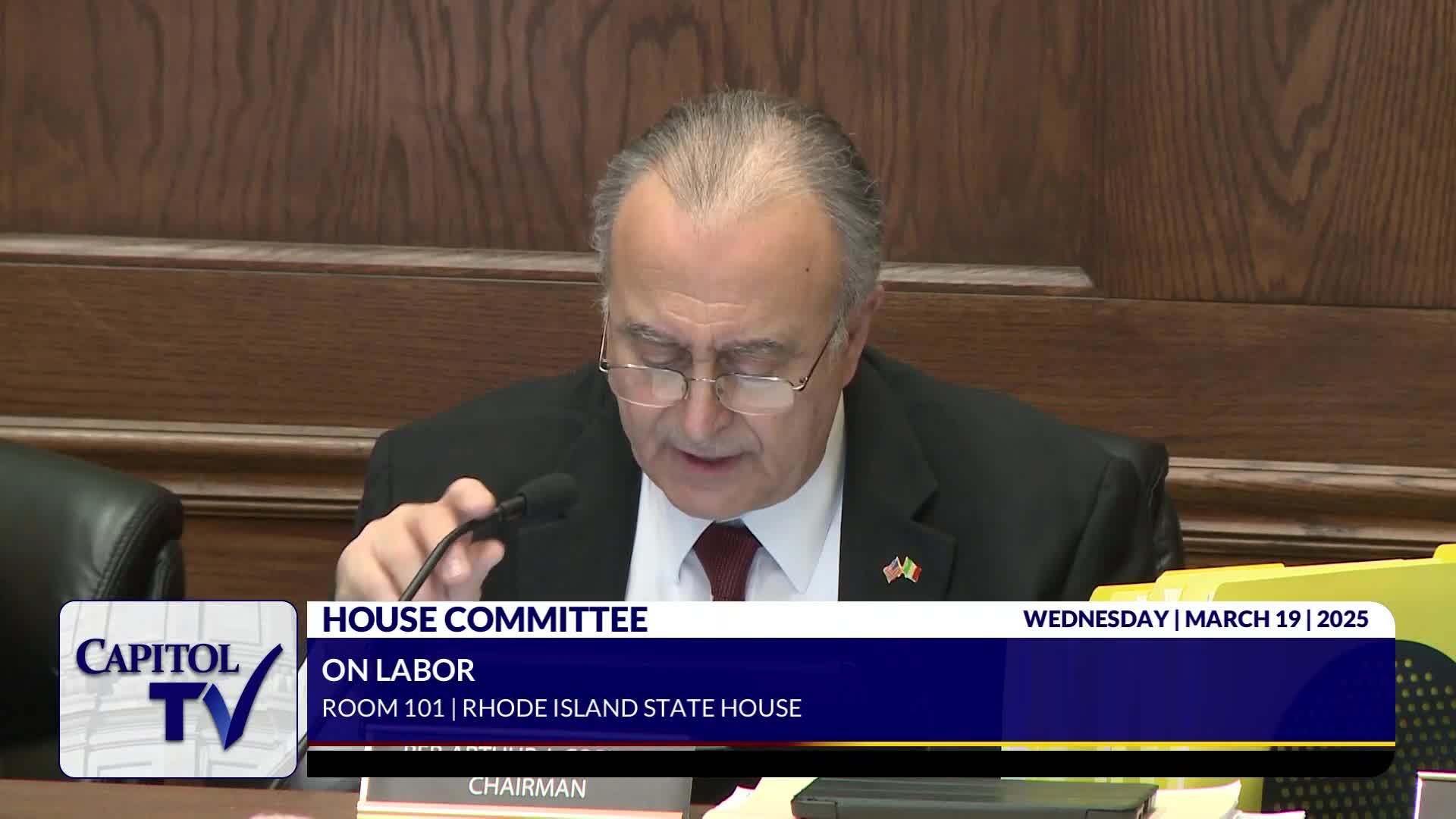
The House Labor Committee on Wednesday heard testimony on H 5940, the Rhode Island Opportunity for Employee Ownership Act, a bill that would require eligible small-business sellers to notify employees when the business is listed or otherwise placed for sale and give employees a structured period to consider buying the business.
The House Labor Committee on Wednesday heard testimony on H 5940, the Rhode Island Opportunity for Employee Ownership Act, a bill that would require eligible small-business sellers to notify employees when the business is listed or otherwise placed for sale and give employees a structured period to consider buying the business.
Supporters say the bill would preserve locally owned businesses, expand opportunities for worker ownership and help aging owners pass businesses to employees rather than see them close. Opponents—including manufacturing, construction and business trade groups—warned the measure would cause operational disruption, risk confidential information and deter buyers.
The bill, introduced by Representative Jennifer Stewart (absent from the hearing due to illness), would trigger notice and a process when an owner of a qualifying business signals intent to sell. Chloe Chasing, who identified herself as a worker-owner at White Electric and a co-founder of the Rhode Island Worker Cooperative Alliance, said the proposal would both support buyers and provide incentives for sellers. “It would incentivize that also for the business owner where they would realize a tax break in the form of state capital gains tax up to a million dollars,” Chasing told the committee, adding the measure “gives employees an opportunity to purchase a business from the owners who are selling the business.”
Jacob de Blacourt, deputy director of policy and communications in the lieutenant governor’s office, said the state faces a succession problem: “Over half of the small business owners in the state are over the age of 55,” he said, arguing that employee ownership can reduce the number of long‑standing businesses that close when owners retire. Multiple current and former worker‑owners — including witnesses from worker cooperatives Small Format and 4 Buds Floral Studio — described conversions they said preserved businesses and local jobs.
Business groups presented sharply different concerns. A representative for a manufacturing trade association said mandatory disclosures and extended negotiation windows “could lead to internal uncertainties affecting business stability, employee morale,” and that mandatory notice would cause employees to leave or customers to be poached. A witness for the Greater Providence Chamber of Commerce said the bill would grant worker groups a valuable right of first refusal without requiring proof of financing, potentially tying up sales “for 210 days” and increasing litigation risk.
Several lawmakers pressed proponents on scope and exemptions. Committee members asked whether the bill applies to all businesses and whether family sales or bona fide third‑party offers would be excluded; proponents said they were open to clarifying exceptions for family transfers, urgent sales and other narrow circumstances. Chasing summarized key thresholds the bill sets: a minimum of three employees to trigger the notice requirement and an upper bound tied to the Small Business Administration’s size standards, which vary by sector.
Opponents raised specific procedural concerns about confidentiality, timing and evidentiary standards. Business witnesses warned that owners often test the market or seek offers before deciding to sell and that an ambiguous definition of “intent to sell” could prompt litigation. Supporters countered that the bill includes matching and good‑faith offer provisions so a competitive bona fide offer would allow a sale to proceed if employees cannot match it.
The committee did not vote on the merits of H 5940. At the start of the hearing the committee voted unanimously to “hold for further study” a set of bills on the docket, a procedural motion the chair said does not reflect a view on merits. That procedural motion was moved by First Second Vice Chair Alzate and seconded by Chairman Casey; the roll call recorded unanimous “yes” votes from members present and the clerk announced that the bills were held for further study.
With additional questions outstanding about exemptions, timing and confidentiality, advocates and business groups signaled willingness to continue negotiations. Proponents urged the committee to consider resources and tools to build worker capacity to buy businesses, while opponents urged a voluntary or incentive‑based approach rather than a mandatory notice and matching requirement.
Committee staff and members indicated the measure will remain under consideration as lawmakers weigh statutory detail, scope and any carve‑outs for family transfers or urgent sales.