Get Full Government Meeting Transcripts, Videos, & Alerts Forever!
Get email alerts on the Teaching Learning And Grants topic
No spam. Unsubscribe anytime.
OTLA and ODE federal programs: math, literacy, STEM, migrant education and after‑school grants highlighted
Summary
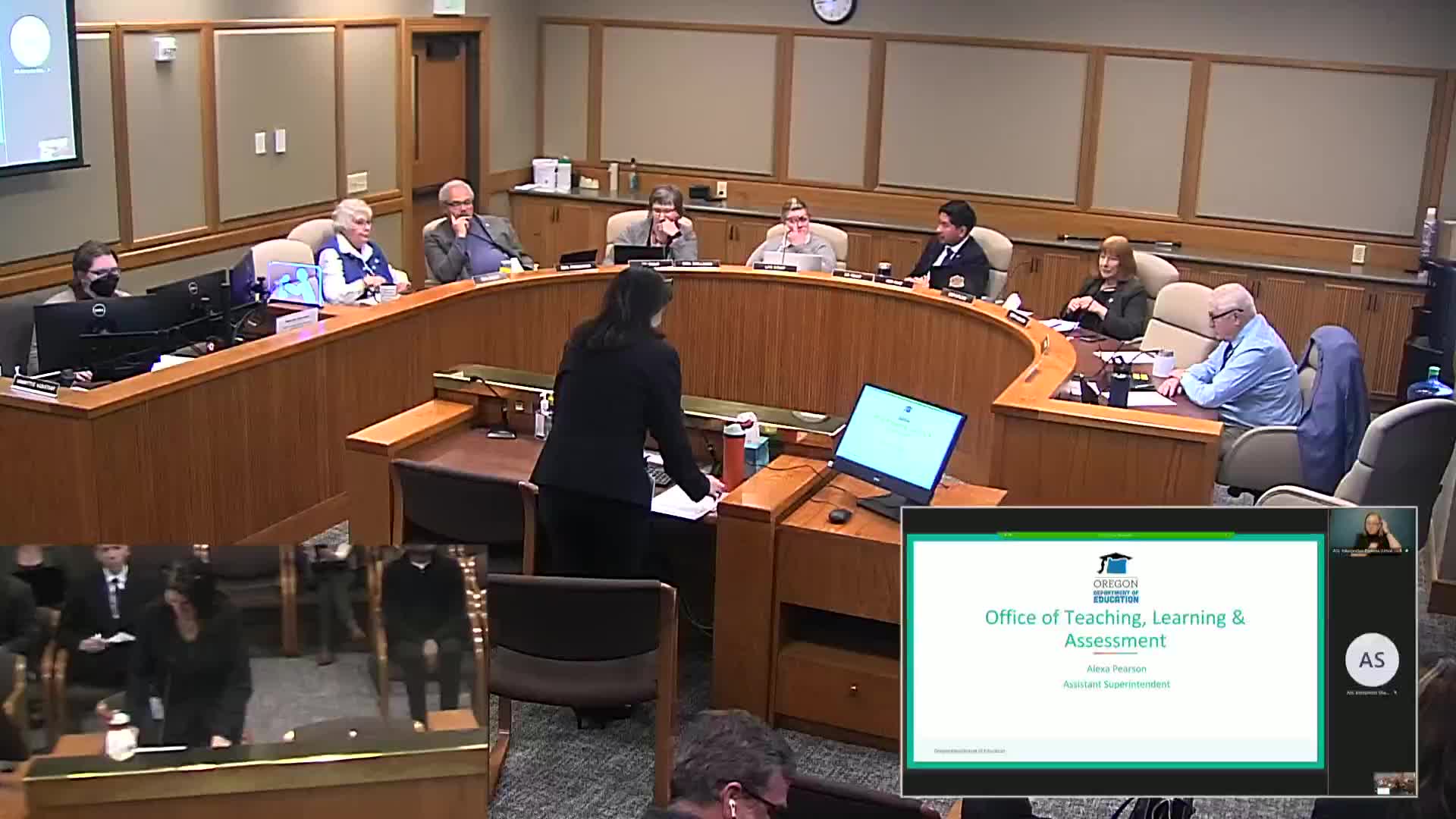
The Oregon Department of Education's Office of Teaching, Learning and Assessment (OTLA) told the Ways and Means Education Subcommittee on March 19 that it administers a broad portfolio of state and federal programs aimed at improving instruction and expanding student access to well‑rounded learning opportunities.
The Oregon Department of Education's Office of Teaching, Learning and Assessment (OTLA) told the Ways and Means Education Subcommittee on March 19 that it administers a broad portfolio of state and federal programs aimed at improving instruction and expanding student access to well‑rounded learning opportunities.
"Our schools, our teachers, and our classrooms are the heartbeat of our communities," OTLA Assistant Superintendent Alexa Pearson said in opening remarks.
Why it matters: OTLA oversees programs that feed into district curriculum, after‑school and summer learning, bilingual education and career connected learning. Many of those efforts depend on federal formula and competitive grants, creating fiscal sensitivity to federal policy and appropriations.
Programs and grants described
• Mathways: A $2.1 million grant supporting development of high‑quality math instructional materials, alignment between high school and higher education mathematics, and professional learning. Pearson said the grant helped develop an Oregon open educational resource pre‑calculus course.
• Early literacy programs: The department highlighted Reach Out and Read (books at well‑child visits) and Smart Reading (volunteer readers in schools). OTLA provided a count for Smart Reading: "so far this year, Smart has already served over 12,000 students across Oregon and given away 52, over 52,000 books," Pearson said.
• PE and PEAK 8 grants: Grants help districts hire licensed PE teachers and provide professional development; OTLA uses a portion of funds for administrative support and technical assistance.
• Library revitalization: A one‑time federal grant funded refreshed library materials, modernized spaces and staff professional development in smaller districts.
• STEM hubs and grants: Oregon's 13 regional STEM hubs received formula funding to sustain hub operations and to run regional innovation grants; OTLA described networked hub activity from early childhood STEM to high‑school career expos, internships and industry engagement.
• Well‑Rounded Courses / Computer Science: A federal well‑rounded courses grant (ending in the upcoming fiscal year) funded expansion of computer science efforts including a ninth‑grade Exploring Computer Science course, professional development and an elementary computational thinking PLC. OTLA said snapshots and evaluation findings from the grant will be available this summer.
• Pattern Science and arts: The grant supported Pattern Science (teacher‑developed science curriculum) and arts lessons integrating social‑emotional learning; OTLA is also developing Native Arts curriculum in partnership with federally recognized tribes and other partners.
• Multilingual and migrant education: OTLA said Oregon has one of the largest migrant education programs nationally, with regional programs providing pre‑K, family engagement and graduation specialists. OTLA reported the 2023–24 migrant student cohort saw an 83% graduation rate. The department also described Title III funding for multilingual learners; Pearson cited an estimate of about $15,500,000 in Title III funds and said Oregon has an estimated 65,000 multilingual learners.
• Federal funds overview: OTLA summarized several federal programs — Title I (about 178 districts receive funds), Title II‑A, Title IV‑A, Title V‑B, 21st Century Community Learning Centers and a competitive Stronger Connections grant that uses Safer Communities Act funding for school climate and mental health supports.
• Summer and expanded learning: OTLA highlighted summer programs funded in part by HB 4082 and other sources. The department stressed that state and federal funds are braided in many local programs and that program design typically requires a licensed teacher on site; committee members requested written clarification on provider and staffing rules for specific summer grants.
Committee concerns and requests
Committee members asked how ODE would respond if federal funding streams were reduced. Pearson and other ODE staff said the agency is tracking federal policy closely and that many programs rely on federal formula grants that would be hard to replace at the state level.
Members also asked for consolidated reporting to identify overlaps or gaps among multiple grants; Representative McLean and others said they would like ODE to return with a holistic summary of grant consolidation efforts and comparisons to previous budget review work.
Ending
Pearson said OTLA will continue to provide program snapshots and evaluation results to the committee, including evaluation material from 21st Century Community Learning Centers and upcoming summaries for computer science and Well‑Rounded Courses work.