Get Full Government Meeting Transcripts, Videos, & Alerts Forever!
Get email alerts on the State Assessments topic
No spam. Unsubscribe anytime.
ODE tells budget panel state testing will cost more than $30 million in 2025–27 biennium; security and timing concerns raised
Summary
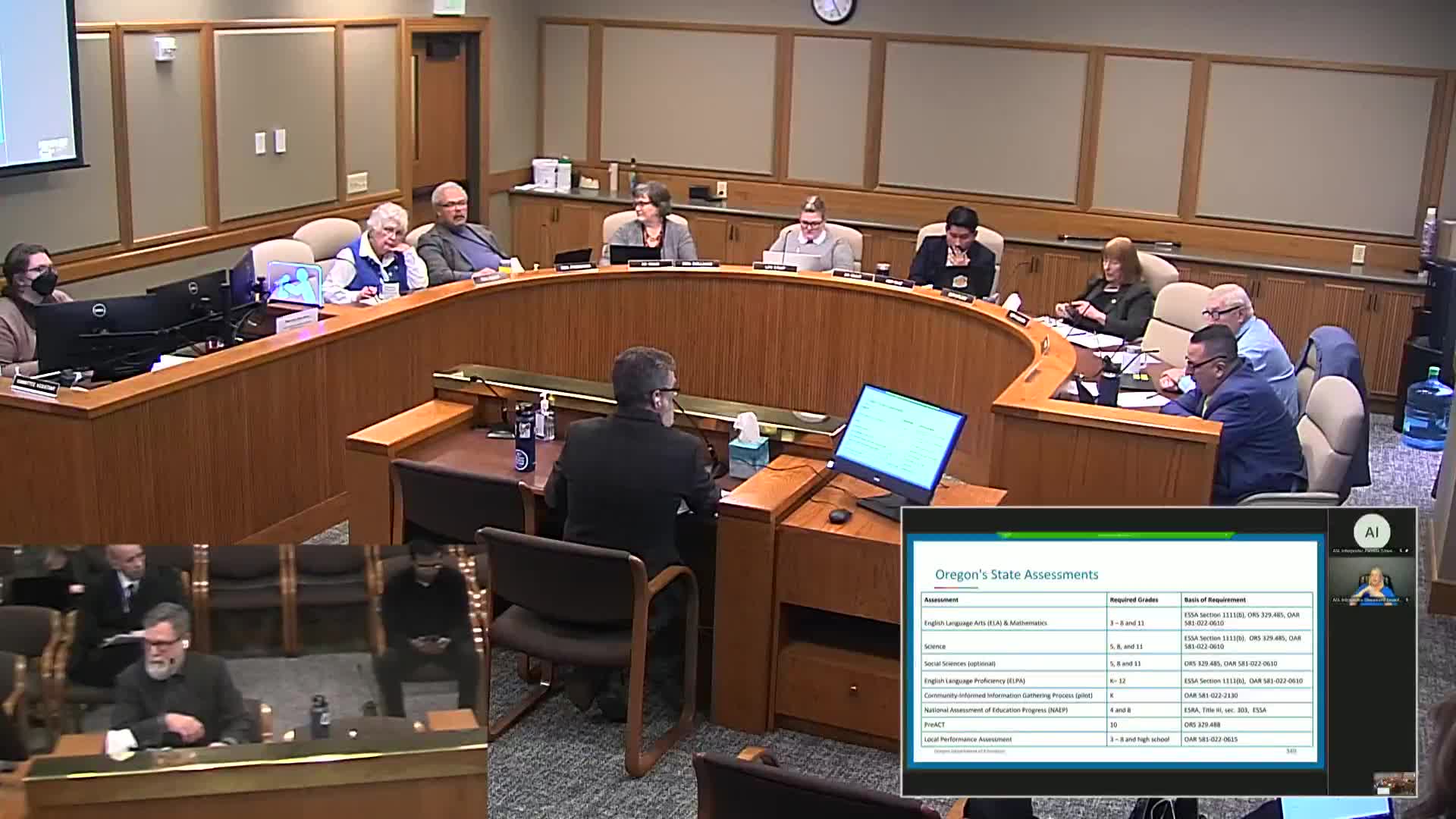
The Oregon Department of Education told the Ways and Means Education Subcommittee on March 19 that continuing the state's assessment system for the 2025–27 biennium will cost more than $30 million, with major vendor costs concentrated in test delivery and item development.
The Oregon Department of Education told the Ways and Means Education Subcommittee on March 19 that continuing the state's assessment system for the 2025–27 biennium will cost "$30,000,000 plus," with major vendor costs concentrated in test delivery and item development.
"...that estimate for the 25‑27 biennium is that it will, cost $30,000,000 plus, to continue to administer the programs that we have," Assistant Superintendent Dan Farley said, adding that $22,700,000 of the estimate goes to the test delivery system.
Why it matters: The assessment vendor costs make up a significant portion of ODE's assessment budget. Committee members asked how the system benefits classroom instruction, how quickly results are available to districts, and whether the contracts and vendor security protect student privacy.
Key details provided by ODE
• Biennial cost estimate: ODE provided an estimate above $30 million for the 2025–27 biennium. ODE said roughly $22.7 million is for the test delivery system and identified $5,295,000 for English language arts and mathematics summative item development under a contract with the Smarter Balanced Assessment Consortium.
• Vendors and security: ODE said student test data are routed to a vendor (identified in testimony as Cambium Assessment, formerly AIR) and that the vendor is contractually required to meet security protections. ODE said Cambium has decades of experience and that ODE has not experienced student‑privacy violations in its assessment work.
• Accessibility: Farley said the state assessment system provides more than 50 different accessibility supports (text‑to‑speech, speech‑to‑text, screen overlays and others) and that each test item must be coded to enable the supports, which increases cost and labor.
• Timelines and utility for instruction: ODE explained that state summative tests are designed as an annual review of curriculum implementation rather than as immediate instructional tools. Preliminary results, ODE said, are available during the test window and final scores are typically finalized in late August after districts complete post‑window checks; interim assessments and formative practices are the tools ODE said should be used for in‑the‑moment instruction.
• NAEP and opt‑out: ODE confirmed the National Assessment of Educational Progress (NAEP) is funded by the U.S. Department of Education and that NAEP participation (when a school is selected) is separate from Oregon's state opt‑out statute for state summative tests.
Concerns voiced in committee
Senator Frederick and other committee members raised concerns about testing pressure in schools and the usefulness of summative results for teachers and students. Frederick said he has heard testing creates stress for students and staff and questioned whether the tests deliver actionable benefits for a classroom student.
Co‑chair Solman noted a practical concern: the perceived delay between test administration and results reducing their utility for immediate remedial instruction.
Ending
ODE officials said they will continue to work with districts on tools (such as target reports and interim assessment usage) designed to turn test data into actionable instructional guidance, and they flagged rising vendor costs and inflation as budget pressures for future biennia.