Get Full Government Meeting Transcripts, Videos, & Alerts Forever!
Get email alerts on the Education Data Research topic
No spam. Unsubscribe anytime.
Oregon Department of Education outlines 'data justice' architecture, expands statewide surveys and public reporting
Summary
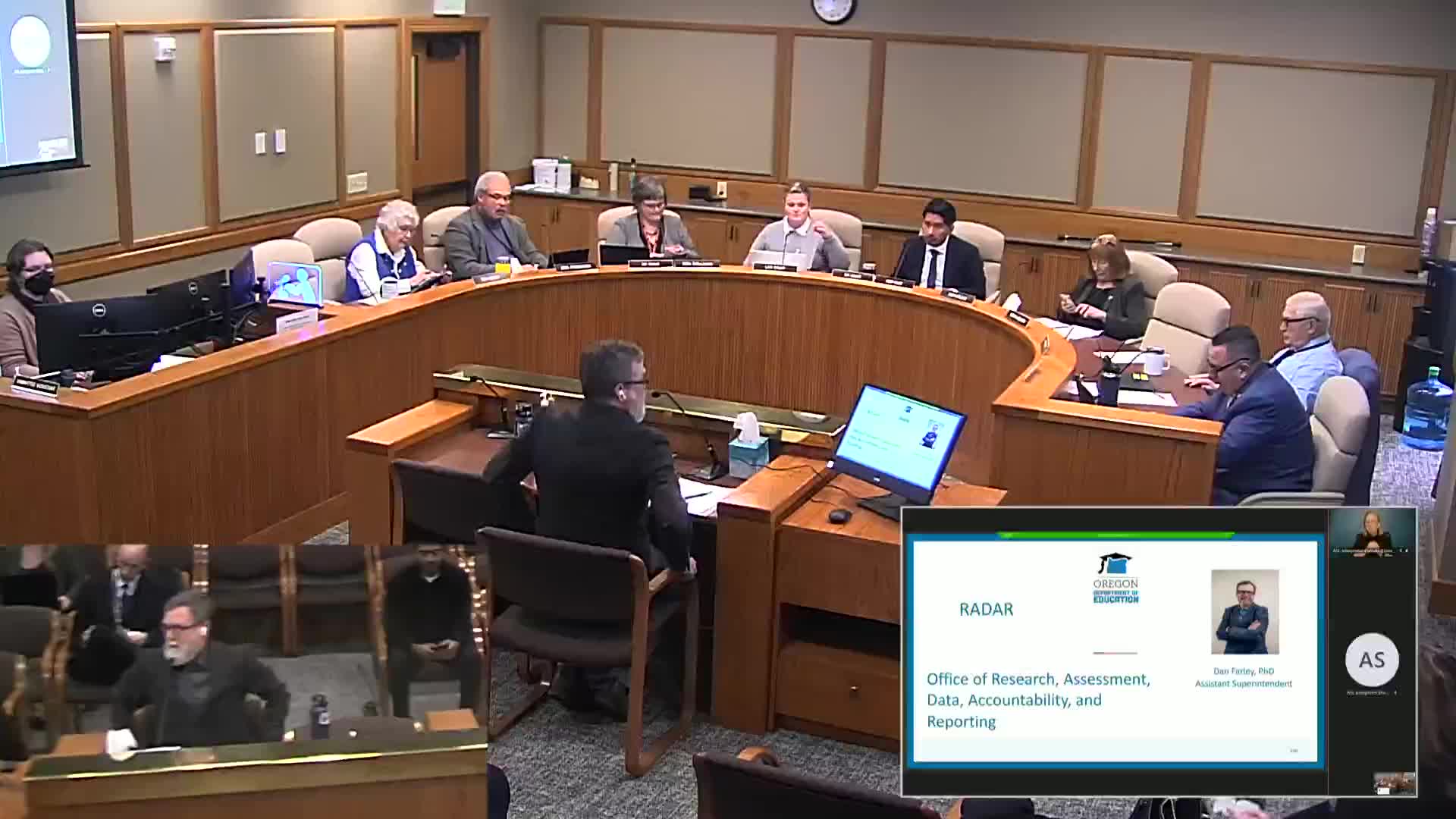
At a March 19 informational hearing on the Department of Education budget, ODE officials described a new research architecture centered on "data justice," expanded statewide surveys for educators and students, and a phase‑one Oregon Online Report Card that covers 2022–2024 data and is available in Spanish.
The Oregon Department of Education on March 19 told the Ways and Means Education Subcommittee it has established a formal research and data structure to guide how the agency collects, reviews and shares education data.
The structure, ODE officials said, is intended to embed what the department called "data justice" — community review and protections intended to ensure information is used for the purposes it was collected for and that communities harmed by prior data practices help set research priorities. "Data justice is really organized around making sure that the information that we collect ... is used the way that it was intended to be used," Assistant Superintendent Dan Farley said.
Why it matters: The changes affect how ODE prioritizes research questions, who can access student‑level data, and how findings are shared with districts, legislators and the public. The new processes are intended to make ODE research more responsive to community needs and to make multi‑year planning for limited research staff more transparent.
What ODE described
• Research architecture and stewardship: ODE said it has formed a research core team, a standing data governance committee (in place for more than two decades), a Committee for Research Ethics and Integrity (described as an ODE institutional review board), and a research implementation team that coordinates staff across ODE offices. A separate body of "data justice stewards" will review charters and later prioritize research themes.
• Research partnerships: The agency plans "research to practice" partnerships with Oregon institutions of higher education to answer questions beyond ODE's internal capacity and to provide research opportunities for doctoral students.
• Public tools and surveys: ODE launched a phase‑one Oregon Online Report Card that displays validated 2022–2024 data, is available in English and Spanish, and includes alt text for accessibility. ODE said the report card links to survey results and curriculum resources.
• Student and educator surveys: ODE described two statewide surveys: the Student Educational Equity Development survey (SEED), administered statewide in 2024, and an "Elevating Voices in Education" educator survey (EVE). ODE said SEED collected data on four student constructs (access to learning resources, opportunities to learn critical content, self‑efficacy and sense of belonging) and reported a 44% participation rate among eligible students in 2024. The EVE educator survey, ODE said, opened Feb. 4 and was extended through March 31; it covers six domains including workplace climate, professional learning, well‑being, student equity and job satisfaction, and is 24 multiple‑choice items plus three short constructed responses with an estimated completion time of 10–15 minutes.
• Research outputs: ODE reported that it has published four research briefs from pilot analyses (including a brief on students' postsecondary planning) and is exploring relationships such as the correlation it described between student self‑efficacy and achievement.
Committee questions and context
Committee members asked how the new architecture would affect timelines, staff capacity and district access to results. Farley said the approach will help the department prioritize limited staff time and that remaining research questions could be routed to partnered higher‑education institutions.
The department emphasized that the new structures are intended to protect student privacy while increasing transparency and the practical usefulness of research for districts and policymakers.
Ending
ODE officials said they will continue to refine charters and publish additional briefs as pilot analyses and survey results mature. The department offered to return to the committee with additional details on how the architecture will operate and how research priorities will be selected.