Get Full Government Meeting Transcripts, Videos, & Alerts Forever!
Get email alerts on the State Employee Compensation topic
No spam. Unsubscribe anytime.
Senate concurs with state employee pay increases; debate over legislator pay fails
Summary
The Montana Senate concurred with House Bill 13, approving negotiated pay and benefit changes for state employees and per diem adjustments; an amendment to remove a provision tying legislator pay to the average Montana wage failed 12-38.
The Montana Senate voted 37-13 to concur with House Bill 13, a package that implements negotiated pay increases for state employees, adjusts some per diem rates and group benefit contributions, and sets a formula tying future legislative pay to a share of the average Montana wage.
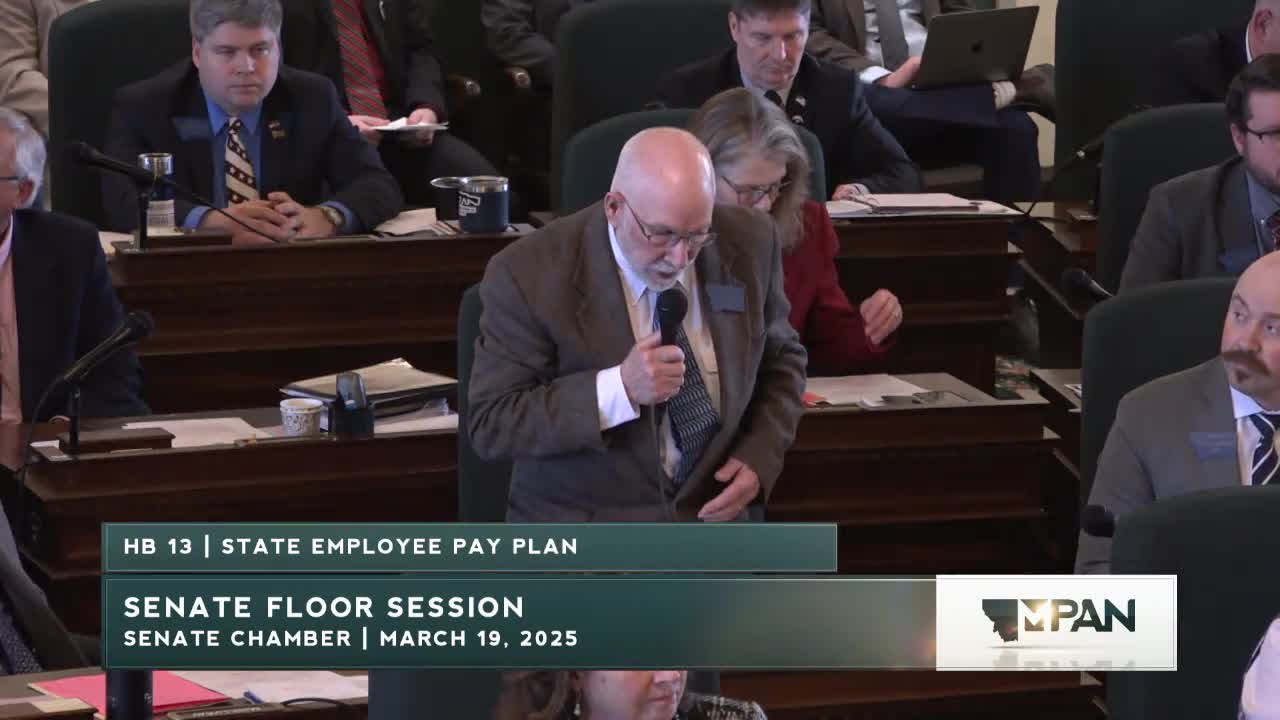
Sponsor Senator Espin said the bill contains “the negotiated settlement with the state employees for the pay raises for the next 2 years,” describing the core wage change as “either a dollar an hour or 2.5 percent, whichever is greater in each of those 2 years.” He also urged colleagues to back the measure, saying, “we are valuable too. We're a state employee that has value and and brings value to this process.”
The bill also includes a provision that would set legislative compensation at a percentage of the state average wage: for the next biennium the bill sets the rate at 80 percent of the average Montana hourly wage (discussed in floor remarks as approximately $22.56), up from the current legislative pay reported on the floor as $16.10 per hour. Opponents criticized including legislative pay in the bill.
Senator Vinton offered an amendment (HB0013.002.005) to remove references to legislative pay and the amendment was the subject of extended floor debate. Supporters of the amendment invoked the governor's prior veto message defending the citizen legislature model; opponents argued higher pay would broaden the pool of possible legislators and compensate for lost earnings and travel costs. The amendment failed on a 12-38 roll call, as recorded by the clerk.
Supporters emphasized pay increases for rank-and-file state employees, with Senators Novak, Newman and others citing state workers from corrections, public health and highway crews and urging a green vote. Detractors warned of optics and the prospect of the legislature voting to raise its own pay.
With the amendment defeated, the body voted to concur with the bill as presented. The Senate's concurrence vote was recorded as 37 ayes and 13 nays. The bill text sets the pay formula in statute and includes appropriation language; the effective dates and specific implementation details were handled in the bill text as read on second reading.
House Bill 13 now proceeds with the Senate concurrence recorded on second reading; the transcript does not specify a final effective date beyond the bill's text and appropriations.
Votes at a glance: House Bill 13 — concurrence recommended; Senate concurrence: 37-13 (pass).