Get Full Government Meeting Transcripts, Videos, & Alerts Forever!
Get email alerts on the Pipeline Abandonment topic
No spam. Unsubscribe anytime.
Senate committee advances bill giving Minnesota landowners right to remove abandoned pipelines
Summary
A Senate committee voted 6-5 to send SF 733 to the environment committee after a day of testimony on a bill that would give landowners the right to require pipeline removal and require abandonment plans and tribal consultation.
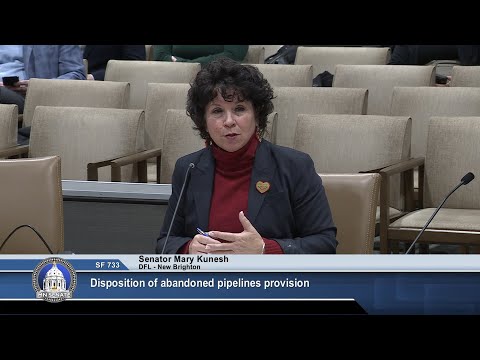
Sen. Mary Kunish, sponsor of Senate File 733, told the Senate Energy, Utilities, Environment and Climate Committee on March 19 that "Currently, Minnesota law does not require a pipeline company to offer pipeline removal." Kunish presented SF 733, a bill that would give Minnesota landowners a right to choose removal of decommissioned pipelines on their property at the pipeline company's expense and require an abandonment plan approved by the Commissioner of Public Safety with at least one public hearing and tribal consultation.
The matter drew competing testimony from environmental advocates, industry representatives and landowners. Sarah Meradian, government relations and policy director for CURE, said SF 733 "seeks to meet the needs of both by establishing a right for Minnesota landowners to choose between removal or abandonment in place." She told the committee removal can help identify and remediate soil contamination, prevent subsidence and protect water resources and said removal can create construction jobs.
Industry witnesses urged caution. Dave Frazier, Midwest Region associate director for the American Petroleum Institute, said federal and state regulations and industry best practices already govern abandonment and that the bill could create regulatory uncertainty. "These best practices help ensure a safe, consistent, and clear process for all stakeholders involved," Frazier told the committee. Kevin Prentice, representing construction union members who build and remove pipelines, said timelines and per-landowner removal requests in the bill would be infeasible: "You couldn't even get the permits in that amount of time, let alone to have actually deployed in construction and remove that."
Retired reporter and landowner advocate Scott Russell described his tracking of the Line 3 process and relayed figures he said came from Enbridge negotiations over removal: "It would cost Enbridge 1200000000.0 or $855 a foot to remove the pipeline," he said, and he said most eligible landowners chose to leave that pipeline in the ground.
Committee members pressed the author and witnesses on several recurring concerns: whether the bill's timelines were practicable, whether leaving pipe in place can be environmentally preferable in some settings (for example under rivers or where removing pipe would damage farm drain tile), how landowner liability would be allocated if operators were relieved of long‑term responsibility, and how multiple landowner decisions across a corridor would be coordinated. Senator Kunish said she would review concerns about timelines and would work to amend the bill as it moves to the next committee.
After discussion, the committee took a roll-call motion to send SF 733 to the environment committee. The motion carried on a 6-5 vote and the chair announced the file would go to the environment committee for further work; the committee also noted the bill could touch transportation and pipeline-safety jurisdiction on further review.
The bill leaves key technical questions unresolved: how state abandonment requirements would interface with federal regulations, whether and how liability would be retained by operators or transferred to landowners, and how removal would be sequenced when adjacent landowners choose different options. The author and several members indicated willingness to negotiate amendments in the coming committee stops.