Get Full Government Meeting Transcripts, Videos, & Alerts Forever!
Get email alerts on the Medical Liability topic
No spam. Unsubscribe anytime.
Senate committee lays over bill insulating healthcare workers from criminal charges for honest mistakes
Summary
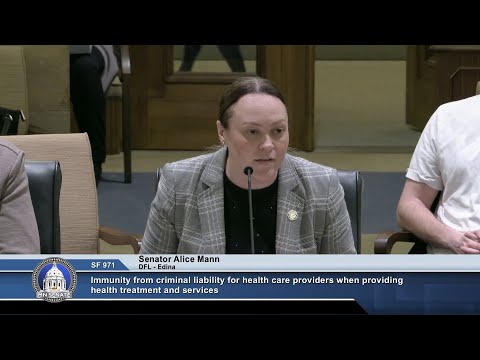
Senate File 971, a proposal to limit criminal prosecution of health care providers for inadvertent medical errors, drew extended testimony and was laid over for further work by the Senate Judiciary and Public Safety Committee on March 19.
Senate File 971, a proposal to limit criminal prosecution of health care providers for inadvertent medical errors, drew extended testimony and was laid over for further work by the Senate Judiciary and Public Safety Committee on March 19.
Proponents told the committee the bill is aimed at preventing prosecutorial overreach after high‑profile out‑of‑state cases in which clinicians were convicted after medication errors. Senator Mann, the bill's author, said the measure would not block investigations, licensing board action, civil malpractice suits or prosecution for intentional or grossly negligent conduct. "This bill very simply states that a health care provider will not be criminally prosecuted if they make an honest mistake because an honest mistake should not constitute a crime," Senator Mann said.
Adam Carlin, chief nursing officer at M Health Fairview Southdale Hospital and policy chair of the Minnesota Organization of Leaders in Nursing, told the committee that criminalizing honest mistakes chills reporting and undermines the "just culture" needed to improve systems. "When providers fear criminal prosecution for errors, they are less likely to report them, making healthcare less safe," Carlin said.
The Minnesota County Attorneys Association urged caution. Robert Small, the association's executive director, said the group's concern is the bill's breadth: as drafted it would apply to the full range of licensed and registered health professionals in Minnesota. "If this bill does go forward, we would urge that you narrow it," Small said, suggesting any immunity be limited to nurses or to a smaller set of providers.
Several committee members expressed unease about the bill's definition of "health care provider" and about carving out criminal‑law exceptions for a broad class of professionals. Senator Crook and others described the current draft as a "blanket immunity" for many statutory crimes and urged statutory cross references or narrower language to identify which licensees would be covered.
Committee counsel and the author discussed possible drafting fixes, including specifying license categories by cross reference to existing statutes or otherwise narrowing the covered universe. The chair said the bill was not ready to send to the floor given the scope questions and laid the bill over for additional stakeholder work and drafting.
Action: Senate File 971 was laid over for further consideration; no final vote was taken.
Why it matters: The measure pits two policy aims against one another—encouraging transparent safety reporting and preventing wrongful criminal prosecutions—and could affect a wide range of licensed health workers if advanced. The committee asked the author and stakeholders to refine the scope and definitions before the bill moves forward.