Get Full Government Meeting Transcripts, Videos, & Alerts Forever!
Get email alerts on the Veteran Recognition topic
No spam. Unsubscribe anytime.
Minnesota subcommittee passes bill to formally recognize Hmong Special Guerrilla Unit veterans
Summary
The Subcommittee on Veterans Affairs passed Senate File 568 to expand the state definition of 'veteran' to include members of the Hmong Special Guerrilla Unit (SGU) who fought alongside U.S. forces in Laos; advocates and two SGU veterans gave emotional testimony about service and loss.
Senate File 568 to expand Minnesota’s definition of “veteran” to include members of the Hmong Special Guerrilla Unit passed the Senate subcommittee on Veterans Affairs and was referred to the Committee on Agriculture, Veterans, Broadband, and Rural Development after testimony from community leaders and SGU veterans.
Advocates told the committee that Hmong fighters acted as surrogate soldiers for U.S. operations in Laos during the Vietnam-era “secret war,” and that fewer than 1,000 SGU veterans remain in Minnesota. "If you can stand up," Lee Pao Xiong told the committee as he gestured toward aging veterans in the room. "Their numbers are dwindling. Their stories fading." Xiong identified himself as director of the Center for Hmong Studies at Concordia University, Saint Paul.
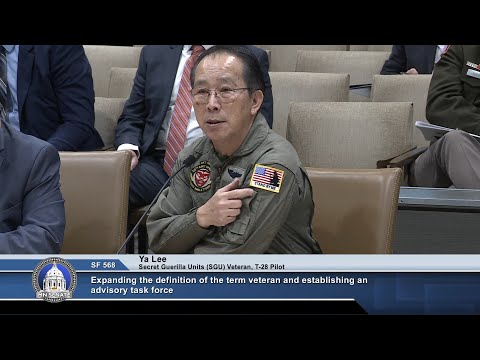
The bill’s author framed the measure as formal recognition of service and sacrifice by Hmong men and women who were recruited and trained to fight alongside American forces. One SGU veteran who testified, Yaa Lee, said he was one of 37 Hmong pilots trained by the U.S. Air Force and described artifacts he brought to the hearing — a 1972 uniform, a U.S. Air Force flying certificate and a Pentagon certificate of recognition signed by then–Air Force Chief of Staff Norton Schwartz — to illustrate the historical record of SGU service. "We fought in every major battle in Laos," Lee said, adding that many fellow veterans are now deceased or seriously ill.
Senators expressed gratitude for the testimony. Senator Duckworth addressed the veterans directly: "Regardless of the outcome of this bill, I appreciate your service… Consider your brothers in arms, and thank you for what you've done." The author urged the committee to place recognition "on paper" so future generations would not overlook the Hmong contribution.
Senator Kupak moved to pass the bill and refer it to the larger committee. The chair called the voice vote; committee members responded "aye," and the motion was announced as passed and referred.
The measure will next be considered by the full committee; proponents said the bill is intended to give official state-level recognition to Hmong SGU veterans and to preserve their service in the historical record.
Details from testimony: Lee Pao Xiong said Hmong recruits included boys as young as 10 and described training, combat and long-term health effects among veterans, including cancer and hearing loss. Yaa Lee said roughly 10 T-28 pilots remain alive and urged passage as a step toward justice and education about the Hmong role in U.S. operations.
Votes and next steps: The subcommittee approved SF 568 by voice vote and referred it to the Committee on Agriculture, Veterans, Broadband, and Rural Development for further consideration.