Get Full Government Meeting Transcripts, Videos, & Alerts Forever!
Get email alerts on the Nursing Home Workforce topic
No spam. Unsubscribe anytime.
Panel outlines nursing-home minimum-wage rules; Legislature hears competing cost estimates as SF2480 is laid over
Summary
The Nursing Home Workforce Standards Board told the Senate Human Services Committee on May 20 that it used public forums and state payroll data to craft minimum-wage rules for nursing homes, and that the rules are contingent on legislative funding before taking effect.
The Nursing Home Workforce Standards Board told the Senate Human Services Committee on May 20 that it used public forums and state payroll data to craft minimum-wage rules for nursing homes, and that the rules are contingent on legislative funding before taking effect.
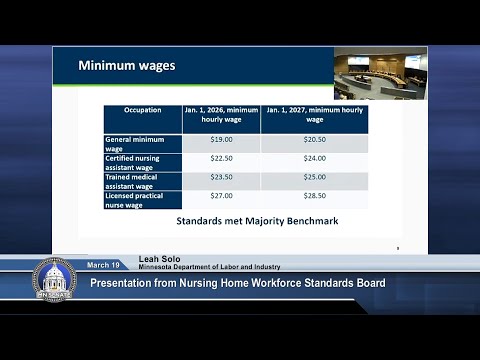
The board’s executive director, Leah Solo, told the committee that the board was created in law in 2023 and “adopt minimum nursing home employment standards that meet or ex exceed existing industry conditions for a majority of nursing home workers.” Solo said the board’s wage standards were written to meet a statutory “majority benchmark” requiring rules to lift at least 50 percent plus one of nursing home workers or match their current wages.
The board adopted two sets of minimum wages in May 2024 and published final notice of adoption in October 2024; Solo said the earliest the wage floors could take effect is Jan. 1, 2026, because the rules are contingent on an appropriation. The board also adopted a separate set of rules, effective Jan. 1, 2025, that require time-and-a-half holiday pay for work on state holidays, established a certification process for worker organizations to provide training, and required nursing homes to post notice of workers’ rights. Solo said the board launched a waiver and variance process in December 2024 for nursing homes that believe compliance would risk closure or receivership and that “as of today, we have received no applications yet under that process.”
Senate File 2480, sponsored by Sen. John Pappas, would appropriate funding for the board’s minimum-wage rule. Pappas summarized the fiscal analysis in the packet and told members the Legislature had two fiscal estimates: roughly $5.6 million under “current law” and about $15 million under assumptions in the governor’s budget about reimbursement growth caps. Advocates for care workers said the increases are long overdue; industry groups and provider representatives cautioned the fiscal notes understate the cost and said the mandates could force closures unless fully funded.
Workers and union representatives testified in support. Theresa Beres, who identified herself as a laundry worker at a nursing home in Roseville and a member of SEIU Healthcare Minnesota, said she had worked in long-term care for 25 years and described staffing and injury consequences from chronic short-staffing. ‘‘I was part of the largest nursing home strike in Minnesota history last March,’’ Beres said, and said the new wage floors and holiday pay will help retention. Matt Jensen, a maintenance lead and former AFSCME local president, said nursing homes are ‘‘homes for people’’ and asked lawmakers to fund SF 2480 so facilities can meet the standards.
Opponents included the Long Term Care Imperative. Kyle Berndt, testifying for that coalition, said its analysis estimates the board’s mandates could cost facilities roughly $200 million statewide and that the bill would set a precedent if the Legislature codified rules without accepting the board’s cost methodology. Erin Hubert, also with the Imperative, told the committee she supports higher wages but said SF 2480 is not the right mechanism and argued the board’s mandates must be matched with reliable appropriations.
Committee debate focused on two themes: fiscal accuracy and process. Several senators, including Sen. John Rasmussen and Sen. Aki, pressed Solo on whether employer representatives on the board had affirmatively supported the wage proposals; Solo said the wage requirements passed the board with six affirmative votes and three abstentions (the abstentions were employer representatives who said they supported higher wages but had funding concerns). Rasmussen and others also questioned the board’s use of expedited rulemaking; Rasmussen offered an amendment to require regular (non-expedited) rulemaking to allow more public input.
Senator Rasmussen offered two amendments during the SF 2480 discussion. The first (A1) would have required at least one affirmative vote from a provider representative on the board before any future mandate could take effect; the second (A2) would have prohibited the board from using expedited rulemaking and required normal rulemaking procedures. Both amendments were moved and debated but were rejected by voice votes (no roll-call tallies were provided on the record). The committee later laid SF 2480 over for possible inclusion in an omnibus bill.
What they discussed and what remains unresolved
- Costs: Pappas described fiscal estimates in the bill packet of about $5.6 million (current-law assumptions) and $15 million under the governor’s proposed reimbursement cap. Provider groups contended the actual cost is far higher (they offered an estimate of about $200 million statewide). Testimony by industry representatives also put the holiday-pay mandate at roughly $20 million statewide.
- Timing and funding: Solo emphasized the wage rule is contingent on an appropriation; without funding the rule cannot go into effect before Jan. 1, 2026. Providers and some senators pressed that DHS and the Legislature must agree on an accurate fiscal number before codifying the rule.
- Process and participation: Some senators argued the board’s expedited rulemaking limited public input. Others said statute authorizes the board to set standards and that the board followed public engagement and data analyses, including DHS wage data used to test wage thresholds.
- Waivers: The board adopted a waiver and variance process in December 2024; Solo said no waiver applications had been received as of the committee hearing.
The committee did not take a final vote on SF 2480. It was laid over for possible inclusion in an omnibus bill. The record shows substantial agreement on the policy goal of raising pay for nursing home workers, and substantial disagreement on the cost estimates and on whether the board’s process provided adequate provider input.
Ending note
Lawmakers and providers asked for additional fiscal detail and for DHS staff to engage further with providers to reconcile competing cost estimates. The bill remains under consideration in the committee.