Get Full Government Meeting Transcripts, Videos, & Alerts Forever!
Get email alerts on the Veteran Claims Shark Legislation topic
No spam. Unsubscribe anytime.
Minnesota bill would require VA accreditation, transparency to curb 'claims sharks' preying on veterans
Summary
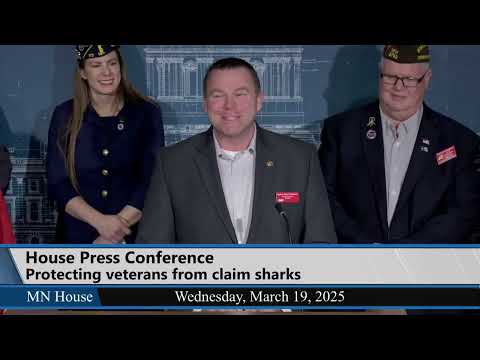
Representative Emma Greenman introduced House File 1855 on behalf of veterans who advocates say are being targeted by so-called "claims sharks," and told a House veterans' committee the bill would require people or companies charging for help with VA claims to be accredited by the U.S. Department of Veterans Affairs and to use transparent fee agreements.
Representative Emma Greenman introduced House File 1855 on behalf of veterans who advocates say are being targeted by so-called "claims sharks," and told a House veterans' committee the bill would require people or companies charging for help with VA claims to be accredited by the U.S. Department of Veterans Affairs and to use transparent fee agreements.
"All this bill does ... is a modest solution that says, if you wanna do that, if you wanna serve veterans, you have to be accredited by the US Department of Veterans Affairs," Greenman said during the hearing. She told the committee the bill had just passed out of the House Veterans Services Committee and was on its way to the Judiciary Committee.
The bill drew support from a coalition of veterans service organizations. Dr. Christy Janigo, legislative chair of the American Legion Department of Minnesota and an assistant county veteran service officer, called HF1855 "the most important veteran issue in the Minnesota legislature this biennium," and said the PACT Act of 2022 had expanded benefits and also opened opportunities for fraud.
"The PACT Act of 2022 ... was the largest expansion of VA benefits in modern history, resulting in approximately 1,800,000,000.0 in new benefits awards," Janigo said, citing the scale of new federal awards and arguing that the expansion attracted private businesses and individuals that charge fees for services veterans can receive for free.
Officials and advocates described a pattern of practices they call predatory: vendors asking veterans to sign contracts for large or lifetime fees; requesting account login or direct deposit information; promising faster or guaranteed ratings; steering veterans to private providers for medical opinions; or filing preliminary paperwork to time retroactive payments. Supporters said accredited representatives — including county veteran service officers in all 87 Minnesota counties, MDVA representatives and service officers from the American Legion, Disabled American Veterans and Veterans of Foreign Wars — provide the same representation at no cost.
"We are not here to degrade attorneys who maintain and obtain the proper accreditation for the Department of Veterans Affairs to do what they do," said John Goen, claims director for the Veterans of Foreign Wars (transcript: "Make no mistake, we are not we are not here to degrade attorneys who maintain and obtain the proper accreditation for the Department of Veterans Affairs to do what they do."). Goen and other witnesses urged requiring accreditation to make representatives visible and accountable to veterans and federal authorities.
Advocates said the federal statutory and regulatory framework lacks effective penalties for some of the harmful practices. John Baker, executive director of the Minnesota Association of County Veterans Service Officers, said states have moved to fill enforcement gaps and called HF1855 a state-level anti-fraud measure. "I actually call this the veteran anti fraud claim bill because this is really what it is," Baker said.
Representative Greenman and witnesses described how the bill would do two things: prevent unaccredited businesses from normalizing consultative fee models that skirt prohibitions on charging for preparation or prosecution of claims, and provide consumer-protection remedies — including private causes of action and enforcement by the attorney general — when violations occur. Greenman said accreditation gives accredited representatives access to VA claims systems and creates professional duties that make them accountable if they mishandle claims.
Committee members asked about enforcement and federal overlap. Witnesses replied that accreditation and state consumer-protection tools are intended to prevent fraud before it happens and to provide remedies when it does. They acknowledged the Senate companion, SF 1894, had been amended in committee to remove accreditation, and Representative Greenman said she would seek to keep accreditation in the final package.
Support came from multiple veterans groups that together described an ongoing outreach effort. The hearing included speakers identified as representing the American Legion Department of Minnesota, the Disabled American Veterans Department of Minnesota, the Veterans of Foreign Wars, and the Minnesota Association of County Veterans Service Officers. Several witnesses described direct encounters with veterans who signed costly contracts or were steered away from free county or organizational services.
No formal vote on HF1855 was recorded in this hearing transcript. The bill was described as having passed out of the House Veterans Services Committee earlier and was reported to be headed to the House Judiciary Committee; sponsors and witnesses said a companion bill was pending in the Senate.
The proponents urged that accreditation and fee transparency would reduce fraud and protect both veterans and taxpayer-funded benefits by preventing predatory businesses from taking retroactive awards or large upfront fees away from veterans who could receive representation for free.