Get Full Government Meeting Transcripts, Videos, & Alerts Forever!
Get email alerts on the Broadband Digital Opportunity topic
No spam. Unsubscribe anytime.
House committee adopts technical and scope amendments to HF 2279, lays bill over for possible inclusion
Summary
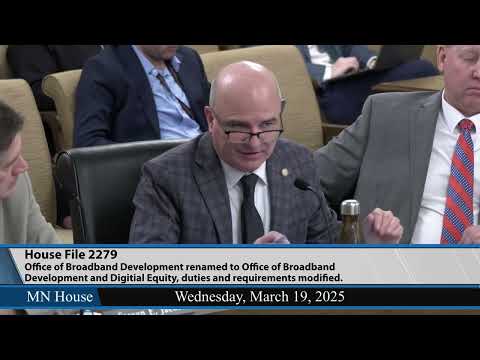
A Minnesota House committee adopted two author amendments to House File 2279 to rename and broaden the state Office of Broadband to include "digital opportunity," remove a proposed grant-creation language, and lay the bill over for possible inclusion in a future omnibus bill.
A Minnesota House committee on a bill about broadband and digital inclusion adopted two author amendments and laid House File 2279 over for possible inclusion in a future bill.
Rep. Griffin Vang, the bill's author, moved adoption of the A1 amendment, described as a technical correction identified by nonpartisan staff, and the A2 amendment, which renames the Office of Broadband to include “digital opportunity,” aligns state terminology with federal digital opportunity plans and removes policy language that would have established a new grant program. Both amendments were adopted by voice vote and the bill as amended was laid over.
The bill, as explained by Vang and by testifiers from Hennepin County, would broaden the office's mission beyond infrastructure to include adoption, affordability and digital skills. "This bill seeks to address some of the concerns and reflects the expanded mission of the program," Vang said, adding that the changes would "result in better high‑speed Internet access, broadband adoption [and] affordability across this entire state." Vang said the bill contains no direct funding obligations.
Mika Behr, a Hennepin County Office of Broadband and Digital Inclusion staff member, urged support for the bill and described how lack of reliable broadband affected education and farm operations in rural Minnesota and limited opportunities in urban multifamily housing where units are not wired or service is unaffordable. "Broadband gave me the opportunity to become the first person in my family to earn a college degree," Behr said, recounting personal experience on a dairy farm and later noting remaining access and affordability gaps in Hennepin County.
Phil Essington, identified as director of Hennepin County's broadband and digital inclusion program, told the committee that multiple technologies are likely needed to reach all Minnesotans. "We support the bill because we think that drilling fiber isn't enough for getting all Minnesotans connected," Essington said, citing low‑earth‑orbit satellite and fixed wireless as options for some locations.
Committee members asked about program scope, affordability and technical standards. Director Mackey (Office of Broadband/Digital Opportunity, DEED) said Minnesota is participating in the federal Digital Equity Act and noted the state developed a Digital Opportunity Plan under that program. Mackey described the prior federal Affordable Connectivity Program subsidy and said the state does not currently operate a statewide subsidy program for monthly service, though some providers offer discounts. On service thresholds, Mackey said Minnesota's statutory goals for 2026 set "served" at 100/20 (100 Mbps download / 20 Mbps upload) and "unserved" at 25/3, and that grant recipients must build to scalable 100/20 service at a minimum.
Rep. Paul Burkel, Rep. Nelson and Rep. Gander raised questions about last‑mile service, alternative technologies and whether the state would subsidize monthly service for low‑income households; Mackey and Essington responded that a mix of technologies and outreach is needed and that the state currently focuses on ensuring at least one provider per location while relying on federal programs or provider offerings for subsidies.
Rep. Vang renewed her motion to lay HF 2279, as amended, over for possible inclusion in a future bill, and the committee laid the bill over.
Votes at a glance: A1 amendment (technical) — adopted by voice vote; A2 amendment (rename office, remove grant‑creation language) — adopted by voice vote; HF 2279 as amended — laid over for possible inclusion in a future omnibus bill.
The bill does not appropriate funds as presented; committee discussion focused on definitions, coordination with federal programs and how to ensure adoption, affordability and digital skills work accompanies infrastructure investments.