Get Full Government Meeting Transcripts, Videos, & Alerts Forever!
Get email alerts on the Veterans Claims Fraud topic
No spam. Unsubscribe anytime.
Minn. committee hears competing views on bill to curb "claim sharks," refers HF1855 to judiciary
Summary
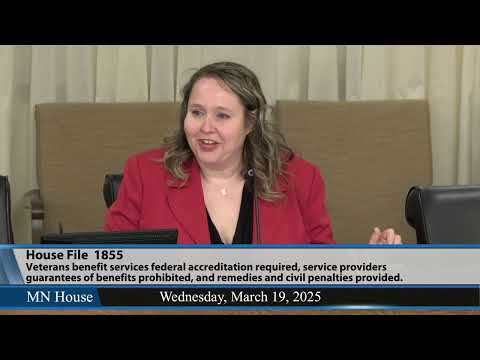
Rep. Grama told the House Veterans Committee that House File 18‑55 would require accreditation and written fee agreements for private providers who assist veterans with VA claims to curb so‑called "claim sharks."
Rep. Grama, the bill’s author, told the House Veterans Committee that House File 18‑55 targets "claim sharks" that charge veterans for assistance with VA benefits and "take a cut" of veterans’ retroactive payments. She said the bill would require providers who charge for help on claims to be VA‑accredited and to use written fee agreements, prohibit guaranteeing outcomes and give veterans consumer‑protection remedies under state law.
The bill drew long testimony from veterans service organizations, county veteran service officers and private providers. Dr. Kristi Janigo, legislative chair of the American Legion Department of Minnesota and an assistant county veteran service officer, said those who do this work "at no cost to the veteran are not motivated by profits" and described accreditation and training required of county and VSO representatives. Ben Johnson, deputy commissioner for Grama and Services at the Minnesota Department of Veterans Affairs (MDVA), told the committee: "I simply want to state unequivocally that we support this bill in its current form," and emphasized the state and county network of accredited service officers.
Supporters described a range of predatory practices. Marissa LaCourte, County Veterans Service Officer for Goodhue County, recounted a case in which an 87‑year‑old man paid $2,000 to a private firm that "did nothing for him": "They promised him if he paid $2,000 the claim would be processed by the end of the month. The claim was processed 14 days later ... That agency took his check for $2,000 cashed it. They didn't even process the power of attorney, but they had no intention of refunding that man his money," she said. LaCourte and others told the committee firms often file large numbers of claims or marginal claims that create extra exams and delays for other veterans.
Veterans of Foreign Wars witnesses and the Minnesota Association of County Veterans Service Officers pushed for the bill as an anti‑fraud measure. John Gohn, director of the VFW claims office in Minnesota, said his office represents tens of thousands of Minnesota veterans and called the practices "illegal activities" that "skimming" benefits from veterans and burden the VA and VSOs.
Private companies and some accredited attorneys opposed the bill as drafted. John Blumstrom, manager of government and public affairs for Veterans Guardian, said his firm operates on a contingency basis, discloses fees up front and would welcome a path to accreditation at the federal level; he asked lawmakers to "table this so that we can sit down and put together a common sense piece of legislation." Brian Lewis, a VA‑accredited private attorney, said the bill "as drafted is protectionist" and warned the language could sweep in accredited attorneys and some lawful businesses because of how the bill treats referrals and fee disclosures.
Other witnesses and some committee members urged refinement. Benjamin Krause, an attorney and chair of the United Veterans Leadership Council, noted existing Minnesota laws—including MN Stat. 481.02 on the unauthorized practice of law and prior disclosure requirements—and urged careful drafting to avoid conflict with federal law governing accreditation and attorneys’ practice.
Committee members discussed competing priorities: protecting veterans from fraud while preserving access to lawful, fee‑based representation where veterans choose it. Representative Bennett said proponents and opponents "should not be lumped together" and urged the author to narrow the bill to target predatory actors. Representative Olson warned of creating a gap in services if the bill removes options without ensuring enough accredited or public providers to absorb demand. Several members said they want additional stakeholder work before the bill moves further.
After questions and brief member debate, the committee took a procedural action. Chair Bliss moved that the bill be re‑referred to the Judiciary Committee; the motion was approved by voice vote and the measure was sent to Judiciary for further work.
The committee hearing included a mix of veterans, county service officers, representatives of national veterans service organizations and several private companies that assist veterans with claims. Testimony ranged from personal anecdotes of alleged predatory practices to technical and legal concerns about accreditation, referral rules, fee disclosure and federal preemption.