Get Full Government Meeting Transcripts, Videos, & Alerts Forever!
Get email alerts on the Police Budget topic
No spam. Unsubscribe anytime.
Cathedral City police chief seeks targeted increases for dispatch, animal control and equipment in two-year budget
Summary
At a March 19 special meeting, Cathedral City’s police chief reviewed staffing, service changes and budget requests for the 2025–27 biennial cycle, seeking additions for dispatch, community service officers and an anticipated higher animal-control contract while proposing equipment replacements and modest cuts in operations.
Cathedral City’s police chief presented a staffing and budget review to the City Council on March 19, asking for targeted additions to the department’s two-year budget and describing service changes in dispatch, community service officer staffing, animal control and equipment replacement.
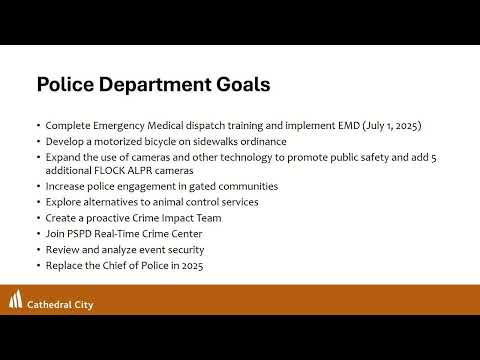
The presentation outlined historical staffing trends, crime- and call-volume statistics for 2023 and 2024, and specific budget requests for fiscal years 2025–26 and 2026–27. The chief described proposed one-time and ongoing expenses, and warned some near-term goals—such as implementing Emergency Medical Dispatch (EMD) training by July 1, 2025—would be difficult without successful recruitment and training.
Why it matters: the requests would affect the police department’s on-the-street capacity and the city’s contract spending for animal control. Council members asked for clarity on staffing math and contract timing; the chief said staff will return with further details as recruiting and contract negotiations proceed.
The chief told the council the department has increased sworn staffing since 2013 while some non‑sworn areas, such as dispatch, have dipped. He said the dispatch center currently has one sergeant, 10 full‑time public safety dispatchers and two part‑time dispatchers (the two part‑time positions are counted as 1 FTE). On the proposed EMD‑funded additions, the chief said that if council approves two additional public‑safety dispatchers the department’s staffing model would have three dispatchers assigned to each patrol team (a shift structure the chief described as supporting four patrol teams).
Regarding calls and workload, the chief reported the dispatch center handled 84,447 calls in 2023 (36,100 emergency 911 calls plus 48,347 non‑emergency calls) and 66,272 calls in 2024 (24,588 emergency and 41,684 non‑emergency). He attributed part of the 2023 higher volume to the department’s transitional assistance to Desert Hot Springs while that city built out its own dispatch center.
On community service officers (CSOs), the chief said the department currently has two CSOs and a limited‑term public safety assistant (PSA). He described a plan to convert a vacant records specialist position to a CSO to reach three CSOs and to request funding in the 2026–27 biennium to add a fourth CSO beginning Jan. 1, 2027, if approved. The chief framed CSOs as lower‑cost personnel who take on follow‑up, scene processing and non‑emergency investigative work, freeing sworn officers to focus on proactive patrol and crimes in progress.
Animal control was a major budget pressure in the presentation. The chief reported fiscal‑year 2023–24 contract costs were $246,350 and that year‑to‑date costs as of January 2025 were $232,559 and trending higher. He said the county contract is part‑time (8 a.m.–noon weekdays) and that the city pays overtime for afternoons and weekend responses. The chief asked the council to budget for an anticipated 20% increase in the first year (an estimated $65,800) and a 5% CPI adjustment in the second year (an estimated $85,540), and said the council had directed staff to explore alternatives but that options may be limited or cost‑prohibitive.
The chief also requested funding for replacing expiring ballistic plate carriers and helmets, proposing roughly $25,000 in each year of the two‑year budget to update that safety gear and recommending planning for ongoing replacement funding thereafter. He described other modest additions for training, ammunition and PSEC technology/user costs tied to regional radio and cybersecurity work.
Accomplishments and projects: the chief noted there were no weapon‑related or violent homicides in Cathedral City in 2024, an expanded Flock automated license plate reader deployment (25 cameras citywide with a plan for five more after July 1), the addition of a CBAP mental health technician through Riverside University Health System, and participation in multiple community events. He described ongoing work toward a real‑time crime center and potential drone operations; the chief said staff intends to host a Palm Springs Police Department presentation to the council before seeking funding for that program.
Council members asked for clarifications about staffing math, the number of dispatchers on shift, and how CSOs are being used now that short‑term vacation‑rental workload has declined. The chief said CSOs take reports, process scenes and support evidence collection—work that reduces sworn officer overtime and lets officers be more proactive. On EMD implementation, the chief cautioned that 22 applicants were tested for dispatch, three passed initial testing, and none were yet through background checks, making a July 1 deadline challenging.
There was no public comment. The council neither voted nor took formal action during the special meeting; the presentation was for information, discussion and direction only. The chief said staff would return with follow‑up details on recruitment, contract timing and refined budget numbers as they are developed.
The chief concluded by thanking council and staff; Mayor Ross adjourned the meeting.