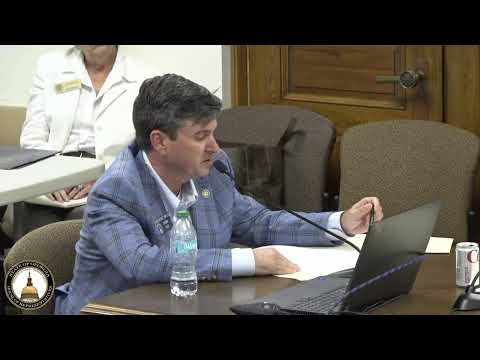
Committee approves SB 259 "Ridge’s Law" to give families access to independent medical reviews in suspected-abuse cases
Loading...
Summary
Senate Bill 259, known as "Ridge’s Law," was passed by the Judiciary—Juvenile Committee after parents and advocates described cases where infants were removed from families following hospital evaluations; the bill allows families to obtain independent medical evaluations or pediatric specialty consultations and requires hospitals to log review of prior medical records.
Senator Brass, sponsor of Senate Bill 259, told the Judiciary—Juvenile Committee that the bill—now called "Ridge’s Law"—was filed after a constituent's child was taken into temporary custody following a hospital evaluation and remained separated from family for more than a year and a half. "I'm bringing you SB 259, also now known as Ridges Law," Brass said, describing a case in which a 6-week-old infant was removed from his family and returned only after 15 months.
The bill requires that when a child is taken into temporary custody for an investigation of alleged abuse the family may, at their own expense, obtain an independent medical evaluation or a pediatric specialty consultation. It also directs hospitals to record whether a child's prior medical records were reviewed and to log that review in the department's internal system (referred to in committee as SHINES); if a review was not completed, the hospital must record the reason and the record of that decision. Senator Brass said the bill also requires the attending doctor to notify families of their right to request a second opinion.
The committee heard extended testimony from multiple parents who said they had been separated from children after hospital staff or a child-abuse specialist concluded abuse. Bailey Collins, who identified herself as the mother of "Ridge Collins," told the panel her son was taken from her at 11 days old and that proving her family's innocence required expensive experts and attorneys. "Our nightmare started on August eleventh of 2023. My son was taken away from us," Collins said. She described hiring expert witnesses and said the juvenile court ultimately ruled in the family's favor after a year.
Witnesses gave similar accounts. Kelly Holshek Lopez said her family spent more than $300,000 fighting allegations, endured long separations and only obtained a second medical opinion out of state. "What if on that night when false allegations were made, we had been given the chance for a second medical opinion?" Lopez asked the committee. Tracy Lester, a grandmother, said her daughter remains in prison after a conviction she contends was based on incomplete medical review.
Advocates from nonprofit groups also supported the bill. Gretchen Brocard, Georgia state organizer for You Are the Power, urged the committee to act, saying the bill protects families who bring children to medical facilities seeking care and instead face rapid accusations. "SB 259 is an extraordinarily important piece of legislation," Brocard said. Jonathan Williams, an advocate who said his family had foster children with undiagnosed conditions, proposed two amendments: remove the word "pediatric" from the specialist language, and require child-abuse pediatricians to identify themselves when interacting with parents. "The word pediatric should be removed from the type of specialist the family can seek for a second opinion," Williams said, arguing that some locally affiliated pediatric specialists decline to contradict colleagues.
Committee members asked questions about timing and scope. Senators and representatives noted that preliminary juvenile hearings occur quickly (a committee member cited a 72-hour preliminary hearing), and asked whether results from an independent evaluation could be obtained in time and considered by the court. Senator Brass said the bill requires courts to consider results from independent evaluations or pediatric specialty consultations at dependency hearings and that line-item language within the draft protects an option for "independent medical evaluation" in addition to pediatric specialty consultation to address the concern that locally affiliated specialists may not provide contrary opinions.
After discussion, the committee voted to pass the bill. The chair called for the question on "LC570260S, Senate Bill 259." There was a motion and multiple seconds; the committee voice-voted in favor and the chair declared, "It does pass." The committee did not adopt immediate amendments discussed during testimony; members signaled willingness to explore additional disclosure or identification rules in a future study or committee process rather than attach them to the current clean bill.
Why it matters: Testimony in the hearing described long family separations (witnesses cited separations ranging from months to more than a year), substantial out-of-pocket costs for retaining experts (witnesses cited figures including about $5,000 for a single expert review and more than $100,000 and $300,000 in legal costs), and cases where additional medical review later identified underlying medical or genetic conditions. Supporters said the bill would give families a formal mechanism to obtain an outside medical review early in custody and dependency proceedings and ensure courts can consider those opinions.
Next steps: The committee passed the bill out of the Judiciary—Juvenile Committee; it will move forward in the legislative process according to standard procedures. The bill's sponsor and several committee members said they would consider further study or future legislation to address whether child-abuse pediatricians must announce their role to parents or other disclosure procedures, but they did not add those requirements to SB 259 in committee.