Get Full Government Meeting Transcripts, Videos, & Alerts Forever!
Get email alerts on the Education topic
No spam. Unsubscribe anytime.
Georgia Public Broadcasting tells lawmakers its education resources reach every county; highlights funding, emergency role and statewide usage
Summary
Georgia Public Broadcasting officials told a House committee that GPB’s free K–12 resources are used in every Georgia school district, that state funding covers about one-third of its budget, and that the network plays a statewide role in emergency alerts and public-safety communications.
Georgia Public Broadcasting executives told a legislative committee that GPB’s free K–12 materials are used in every county in Georgia, that the network relies on a mix of state funds and donations, and that its broadcast infrastructure is a key part of the state’s emergency alert capabilities.
“State funds make up 34% of GPB’s overall revenue,” Elizabeth LaPrade, GPB’s chief financial officer, told the committee, describing the remainder as a mix of individual giving and sponsorships, federal Corporation for Public Broadcasting funds, client services and other revenue. LaPrade said about 36% of GPB’s revenue comes from individual giving and sponsorship, 12% from indirect federal funds via the Corporation for Public Broadcasting, 10% from client services and the remainder from other sources.
The presentation focused on three areas: education services, broadcast and technology infrastructure, and community engagement. Laura Evans, GPB’s vice president for education, said GPB offers a Georgia Studies collection that drew about 1,400,000 clicks in the last school year and that GPB recorded about 14.7 million clicks on its educational content across platforms last school year. Evans said GPB’s education content is available at no cost to teachers, students and families and is aligned with Georgia Department of Education standards.
“Everything that we do in the education division at GPB is aligned to the latest Georgia standards and curriculum,” Evans said, adding that GPB works closely with the Georgia Department of Education and that the network provides virtual field trips, full online courses (including physics, chemistry and economics) and resources that teachers use to fill instructional gaps.
Taylor, GPB’s vice president of technology, said the network operates nine television stations, 21 radio stations and 27 tall broadcast towers across the state. He said the towers and backup systems allow GPB to distribute Emergency Alert System (EAS) messages statewide and to serve as a reliable broadcast partner when other infrastructure fails.
“We are one of the pillars GPB’s network is one of the pillars that distributes EAS,” Taylor said, noting the network’s partnerships with the Georgia Emergency Management Agency (GEMA) and the National Weather Service.
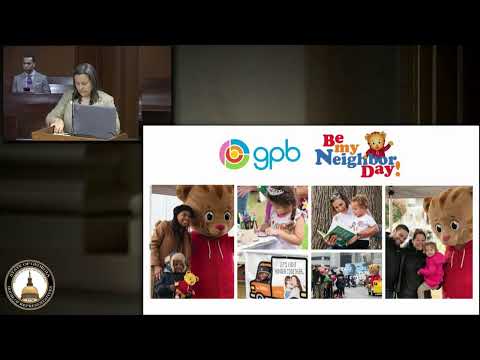
Adam Woodliff, GPB’s chief operating officer, described locally produced programming that connects audiences statewide, including long-running public affairs and high-school sports broadcasts. Hackshaw, GPB’s vice president for development and engagement, said GPB has community partnerships in 21% of Georgia counties and aims to expand that to 75% in five years. He described community events such as Be My Neighbor Day, a free family event run in partnership with PNC Grow Up Great and the Fred Rogers Company.
Committee members asked follow-up questions about usage patterns, broadband access and federal funding. Representative Fleming asked whether GPB’s heavy pandemic use had persisted; Evans said GPB saw a spike in 2020 and that usage dropped from that peak but remained above pre-pandemic levels. Representative Russell F. Gamble asked about legacy programming and community outreach; Hackshaw and others described ongoing local programming and outreach to school systems. Representative Burnau asked whether GPB was affected by federal budget cuts; LaPrade said continuing resolution language passed last Friday preserved full funding for the Corporation for Public Broadcasting, and GPB was not currently affected.
The committee documented several specific figures during the presentation: the FY24 state appropriation reduction that LaPrade said represented about 4% of GPB’s expenditures; GPB’s statement that it reached educators in person with roughly 7,000 participants last school year; roughly 40 virtual field trips in the Georgia Studies collection; and a reported 585 hours of locally produced television content per year. Presenters described usage analytics as based on IP addresses and said they track county-level activity, which the committee saw on a heat map showing statewide coverage with some lower-usage areas.
Votes at a glance
During the same meeting the committee recorded two procedural votes earlier in the agenda. Representative Scott moved to pass City Bill 20LC610138S; the committee voice-voted the motion and advanced the bill. The committee also voted to give Senate Bill 180 (LC 49 22 06) a do-pass recommendation to rules. The transcript did not record detailed roll-call tallies for either vote.
Why it matters: GPB’s officials told lawmakers that the network is both an educational content provider used across Georgia’s school systems and infrastructure partner for emergency alerts. Lawmakers said they could help increase awareness and usage in lower-engagement counties and flagged broadband access as a potential barrier in some rural areas. GPB asked for continued state support and for lawmakers’ assistance in promoting its free educational resources.
Sources: Remarks by Bert Wesley Huffman, president and CEO of Georgia Public Broadcasting; Elizabeth LaPrade, chief financial officer; Laura Evans, vice president for education; Taylor, vice president of technology; Adam Woodliff, chief operating officer; Hackshaw, vice president for development and engagement; and questions from Representatives Fleming, Russell F. Gamble and Burnau during a committee hearing.