Get Full Government Meeting Transcripts, Videos, & Alerts Forever!
Get email alerts on the Community Plan Update topic
No spam. Unsubscribe anytime.
Monterey County holds EIR scoping meeting for Moss Landing Community Plan update; public raises sea‑level, sewer and habitat concerns
Summary
County staff opened CEQA scoping for a draft Moss Landing Community Plan update and associated EIR, seeking input through Jan. 21, 2025; public comment focused on sewer capacity, sea‑lion habitat, pedestrian connections and project specifics including MBARI work and road improvements.
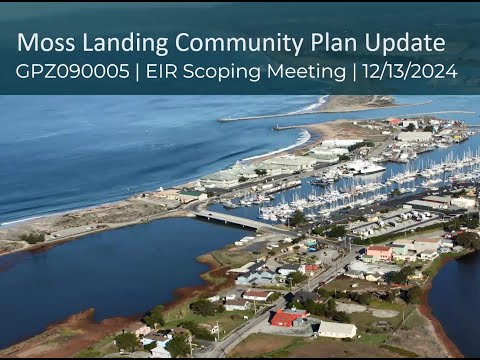
Monterey County staff held an environmental-impact-report (EIR) scoping meeting on the Moss Landing Community Plan update to solicit public input on the scope and content of environmental review. County planners said the county posted a draft plan dated Dec. 6, 2024, and that the Notice of Preparation comment period runs through Jan. 21, 2025.
The Monterey County planners said the EIR will analyze the plan update itself, proposed updates to related North County Land Use Plan policies and the Monterey County Coastal Implementation Plan, and two specific development projects identified for review: remaining components of the Monterey Bay Aquarium Research Institute (MBARI) master plan and a Moss Landing Road storm‑drain, street and sidewalk improvement project. "The comment period for the NOP began on 12/06/2024 and will go until 01/21/2025," said Katie Skirriac, planner with Monterey County.
Why it matters: the county said the EIR will compare reasonably anticipated buildout under the draft community plan to current on‑the‑ground conditions and consider feasible alternatives and mitigation measures required by the California Environmental Quality Act (CEQA). County staff highlighted two plan policies that will guide buildout assumptions: a policy allowing up to 150 visitor‑serving units within the plan area and a policy providing for the water, wastewater and traffic equivalent of 2,000,000 square feet of industrial development at the Moss Landing Business Park.
Scope and schedule: Monterey County planners described the EIR topics to include biological resources, water resources, circulation and traffic, cultural resources, visual resources, and climate‑change and sea‑level rise hazards. Phil Angelo, a planner with Monterey County, said the EIR "will also analyze the reasonably anticipated buildout that will result from adoption of the new community plan," and listed the 150 visitor units and the 2,000,000 square feet industrial threshold as key policy inputs. The county is planning a community workshop on sea‑level rise in February 2025 and anticipates releasing a draft EIR for public review in July 2025, a final EIR in December 2025, and subsequent Planning Commission and Board of Supervisors hearings in early 2026. Final adoption would require certification by the California Coastal Commission.
Project specifics mentioned in the meeting include MBARI's remaining master‑plan elements: a proposed 7,500‑square‑foot boathouse (referred to in the draft materials) and a small mooring‑dolphin structure identified as Building F; staff noted the mooring dolphin would fall under California Coastal Commission jurisdiction rather than county jurisdiction. The Moss Landing Road project was described as including drainage, curb and gutter, and sidewalk work intended to connect Highway 1 to the Heights neighborhood.
Public comments and issues: speakers urged the county to consider several specific topics in the EIR. Alyssa Gutcher of TMC asked for details about the planned sea‑level rise workshop; Mike Novo, a county planner, replied that "we have some draft regulations we've been working on. So it's gonna be really focused on those regulations," and suggested follow‑up for workshop details.
Representatives of the Castro Community Services District raised sewer‑capacity concerns and asked whether existing system limits remain in effect. A Castro CSD representative (Mr. Khan) traced the origin of the limitation to an earlier Castro decision and said the regional pump station near the post office was a focal point for capacity questions; he urged re‑evaluation of previous estimates. County staff replied that potential improvements identified by the EIR or technical analyses would need to be funded and prioritized through capital programs and that funding is not pre‑established.
Several residents urged protection of environmentally sensitive habitats and described observed disturbance of marine mammals in haul‑out and resting areas. One resident described sea lions displaced from prior resting sites adjacent to waterfront development and materials storage and asked the county to include habitat protections and to consider prior power‑line burial plans as an appendix so they are not lost between meetings. County staff encouraged written submission of such evidence and said habitat protection is among the EIR topics to be analyzed.
Process and how to comment: county staff said verbal comments at the meeting would be recorded and encouraged written submissions to ensure accuracy. Written comments may be submitted by email to scopingcomments@countyofmonterey.gov (as shown at the meeting) or by mail to the County of Monterey; the NOP comment deadline provided at the meeting is Jan. 21, 2025. Planners indicated further public meetings and formal hearings will follow release of the draft EIR.
Next steps: staff will consider comments from the NOP period and this scoping meeting when determining the EIR's scope, refine technical studies and alternatives, hold the sea‑level‑rise workshop in February 2025, and return to the Planning Commission for an informational update in March or April 2025 before the draft EIR release.