Get Full Government Meeting Transcripts, Videos, & Alerts Forever!
Get email alerts on the Land Use Rezoning topic
No spam. Unsubscribe anytime.
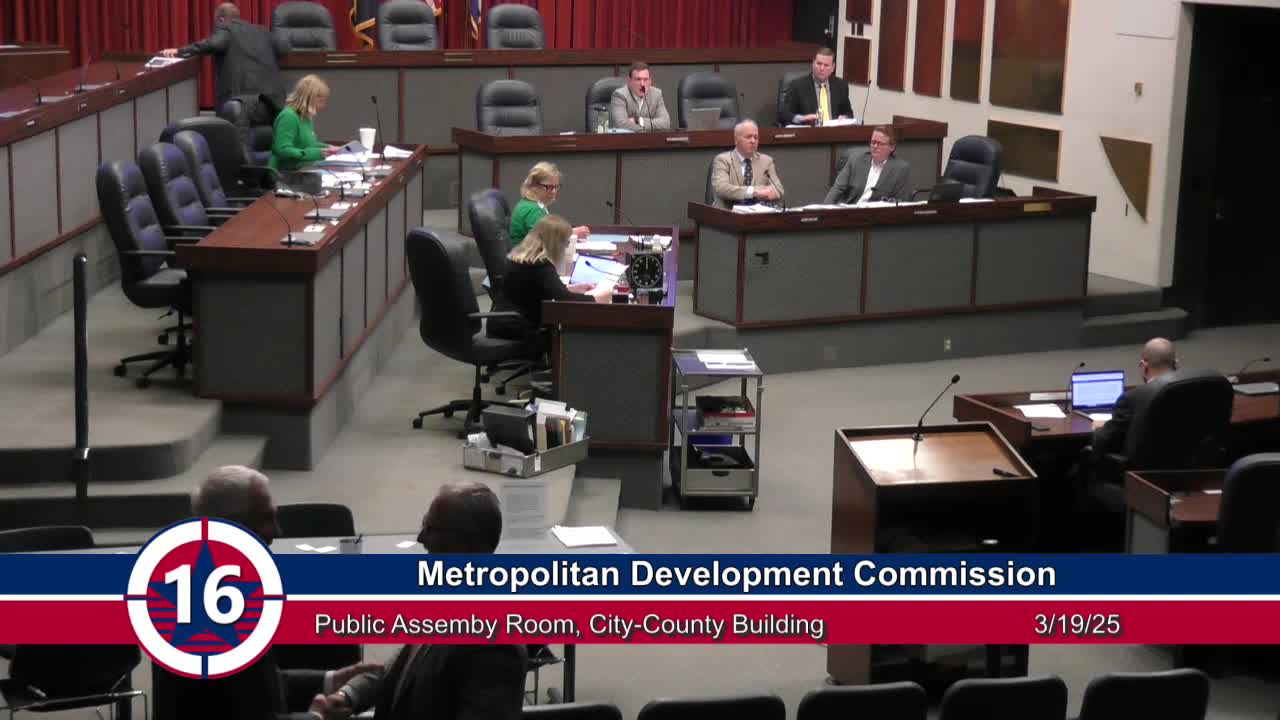
MDC denies rezoning request for contractor yard at 6670 E. 30th Street
Summary
The Metropolitan Development Commission denied a rezoning request to reclassify a 2.37‑acre site at 6670 E. 30th Street to C7 TOD to permit outdoor storage for a building contractor; commissioners and staff cited incompatibility with the TOD overlay and concerns about unlimited outdoor storage.
The Metropolitan Development Commission voted to deny a rezoning petition (2024ZON110) that would have changed zoning for 6670 East 30th Street from C3‑TOD to C7‑TOD to allow outdoor storage for a building contractor.
The petitioner, represented by planning consultant Mitch Seiver, requested the rezoning to permit a contractor’s operation with outdoor storage and equipment staging. Seiver said the company uses the site as an operations yard and intended to improve and pave the property and install low‑intensity security lighting; a corporate officer told the commission the company employs about 38 direct employees and contracts with a larger pool of crews in the Midwest. The petitioner offered four commitments: pave and stripe the site within six months of drainage‑permit approval, dusk‑to‑dawn low‑intensity security lighting, seasonal plantings at the entrance and a commitment that “no building materials will be stored outside.”
Planning staff and the hearing examiner recommended denial. Staff told commissioners the site is within a Transit‑Oriented Development (TOD) overlay intended to encourage pedestrian‑oriented uses and pointed out that C7 zoning permits unlimited outdoor storage. Staff said the TOD overlay and the comprehensive plan recommendation for community commercial favored lower intensity commercial than what C7 allows and added that the property had received code citations related to an unpermitted fence and previous site debris; staff concluded the requested C7 district was not appropriate for the location.
During the hearing staff also noted that C4 and C5 zoning categories can permit contractor operations under controlled conditions — for example, C5 limits outdoor storage to 25% of the building footprint or C4 by special exception — and that a petitioner proposing an enclosed building and a site plan tied to a lower‑intensity district could advance a different outcome.
The commission took one ballot on the petition. Six ballots were cast; the clerk announced a vote tally of five “no” votes and one “yes” vote, and the petition was denied.
Petition details in the record described the site as roughly 2.37 acres; the petitioner explained that their corporate headquarters is at a separate Shadeland Avenue address and that the 30th Street site is intended for equipment housing, maintenance and staging rather than customer transactions. The petitioner said much of its work involves tasks for regional homebuilders and that equipment is typically on site only when needed for upkeep or awaiting deployment to a job.
The denial leaves the site at its current C3‑TOD designation. Staff and the commission noted that a different petition that required construction of an enclosed structure and limited outdoor storage could be considered under a lower‑intensity commercial district in the future.