Get Full Government Meeting Transcripts, Videos, & Alerts Forever!
Get email alerts on the Alpr Policy topic
No spam. Unsubscribe anytime.
San Marcos police recommend 30-day retention for license-plate reader data; council asks for MOU and stricter outside-agency controls
Summary
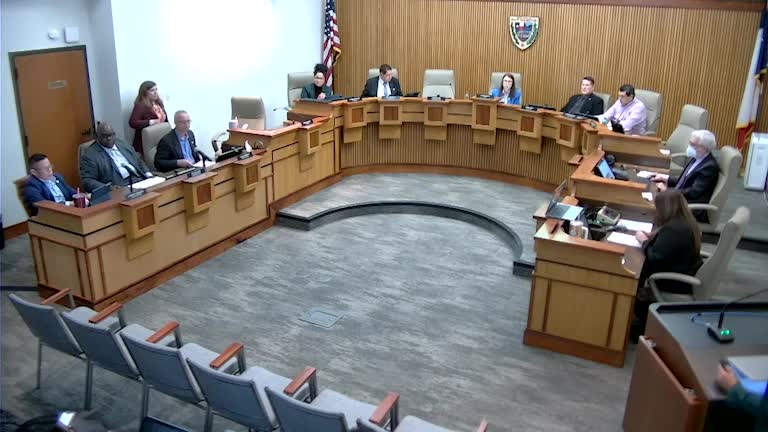
San Marcos Police Department leaders presented proposed changes to the city's automatic license plate reader policy on March 18, recommending a 30-day retention period and proposing memoranda of understanding for outside agencies; staff said it will return April 1 with the MOU and a recommended contract amendment.
San Marcos Police Department leaders on March 18 presented proposed revisions to the city's automatic license plate reader (ALPR) policy and outlined steps to formalize how the department will retain data and share it with outside law enforcement agencies.
Chief Standridge (identified in the presentation as the police chief) told the City Council that the department recommends retaining ALPR reads for 30 days. "I strongly recommend that we retain 30 days," he said, citing investigative cases and what staff characterized as frequent delays between offenses and reporting. Standridge described several investigations in 2024 in which delayed reporting or case development made older ALPR records relevant to identifying vehicles linked to offenses.
The chief described two investigative examples to explain the policy rationale: a series of 2024 incidents involving voyeurism and burglary where ALPR queries tied a vehicle to multiple scenes days after the events, and a previously adjudicated homicide (the presentation referenced the case of Mandy Reynolds) where ALPR data contributed to identifying a suspect who had traveled through other jurisdictions. Standridge also cited an internal analysis showing substantial delayed-reporting intervals for certain crimes (the presentation cited examples such as embezzlement averaging 317 days delayed reporting and some sexual-assault-related offenses with reporting delays the presentation listed in the hundreds of days), and he said that norm argues for retention at or near 30 days.
Standridge described the Flock Group Inc. ALPR system and emphasized several limitations and protections in the proposed policy: the system captures still images of vehicle rear plates; the vendor asserts it will not sell or share data with third parties; the system does not perform facial recognition or speed enforcement; and the vendor's data controls are configured by the department. The department currently has 33 cameras on the system (not all operational), Standridge said, and several recent grant awards added cameras; staff said the grants and seized-funds match will cover additional units with no general-fund impact in fiscal 2025.
Council members asked about safeguards for privacy and for limiting data access by outside agencies. The presentation and subsequent discussion addressed three council priorities: retention periods, privacy protections, and data sharing. Proposed changes in the draft policy include:
- Requiring login training and audits. The draft language would mandate initial and biennial training for system users and require audits of queries; Commander Eric Sprigle and Sergeant Tommy Villanueva were identified in the presentation as the staff who will perform audits with at least an annual formal audit.
- Requiring a query reason. The draft requires that users enter a reason for each query, typically an incident or case number, with auditing exceptions for authorized audit actions. Staff said that outside agencies seeking access would be required to sign a memorandum of understanding (MOU) that mirrors this requirement.
- Narrowing permissible use. The draft narrows use to "official law enforcement purposes only," e.g., to support a specific criminal investigation or missing-person case, and states that captured data will be purged after 30 days unless retained as evidence.
- Defining prohibited targeting. The draft adds language that locations for ALPR cameras will be determined by investigative need and not on the basis of protected characteristics such as race, religion, gender identity, immigration status, or — at council request — economic status.
Council members pressed for further safeguards around outside agencies. Several council members asked whether federal agencies (including ICE) or other outside entities could obtain San Marcos data without more restrictive protections. City Attorney Geary said cooperative agreements with outside law-enforcement partners are common and that he would need to research whether the city could require court orders in all circumstances; staff proposed using an MOU and administrative controls as a middle ground. Several council members said they wanted a definition of "outside agency" added to the policy and requested that the MOU include requirements and penalties (including loss of access) if an outside agency failed to follow the city's rules.
Kristen, a Flock representative, told council that Flock customers can be configured so that a department controls who can view its cameras and that the city owns its data.
Commander Sprigle said daily operational queries vary but that the department sees approximately seven to 10 queries per day on average; on busier days the system can record more queries or multiple hits for the same vehicle across cameras. Staff said they will require outside agencies to provide a case or call number on queries as part of the MOU; staff acknowledged that Flock's portal currently permits the query-reason field to be left empty but said the MOU and internal procedures would compel agencies to provide that information and that the department can audit for compliance.
The draft policy also addresses private cameras owned by businesses or residents: the department would consider one-way access to privately owned camera feeds only if the private owner grants access, and any data shared with the department would be subject to the department's policy.
Legal and administrative protections were discussed: the presentation cited relevant state practice standards for accreditation, penal-code sections for misuse of access and harassment or intimidation language and the department said misuse could lead to administrative discipline or criminal referral. Standridge said misuse of the system could be prosecuted under state law and could lead to termination for employees.
Next steps: staff said it will draft an MOU template for outside agencies, refine the policy text (including adding a definition of "outside agency"), and return to council on April 1 with a recommendation to amend the Flock contract to authorize all 33 cameras. Staff said most additional cameras are grant-funded and that the fiscal 2025 general fund will not be affected. Staff also said it will make a transparency portal available for public view once policy language is finalized.
Ending: Council members expressed continued concern about privacy and oversight but several members said they were satisfied with the proposed changes and with staff's plan to return with an MOU and a formal contract amendment. No final ordinance or contract amendment was adopted during the work session; staff will return with the MOU and proposed contract resolution for council action.