Get Full Government Meeting Transcripts, Videos, & Alerts Forever!
Get email alerts on the Public Safety Funding topic
No spam. Unsubscribe anytime.
Riverton council keeps four‑person crews at two fire stations after public and council pushback
Summary
After public comment from firefighters and residents, the council voted unanimously to maintain four‑person staffing at Stations 121 and 124, rejecting proposed reductions that would have produced operating savings but raised safety concerns.
Riverton City Council voted unanimously to keep four‑person staffing at Unified Fire Authority stations 121 and 124 after a lengthy work‑session and public comment that highlighted firefighter safety standards and operational impacts.
CFO Tony Hill of Unified Fire presented a staffing and cost model showing that converting both stations from four‑person to three‑person crews would lower operating costs substantially — roughly $800,000 in the current model — while converting a single station would reduce the city’s allocation by roughly $400,000 and could delay the need for a property‑tax increase by an estimated one to two years.
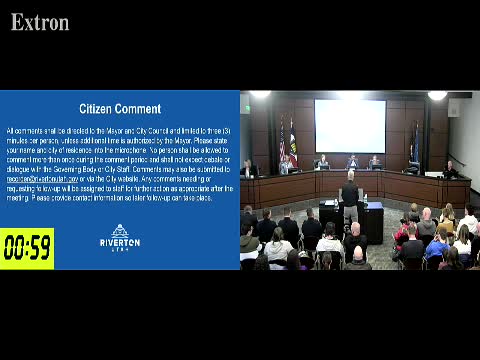
Several public commenters, several of them former or current firefighters, urged the council to keep four‑person crews. Darren Park told councilors the city should require a minimum four‑person crew on any fire apparatus assigned to a Riverton station, arguing that departures from that standard would raise the risks to residents and firefighters and could increase insurance costs. Former Salt Lake City firefighter Ed Endemanno cited NFPA guidance and said larger initial response crews improve outcomes: “A minimum of 16 people show up to a basic house fire. That’s 4 on each apparatus to the first 4 arriving apparatus.” Another former firefighter, Dave Park, described the operational and morale consequences of reduced crews and urged the council to preserve current staffing levels.
Council members said the public comments and UFA briefings informed their decision. Council member Broeker moved — and Council member McDougall seconded — a motion to approve two resolutions maintaining four‑person staffing at Stations 121 and 124. The council then adopted the resolutions by roll‑call vote; all recorded votes were “yes” (Council members Perucci, McDougall, McKay, Broker, Hammond and others recorded affirmative votes).
City staff had flagged that special‑operations capability — heavy rescue and Hazardous Materials (HazMat) response — and ambulance coverage are affected by staffing reductions: the special teams are organized regionally and rely on staffing across units. Staff and UFA leaders warned that reducing crew sizes at those stations could also reduce ambulance availability and complicate regional special‑operations responses.
The council’s action preserves current service levels; staff and UFA will continue to present budget alternatives and long‑term funding options, and councilors asked staff to examine whether other budget choices or revenue strategies could address anticipated fiscal pressures while maintaining service levels.
The council’s formal adoption of the two resolutions was the final step after months of committee briefings and public comment; the resolutions will be recorded in the minutes and implemented within UFA’s staffing model.