Get Full Government Meeting Transcripts, Videos, & Alerts Forever!
Get email alerts on the Wildland Urban Interface topic
No spam. Unsubscribe anytime.
County staff previews wildfire‑risk ordinance based on 2021 WUI code; public education planned
Summary
County staff introduced the wildland‑urban interface topic to council, explained proposed building and fire code changes, and said an educational public meeting and formal ordinance introduction are expected in coming weeks.
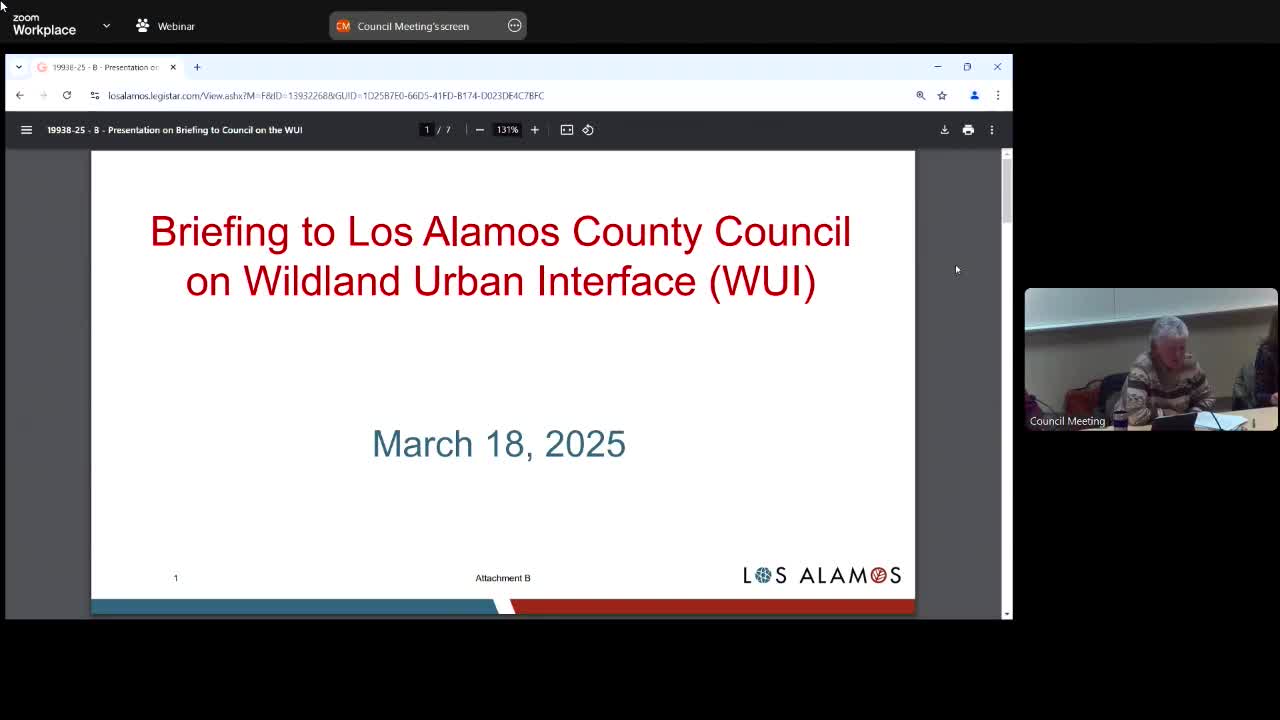
County planning and fire officials gave council an introductory briefing on March 18 about a draft wildland‑urban interface (WUI) ordinance that would update Los Alamos County building and fire codes to the 2021 International WUI code standards.
Juan Veil, the planner who led the presentation, said the briefing was intended to collect council and public input rather than to adopt the ordinance that night. He introduced a panel including David Martinez, the countychief building official, and Kelly Stern, wildland division chief for the Los Alamos County Fire Department, and Acting Fire Marshal Cordova.
Martinez summarized proposed Chapter 5 (building) provisions from the 2021 WUI code. Key items described include requiring Class A roof coverings (ASTM E108 or UL 790), ignition‑resistant or approved noncombustible exterior wall methods or 1‑hour fire‑resistance construction in critical locations, enclosed underfloor areas and standards for accessory structures and projections (decks, porches, balconies). Detached accessory structures within 50 feet of habitable buildings would be required to meet higher exterior material standards.
Chief Stern explained the fire‑protection and defensible‑space approach the department favors: reducing ignition potential from ember showers, promoting "defensible space" practices (noting the 0‑to‑5‑foot zone immediately around structures should be cleared of combustible materials), and expanding home assessment outreach. Stern said the county's home assessment program has grown recently from six assessments in a year (March 2023–2024) to dozens in March 2025 alone; the department reported about 700 total assessments to date.
Staff emphasized their intent that the ordinance be safety‑oriented rather than punitive: they proposed an educational public meeting and then a formal introduction as early as April with a possible public hearing in May; a 30‑day appeal period would follow before final adoption. Staff also noted they do not plan to require permits for small items such as gutters and downspouts that are not normally permitted today, but that work requiring permits (for example, deck replacements or new accessory structures within 50 feet of a home) would be reviewed under the new standards.
Councilors asked practical questions about how the code affects existing homes and developers, the rationale for sprinkler thresholds in taller multifamily buildings, and whether adoption would help residents keep private insurance. Staff said the ordinance is intended to bring county standards in line with the WUI code, restore some requirements that had been removed after Cerro Grande, and provide guidance and assessments that insurers may use when evaluating risk, but acknowledged that insurers retain discretion over underwriting decisions.
Why it matters: Wildfire risk and homeowner insurance issues were raised repeatedly by residents and council members. The proposed ordinance would change construction standards for new and permitted work, expand defensible‑space guidance and formalize county code language aligned with widely used national WUI standards.
Sources: Presentation by Juan Veil, David Martinez and Kelly Stern at Los Alamos County Council work session, March 18, 2025.