Get Full Government Meeting Transcripts, Videos, & Alerts Forever!
Get email alerts on the Emergency Management topic
No spam. Unsubscribe anytime.
Beaverton emergency manager outlines activations, volunteer capacity and plan to formalize interdepartmental steering group
Summary
Beaverton emergency manager Nicole Cutchan told the city council the office logged nine emergency operations center activations in eight months, described volunteer capacity and training, and outlined a steering committee and FEMA-aligned staffing changes to improve readiness.
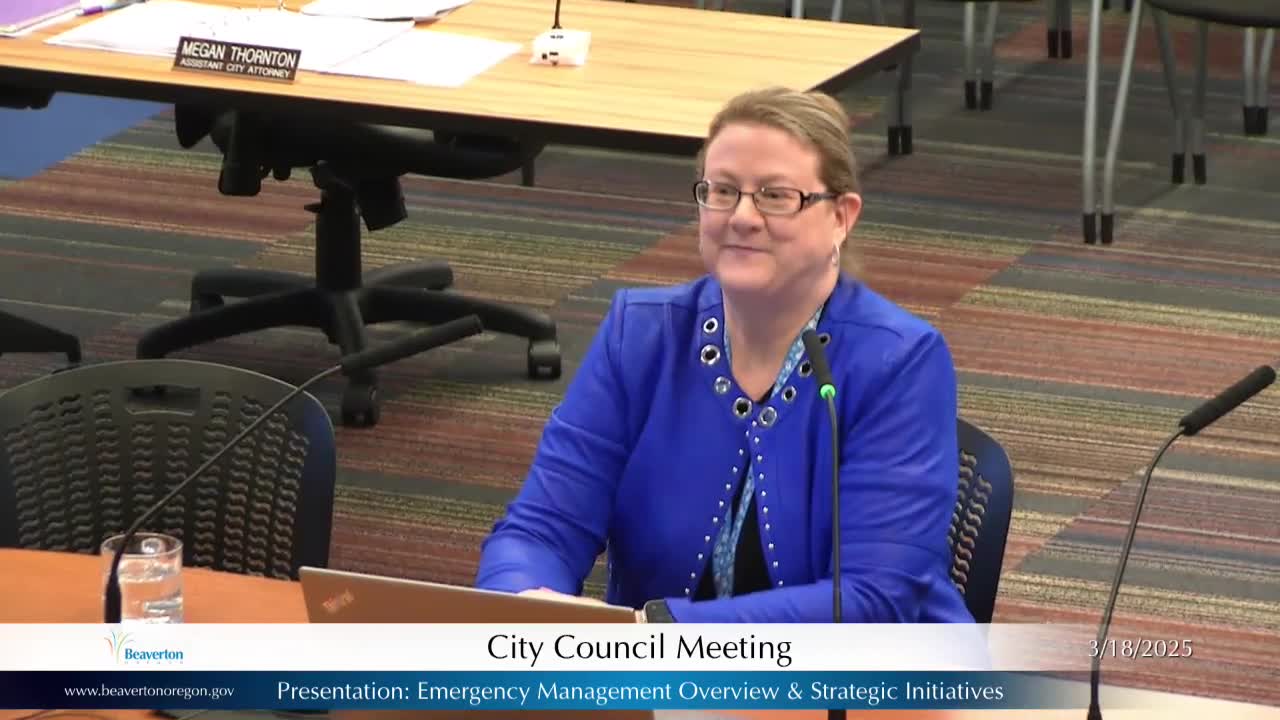
Nicole Cutchan, Beaverton’s emergency manager, told the City Council that Emergency Management has activated the city’s Emergency Operations Center nine times in the past eight months and is working to strengthen planning, staffing and partnerships.
Cutchan said the nine activations included weather events (severe thunderstorms and extreme winter weather), two severe heat incidents, an activation for an air-quality event during a parade, a citywide exercise and a response to a threat incident at a middle school. “Emergency Management is now under the Police Department,” Cutchan said, and described duties that include monitoring, coordinating warnings, supporting first responders and readying volunteers to staff cooling or warming centers.
The presentation listed volunteer capacity and training as core capabilities. Cutchan said volunteers logged about 3,871 hours over the past year and 157 unique volunteers took part in 112 events. She said 234 volunteers are ham radio certified and that the city’s Community Emergency Response Team (CERT) and the Beaverton Emergency Radio Team supported events, staffed cooling centers and helped with family reunification during a school threat incident.
Cutchan reviewed strategic recommendations from a recent Stantec emergency management assessment, including creation of a formal Emergency Management Steering Committee (Beaverton Emergency Services Operations Group, “BESOG”) to coordinate plan updates and after-action reports across departments. She outlined plans to reorganize the Emergency Operations Center staffing under FEMA guidance and ensure EOC staff receive FEMA National Qualification System training.
Cutchan said Emergency Management is pursuing regional grants through the Regional Disaster Preparedness Organization (RDPO) and other partners to improve radio coverage in Cooper Mountain and to support outreach to the city’s culturally diverse communities. She described ongoing outreach work — focus groups with the Iranian community, preparedness presentations for older adults and work with Centro de Bienvenido — and a proposed volunteer outreach grant application for $10,000.
Council members questioned operational definitions and cultural competency for volunteers. Councilor Duggar asked, “What constitutes an emergency?” Cutchan replied that a general rule is events that exceed day‑to‑day resources and require outside support. Councilor Hartmeyer Prigg pressed on culturally responsive training for volunteers; Cutchan said disaster psychology training exists and that staff have begun focus groups to tailor outreach and build trust with immigrant and refugee communities.
Councilor Teeter and others encouraged stronger public–private partnerships; Cutchan noted ongoing engagement with the Beaverton Area Chamber of Commerce, Nike and regional public‑health and emergency partners. She also described staffing plans: the emergency management office is seeking a deputy emergency manager and is considering internships and temporary programs (including DOD SkillBridge) to augment capacity.
Councilors thanked Cutchan for the presentation and asked staff to return with follow-up details on training, the steering committee membership and grant timelines.