Get email alerts on the Coliseum Redevelopment topic
No spam. Unsubscribe anytime.
Dane County committee approves RFP framework to guide Coliseum renovation
Summary
A county committee voted to move forward with an RFP-style solicitation focused on renovating the Veterans Memorial Coliseum at the Alliant Energy Center, while reserving flexibility for respondents and flagging fiscal constraints, housing questions and county-ownership limits.
Dane County’s Alliant Energy Center redevelopment committee voted to proceed with a request-for-proposals framework aimed at renovating the Veterans Memorial Coliseum, committee members said at a meeting that reviewed RFP parameters and next steps.
The committee approved a motion to advance the framework after a discussion that emphasized a focused solicitation for Coliseum renovation, asked respondents for financial projections that separate Coliseum costs, and left limited room for optional campus-wide elements such as housing or additional development.
The framework, as presented by Kevin, director of the Alliant Energy Center, makes renovating the Coliseum the primary focus while allowing respondents to propose complementary improvements elsewhere on the campus. “We view this as a complete interior renovation of the Coliseum as our primary focus,” Kevin said, adding that proposals must include financial projections and partnership details. Kevin said the county will “maintain ownership of the land” and that proposals should address parking, operations and how current clients will be accommodated during construction.
Why it matters: The Coliseum renovation is intended to make the venue more active year-round and to preserve the Alliant Energy Center’s role in hosting multi‑day shows that drive substantial economic activity for the county. Committee members repeatedly raised the need for fiscal constraints, clear scoring criteria and a requirement that respondents return an apples‑to‑apples cost for the Coliseum renovation alone so evaluators can compare proposals.
Discussion highlights
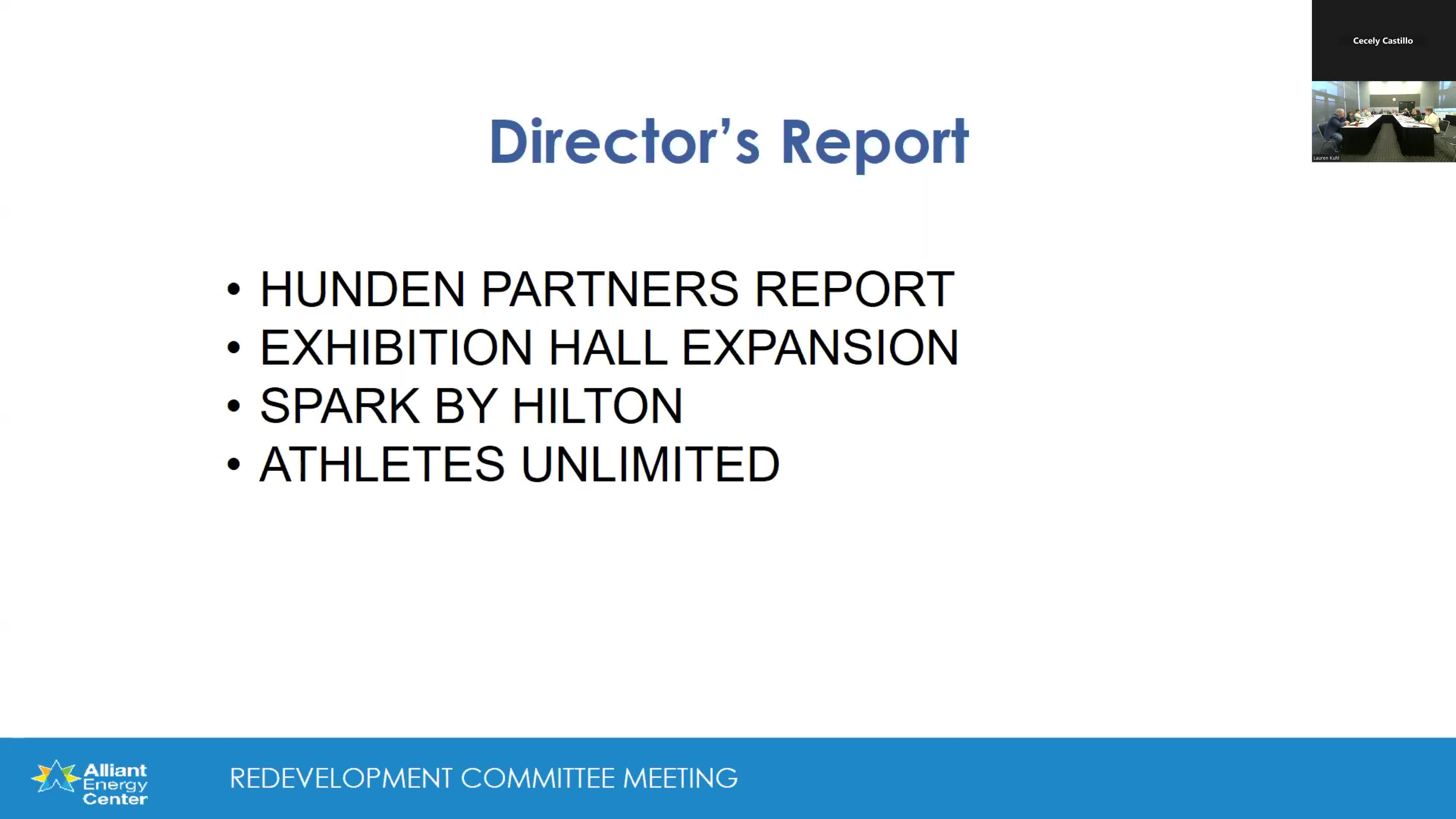
• Financial projections and scope. Kevin said consultants Punden (and an additional review being proposed by Hundden) would reexamine cost estimates and financial projections; the supplemental review is expected to take about six weeks and cost roughly $50,000. Kevin also said the Coliseum could be expected to host “at a minimum 120 events a year” if revitalized. Committee members urged that every proposal clearly separate the Coliseum-only renovation cost from any campus-wide elements so the county can compare proposals directly.
• RFP vs. RFI debate. Several members—including a committee member identified as Ellie—said they favored an RFI (request for information) or at least stronger fiscal guardrails because RFIs can attract more exploratory, lower‑burden responses. Ellie said she “remain[s] really cautious” that proposals could be much more expensive than public resources allow. Leadership described the document as a hybrid intended to solicit credible, actionable proposals while permitting respondents to suggest additional value-add elements.
• Ownership, leases and development. The draft parameters state the county would retain ownership of the land and existing buildings unless otherwise negotiated. Committee members discussed whether that stance should be flexible for certain quadrants or future new construction (for example via land leases, which exist elsewhere on the campus). One member noted that new construction on parcels could be owned by the developer and simply sit on county land under a lease structure.
• Housing and public subsidy. City and committee representatives raised housing as a potential generator that could support financing tools like tax increment financing, but event operators cautioned that on‑campus permanent housing could conflict with large events that use most of the site. The RFP language does not close the door on housing; it leaves the option open but asks respondents to acknowledge operational challenges and to include mitigation strategies if housing is proposed.
• Local labor and existing events. The county executive prioritized local labor for construction and operations; the RFP parameters ask respondents to address labor and to show how their plan would protect or continue existing multiday shows such as World Dairy Expo and other long‑lead events that generate significant economic activity. A Destination Madison representative asked that proposals demonstrate how they will support multi‑day shows that book years in advance.
Committee process and next steps
Committee members asked for final edits to the draft RFP; Kevin said the committee would review a final draft and that representatives from the committee would sit on any review panel that analyzes proposals. Chair Patrick Miles noted the county executive’s desire to move quickly and said the County Board would later need education and a vote when contract execution is required. Kevin said the additional consultant review (the Hundden scope) could be available by April, and staff expect to return to the committee with a revised draft in advance of an April meeting.
Formal actions
Two formal actions recorded during the meeting were: approval of the February 24 meeting minutes and approval of the RFP framework with edits and suggestions captured during the discussion. The motion to advance the RFP framework passed; mover and second were not specified in the transcript extract.
Ending
Committee members asked staff to distribute the revised RFP language for review ahead of the next meeting; staff said they would provide an updated document and confirmed the committee will participate in proposal review if the RFP is released. The committee scheduled follow-up work and noted that the County Board will need a presentation and likely a committee‑of‑the‑whole session before any contract is executed.
AI generated
The text on this page is AI generated. Summaries, highlights, analysis, and video transcripts are all produced from the original source material.
AI can make mistakes, so if you spot one, and we will fix it for everyone.
Note: the source content is unaltered by us. Any content source we link to, be it a video, an audio recording, or a document, is presented exactly as its publisher released it. That publisher is usually a government body, sometimes an individual official or another organisation.