Get Full Government Meeting Transcripts, Videos, & Alerts Forever!
Get email alerts on the Workplace Safety Mask Rights topic
No spam. Unsubscribe anytime.
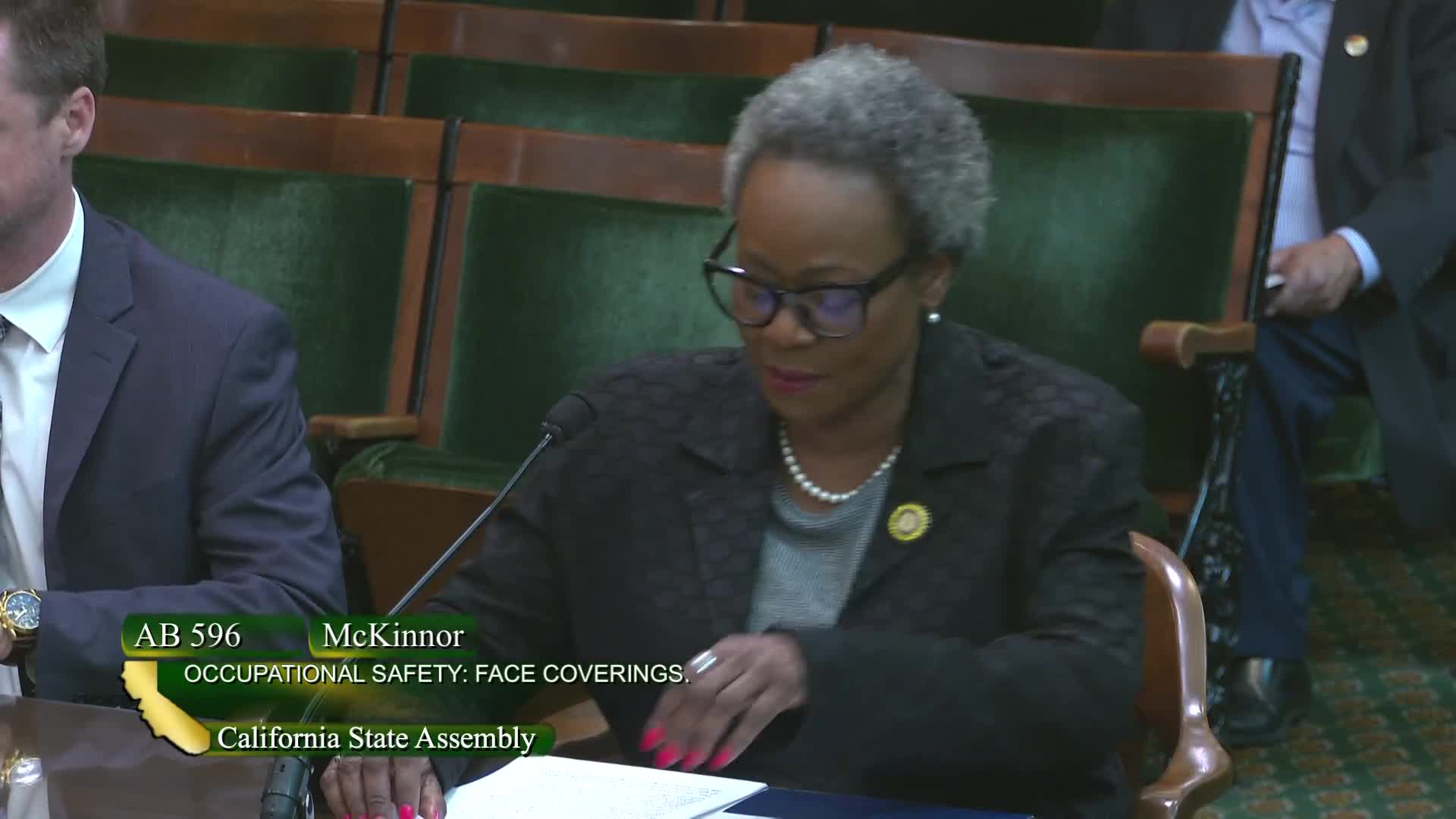
Assembly committee sends AB 596 to appropriations to preserve workers' right to wear face coverings
Summary
The Assembly Labor and Employment Committee voted March 19, 2025 to refer AB 596 to the Appropriations Committee. The bill would codify employees' right to wear a face covering at work unless doing so creates a direct safety hazard, preserving protections that had been in Cal/OSHA guidance.
A member presented AB 596 to the Assembly Labor and Employment Committee on March 19, 2025, and the committee voted to refer the bill to the Appropriations Committee.
The bill would make explicit that employees may wear a mask or respirator at work unless the employer demonstrates the face covering creates a direct safety hazard for the worker or workplace operations. The presenter said the measure "does not impose new cost on employers. It simply preserves an existing right that has helped keep workers safe and empowered." The presenter urged support to protect workers from airborne illnesses and air-quality hazards such as wildfire smoke, and said the proposal preserves protections that expired when Cal/OSHA standards lapsed in February 2025.
Tim Steed, assistant general manager at the Orange County Employees Association, told the committee the union represents about 18,000 public servants and that members want the option to wear masks for many reasons, including protecting immunocompromised family and reducing exposure to wildfire smoke. He said, "Until recently, our members were able to wear masks in the workplace as a part of the COVID 19 safety standard." Elmer Lazard of the California Federation of Labor Unions said the bill would protect workers from both respiratory viruses and smoke inhalation and that workers should be able to protect their own health.
The California Chamber of Commerce provided narrow opposition, represented by Robert Moochrie, who said the chamber agreed with the benefits of masks but asked the author to add narrow feasibility exceptions for specific moments or duties where masks may be infeasible, noting the original COVID-19 regulation contained limited exceptions for infeasible tasks.
Committee members expressed appreciation for stakeholder engagement and support for further language work; the committee moved AB 596 to Appropriations.
The author said she will continue talks with stakeholders to refine language and address feasibility concerns raised by business groups.