Get Full Government Meeting Transcripts, Videos, & Alerts Forever!
Get email alerts on the Wage Theft Enforcement topic
No spam. Unsubscribe anytime.
Assembly advances bill to deny licenses to employers with unpaid wage theft judgments
Summary
The Assembly Labor and Employment Committee voted March 19, 2025 to send AB 485 to the Appropriations Committee. AB 485 would allow state agencies to deny issuance or renewal of business licenses to employers with outstanding wage theft judgments unless they obtain a surety bond or otherwise satisfy the judgment.
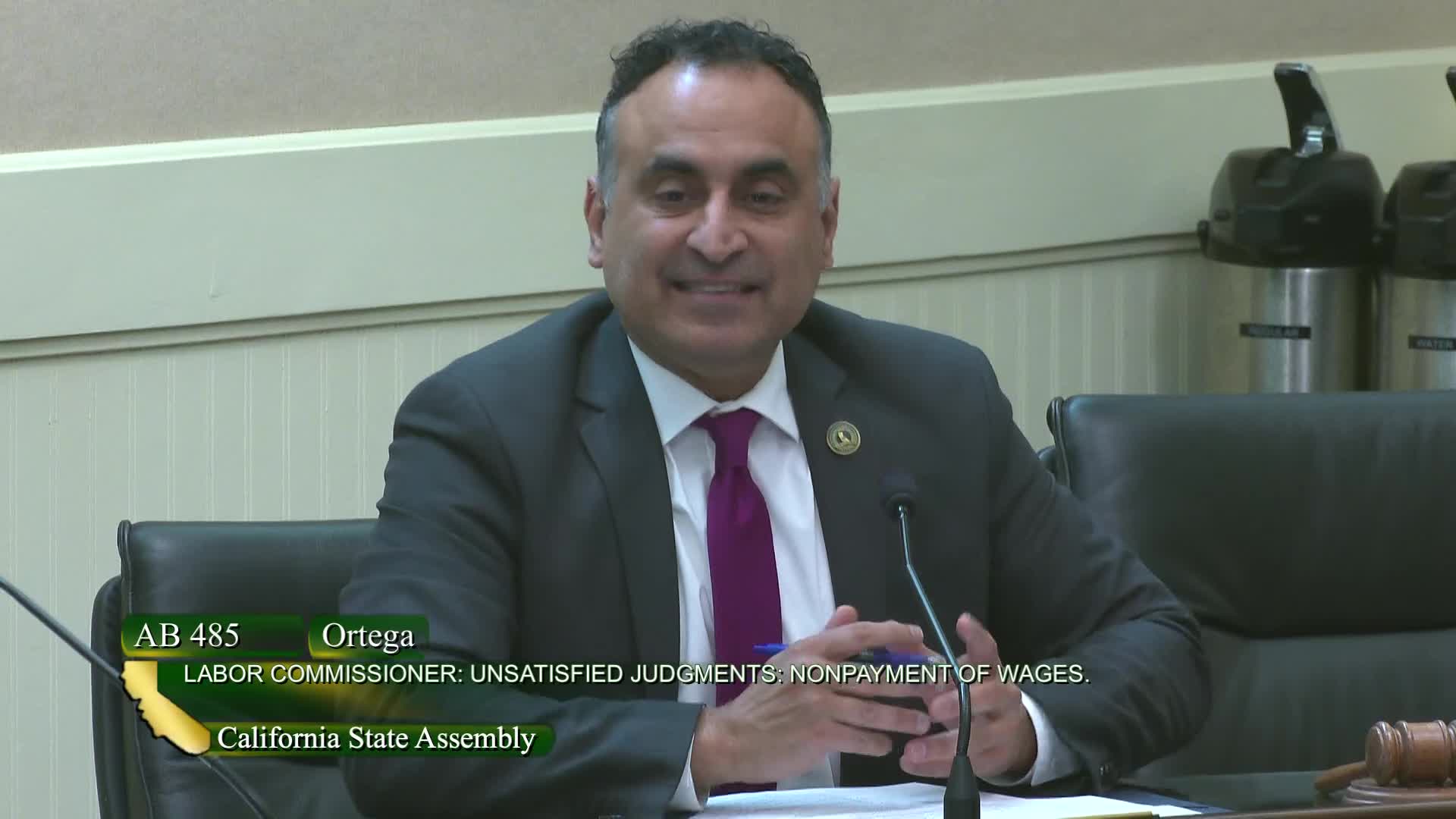
Chair Ortega presented AB 485 on March 19, 2025 and the committee voted to refer the bill to the Appropriations Committee.
AB 485 aims to increase enforcement of wage theft judgments by creating a licensing consequence: state agencies would deny new licenses or renewal of licenses for employers with outstanding wage-theft judgments unless they secure a surety bond or reach an accord that satisfies the judgment. Ortega said the intent is not to close businesses but to create an effective enforcement mechanism to ensure employees can recover stolen wages.
Ortega cited state audit and press reporting to describe the enforcement gap: she said the Labor Commissioner’s judgment enforcement unit recovered the full amount in just 12% of referred cases between 2018 and 2023 and that one investigation found employers paid only one in seven court-issued judgments. Teresa Brillante, speaking for the Santa Clara County Wage Theft Coalition, described her personal experience filing a wage theft claim and noted many workers who win judgments still cannot collect. Brillante said, "We need AB 4 85 so care homeowners that if they don't pay wage theft claims, they won't be able to get a license from the state to open a business and won't be able to renew their license."
Supporters included the California Nurses Association, the California State Association of Electrical Workers, the California Federation of Labor Unions, SEIU California and worker-advocacy groups. Opponents included the California Hospital Association, which expressed "regrettable opposition," saying it feared risking a hospital's license and thereby threatening patient access to care.
Committee members expressed support for stronger enforcement tools to help workers collect judgments and noted the Santa Clara County program that denies or suspends permits has produced payments in most cases. The committee moved AB 485 to the Appropriations Committee; the roll call included Ortega and other members recorded as voting in favor, with one member recorded as not voting.
The author said she will continue to work with stakeholders on technical language and welcomed coauthors.