Get Full Government Meeting Transcripts, Videos, & Alerts Forever!
Get email alerts on the Public Procurement topic
No spam. Unsubscribe anytime.
Committee approves 120‑day notice bill for contracting out bargaining‑unit work
Summary
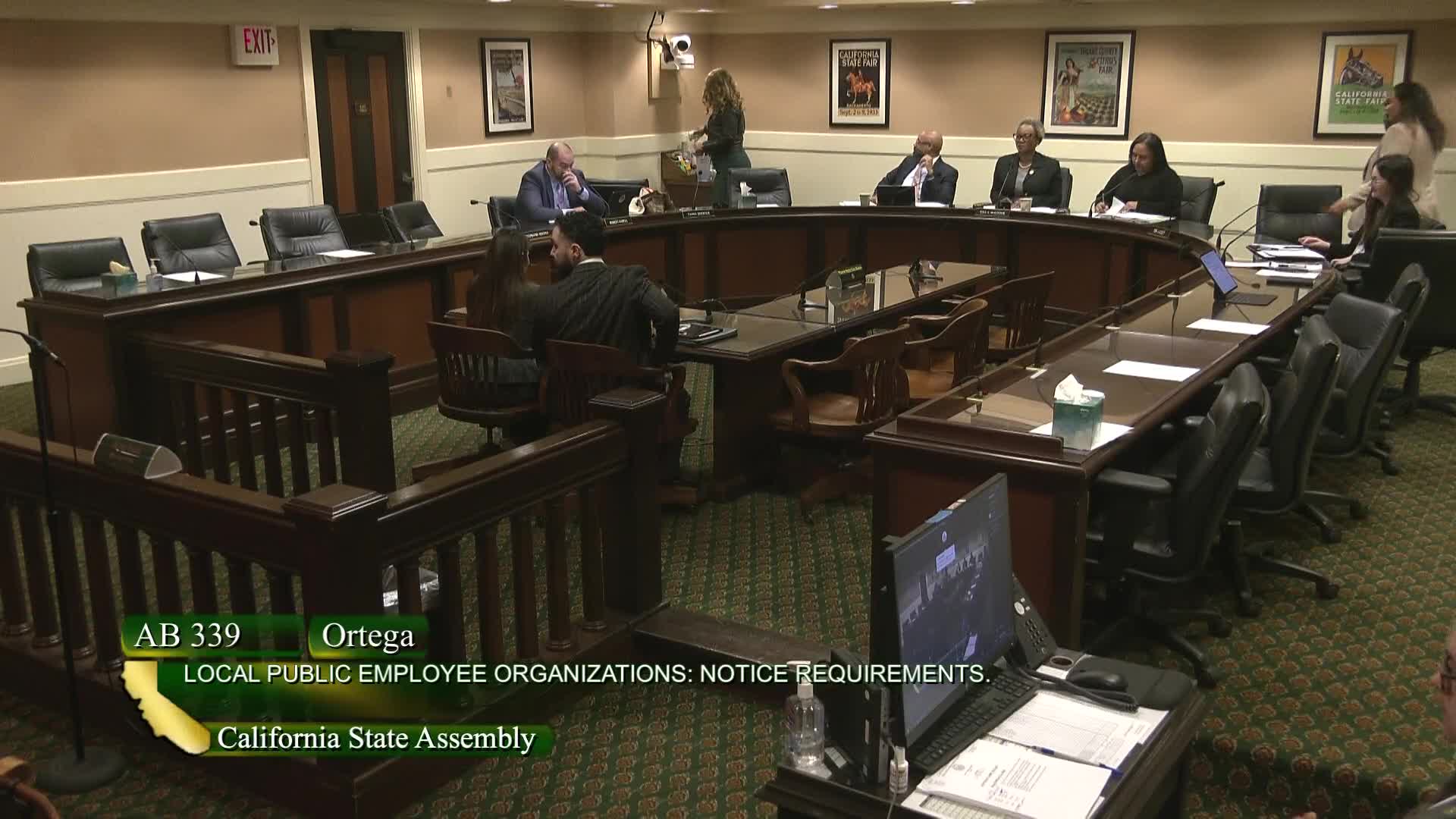
AB 339 would require local governments to notify unions 120 days before starting an RFP/RFQ that would contract out bargaining‑unit work; committee advanced the bill after robust support from unions and opposition from local governments.
AB 339 would require local governments to provide unions notice 120 days before initiating an RFP or RFQ to contract out bargaining‑unit work. Supporters described the bill as a transparency measure to give affected employees and unions meaningful time and information to bargain over contracting decisions. “The 120 day notice requirement doesn't create new bargaining rights. It ensures existing ones have real meaning,” said Bridal Miramontes of AFSCME California.
Union witnesses and labor organizations characterized current practices as short notices that make bargaining largely symbolic. Opponents — including the League of California Cities, Urban Counties of California, county boards of supervisors and other local‑government groups — said AB 339 would impede managers' ability to run efficient operations, expand the scope of notice well beyond current MMBA practice and could create practical procurement conflicts. City and county witnesses said existing remedies under the Meyers‑Milias‑Brown Act (MMBA) and PERB already address failures to bargain in good faith.
The author argued the bill merely formalizes notice information that procurement planning already produces and includes emergency exceptions. After debate and public testimony, the committee moved the bill; the author’s motion passed and the clerk announced it would be referred to the Committee on Appropriations. The clerk’s hearing summary shows a final recorded partial tally of 4‑0 with two members (Alanis and Wynn) not voting at the time the clerk closed the roll; the chair placed the bill on hold for add‑ons.