Get Full Government Meeting Transcripts, Videos, & Alerts Forever!
Get email alerts on the Government Behavior topic
No spam. Unsubscribe anytime.
Waller County constable raises access and treatment concerns after being denied vehicle service at Road & Bridge
Summary
Constable Herschel Smith urged commissioners to treat elected officials and staff equitably after a dispute over vehicle servicing at the county Road & Bridge shop led to a yearlong disagreement and public comments alleging inconsistent notification and due‑process failures.
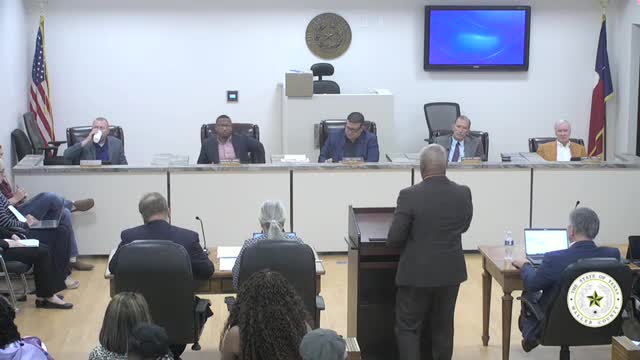
Constable Herschel Smith told the Waller County Commissioners Court on March 19 that he was denied service for a county vehicle by county Road & Bridge staff in February 2024 and later received an email from engineer Ross McCall instructing him to use outside vendors. Smith said he had used Road & Bridge for vehicle service for 12 years without issue and asked the court to place the matter on a future agenda as an action item so it could be resolved.
Smith said he paid county taxes, is an elected official, and that he had not been given an opportunity to respond to the allegations that prompted the engineer’s memo. He described the resulting posture as a denial of due process and said efforts to arrange a private meeting after last year’s election were unsuccessful. Several speakers during the extended public discussion echoed concerns about process and respectful treatment.
Ross McCall, county engineer, told the court he had acted after employees reported feeling unsafe and that, following a reorganization of vehicle maintenance earlier this year, the sheriff’s maintenance division assumed responsibility for county public‑safety vehicle upkeep as of Feb. 15. McCall said he was carrying out his duty as a department head to ensure a safe workplace and that, where needed, constable vehicles should use outside vendors pending clarification of the maintenance arrangements.
Sheriff’s staff said the sheriff’s office has been taking on maintenance and logistics for law‑enforcement vehicles while the county builds a centralized maintenance shop, and that deputies and other public‑safety staff have been assigned locations for service. The sheriff also said there had been interim operational challenges such as appointment scheduling and invoice reconciliation during the changeover.
Multiple public commenters — including elected officials, a retired HR professional and community members — urged transparent communication and full due process when employees report safety concerns. One commenter, who described past personnel actions and what she called a pattern of complaints involving Black men and Road & Bridge staff, urged the court to investigate whether bias or structural problems exist. Others urged sensitivity training and clearer written communication from department heads to all affected offices.
Commissioners and staff agreed to pursue a resolution and suggested a private meeting to attempt to reconcile outstanding issues and to clarify vehicle‑maintenance procedures going forward. Several commissioners also suggested considering dedicated maintenance budgets for constables to reduce friction over where and how county vehicles receive service.
The court took no formal disciplinary action in public session; the matter was discussed at length, and commissioners directed staff to follow up and bring options back to court, including clearer notification practices when maintenance procedures change and potential sensitivity or procedural trainings.