Get Full Government Meeting Transcripts, Videos, & Alerts Forever!
Get email alerts on the Sb54 topic
No spam. Unsubscribe anytime.
CalRecycle delays SB 54 regulation release; lawmakers press agency for timeline and details
Summary
CalRecycle told the subcommittee it will reinitiate rulemaking for SB 54 after reviewing public comments and stakeholder input; lawmakers and advocates pushed for a clearer timeline, citing the statute's deadlines and the public trust implications of the delay.
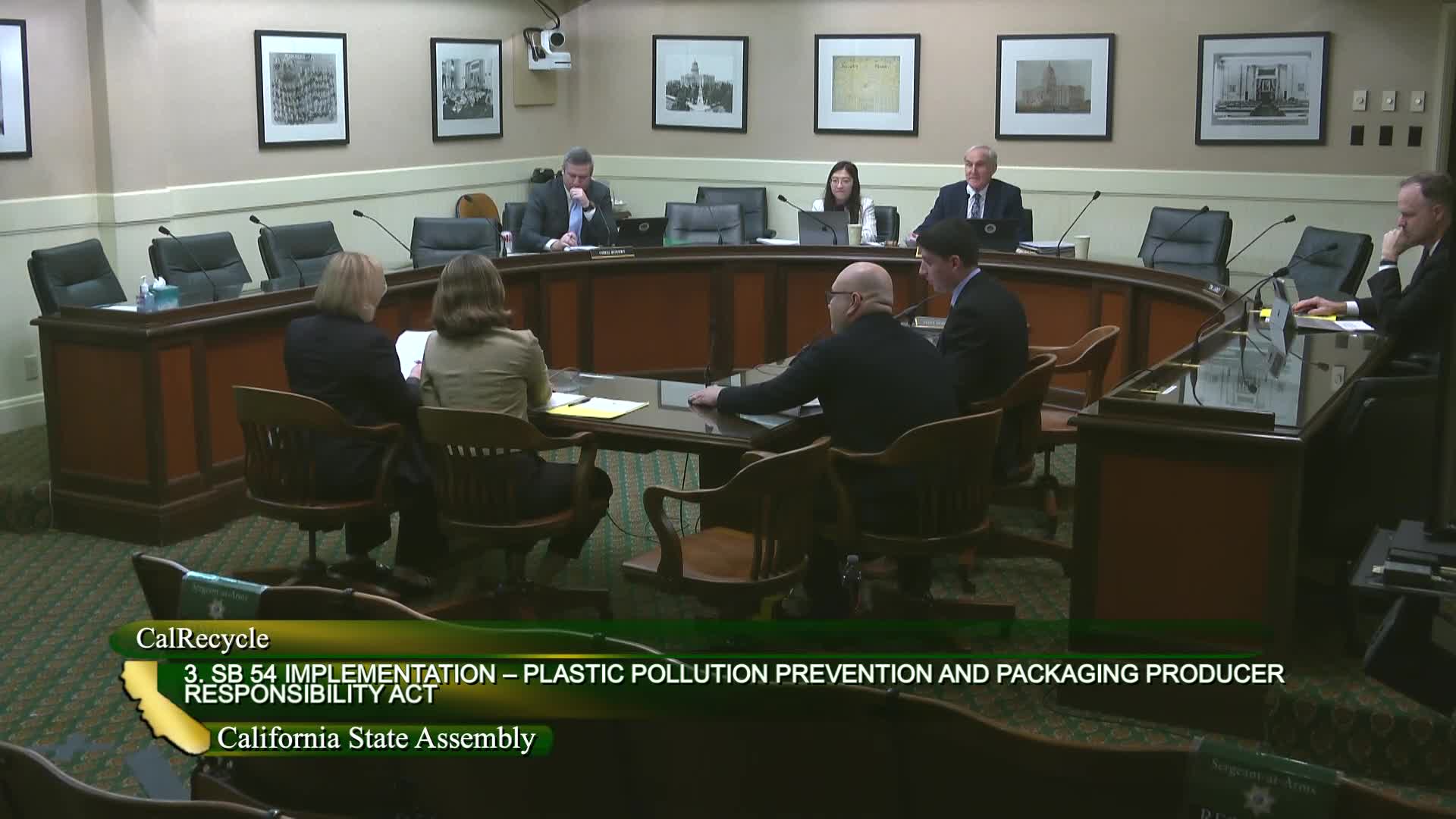
CalRecycle officials told the Assembly Budget Subcommittee No. 4 that the agency is pausing the previously issued SB 54 regulatory package in order to consider extensive stakeholder comments and to reinitiate the public rulemaking process. Lawmakers pressed the department for a concrete timeline and for an explanation of what portions of the regulations require additional work.
Mindy McIntyre, chief deputy at CalRecycle, summarized the agency's SB 54 implementation steps to date: seven informal workshops in 2023, stakeholder advisory work, a Circular Action Alliance appointment as the producer responsibility organization (PRO) and an adopted report establishing a 2023 baseline for single-use plastic packaging. She said CalRecycle initiated formal rulemaking in March 2024 and held public comment periods, but the agency will reopen regulatory work to address the volume of comments and complex, novel elements of the statute such as source reduction and an eco-modulated fee.
Lawmakers repeatedly asked CalRecycle to provide specifics about which regulation components prompted the delay and whether the department expects to meet statutory deadlines for producer plans and targets. CalRecycle said it remains committed to the statutory timeline that requires the PRO to deliver an initial plan by January 1, 2027, and stated a goal of having regulations in place well ahead of that date to give the PRO guidance for its planning. CalRecycle acknowledged the complexity: "It is by far the broadest and biggest EPR program we have ever implemented," a CalRecycle official said.
Committee members pressed CalRecycle to provide anticipated completion dates and to explain how regulatory delays could affect fund sources used for interim work. Department of Finance officials said loans from the Beverage Container Recycling Fund (BCRF) had been used to support regulatory work and that the fund is in a strong position (CalRecycle reported an end-of‑prior-year balance around $889,000,000 and projected $455,000,000 at the end of 2024–25), but legislators said they will seek a firm regulatory timeline and more detailed justification for any delay.
Advocacy groups at public comment urged the legislature to keep pressure on the administration to adopt rules that implement SB 54's source-reduction and producer-responsibility mandates without allowing hazardous technologies such as chemical recycling to meet recycling targets.
The subcommittee did not take votes; members requested a clearer schedule and additional briefings ahead of the May revise and final budget process.