Get Full Government Meeting Transcripts, Videos, & Alerts Forever!
Get email alerts on the Education Policy Enforcement topic
No spam. Unsubscribe anytime.
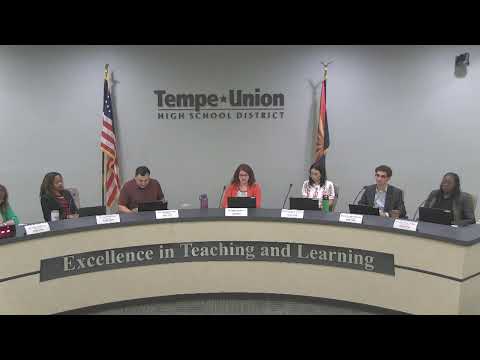
Tempe Union board approves first reading of campus-enforcement procedures after public comment
Summary
The governing board approved a first reading of policy G1 to establish procedures for handling visits by enforcement officers to campus. The vote was 5-0; board members emphasized the item is procedural and will return for a second reading and adoption on March 5.
The Tempe Union High School District governing board voted 5-0 to approve the first reading of policy G1, which the district described as procedures for when enforcement officers come to school campuses.
During public comment, Jim Caron, who identified himself as a long-time Tempe resident, said he opposed the board moving in a direction that, in his view, would ignore federal immigration enforcement. “What this is about essentially is nothing more than just following the rule of law,” Caron said. He asked the board to set an example for youth by following existing law.
Board member Montero responded to the public comment and to the community by saying the policy is intended to clarify procedures, not to refuse legal compliance. “I wanna make sure that it's crystal clear to the community, that this is not a matter of whether we are following the law or not following the law,” Montero said. She described the policy as “simply putting procedures in place of when students are, or when enforcement officers come to campus — who is notified, how they're notified, and how the families and students know their rights in these situations.”
District legal counsel and staff noted the item was being presented as a first reading under board policy BGB; the board will bring the proposal back for a second reading and possible adoption at its next meeting. President Barraza led the motion to approve the first read; the board voted to advance the item by voice vote, recorded as motion passes 5-0.
The first-read approval does not adopt the policy; board members repeatedly framed the action as advancing procedures to a second reading. The board did not take related enforcement actions at the meeting; any substantive changes to district practice will depend on the content of the second-reading draft and any further legal recommendations.
The board scheduled the second reading and potential adoption for the March 5 meeting.