Get Full Government Meeting Transcripts, Videos, & Alerts Forever!
Get email alerts on the Transportation Infrastructure topic
No spam. Unsubscribe anytime.
MDOT outlines road-building process, funding, warranties and new roadway technology to House subcommittee
Summary
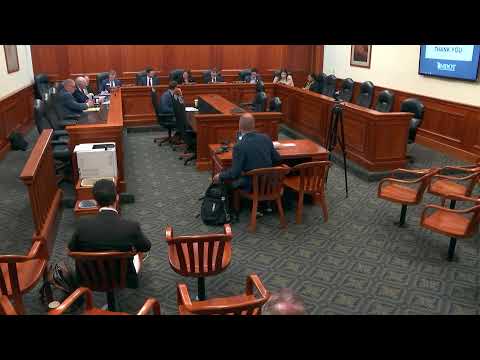
Greg Brenner, Michigan Department of Transportation chief operations officer and chief engineer, told a House appropriations subcommittee that MDOT manages the planning, financing, permitting and construction oversight for the state’s road and bridge projects and outlined how funding, procurement and warranties operate.
Greg Brenner, Michigan Department of Transportation chief operations officer and chief engineer, told the Michigan House Appropriations Subcommittee on State and Local Transportation that MDOT oversees the planning, design, permitting, construction and closeout of major road projects across the state.
The presentation on MDOT’s road-building lifecycle covered agency organization, the Michigan Transportation Fund and Act 51 distributions, federal aid rules and procurement practices, permitting with the State Historic Preservation Office and the Department of Environment, Great Lakes, and Energy, financing and pavement-condition trends, warranties on construction, and pilots for intelligent-transportation systems and other innovations.
MDOT’s role, funding and scale
MDOT manages about 10,000 miles of state routes and roughly 4,800 bridges, Brenner said, while the state has about 122,000 miles of public roads and nearly 12,000 bridges in total. The Michigan Transportation Fund, MDOT’s primary state funding source, brings in roughly $3.8 billion per year, primarily from vehicle registration fees and fuel taxes; that amount is supplemented by federal aid.
By law (Act 51), MDOT receives a share of federal and state funding for state routes; Brenner said approximately 55 percent of the Michigan Transportation Fund is directed to local and county roads under current allocations and that the federal-aid split by statute assigns 75 percent to MDOT and 25 percent to local roads for federal-aid eligible routes.
Project lifecycle, procurement and consultants
Brenner said MDOT’s standard procurement method for construction contracts is low-bid, with projects broken into pay items (for example, dollars per ton of asphalt). He described unbalanced-bid reviews and itemized pay schedules that, in his account, ensure contractors meet specifications and that the low-bid process “levels the playing field.” He added that MDOT uses quality-based selections for certain innovative delivery methods such as design-build.
About half of MDOT’s work is performed by consultants, Brenner said, noting the department lacks sufficient in-house FTEs to cover peak workloads and relies on consulting firms for design and construction oversight.
Permitting, environmental timing and local utility coordination
Brenner identified the State Historic Preservation Office (SHPO) and EGLE as the two main permitting agencies MDOT engages for cultural- and environmental- resource reviews and said MDOT seeks to coordinate with those agencies early in project scoping to avoid seasonal work restrictions (for example, bird-nesting or fish-spawning windows) that can affect construction start dates. “I can’t control birds mating, but no,” Brenner said when asked whether permitting-related delays are frequent; he added such delays are the exception and that MDOT tries to set construction schedules in scoping to mitigate them.
On utilities, Brenner said sanitary sewer and water mains are generally municipal-owned and that MDOT coordinates with local utilities multiple years in advance—often as part of the five-year program—so road reconstruction can be scheduled to avoid repeated cuts in a newly resurfaced road.
Pavement policy, warranties and preventive maintenance
Brenner described MDOT’s use of life-cycle cost analysis for pavement material selection on projects with pavement costs above $1.5 million; projects where concrete and asphalt costs are within 10 percent of each other can be let with alternate bids for both materials. He said MDOT’s capital preventive maintenance (CPM) program uses targeted, earlier interventions—such as thin overlays or crack sealing—to extend pavement life instead of a “worst-first” replacement approach.
MDOT administers warranties on construction projects (started under Public Act 175 of 2015 and originally from 1997). Brenner said the department has issued about 5,000 warranties to date, with roughly 600 currently active; he estimated approximately 12 percent of warrantied projects later require corrective action short of full reconstruction. He described two common warranty types: materials-and-workmanship warranties (typical for reconstruction) and performance warranties (common for CPM overlays and bridge painting). Materials-and-workmanship warranties typically run three to five years; many performance warranties run two to three years.
Quality control and cost performance
Brenner said MDOT’s oversight practices—inspectors in the field, material testing, measurement-and-payment processes and the e-Construction system that replaced paper plans—help keep final project costs close to original estimates. He said that, in his view, MDOT’s typical final project costs are generally within about 1 percent of original estimates, notably tighter than many other states.
Innovation and intelligent transportation systems
MDOT is piloting several roadway and work-zone technologies, Brenner said. Examples he described include a three-mile pilot to support autonomous-vehicle operations near an airport, a wrong-way driving alert system in Metro Detroit, and “smart arrow boards” and in-vehicle construction alerts that can communicate with in-dash navigation systems and apps. Brenner said MDOT partners with industry associations and with private vendors for these pilots and is active with ITS America and other national groups.
Committee action
At the meeting’s close Representative Robinson moved to adopt the minutes of the March 5 meeting; the subcommittee adopted the minutes by unanimous consent, the chair announced.
Why it matters
MDOT’s briefing outlined how the department balances statutory funding splits, federal procurement requirements, permitting constraints and materials-selection rules while pursuing innovation and preventive maintenance to manage a large and commercially vital transportation network. The discussion highlights the trade-offs between short-term maintenance work and longer-term capital projects, the role of consultants in project delivery, and the department’s effort to reduce cost overruns and to pilot technology intended to improve safety and construction-zone communications.
The presentation prompted questions from subcommittee members about low-bid procurement versus quality-based selection, the frequency of permitting delays, coordination with local utilities, compensation for local maintenance partners and the scope of MDOT’s smart-road pilots. Brenner responded with program- and policy-level explanations and described MDOT practices for early coordination and scoping to limit delays and rework.