
Commerce bill on data calls, long-term care products and auto "insurer of last resort" moves to judiciary
Get AI-powered insights, summaries, and transcripts
Sign Up Free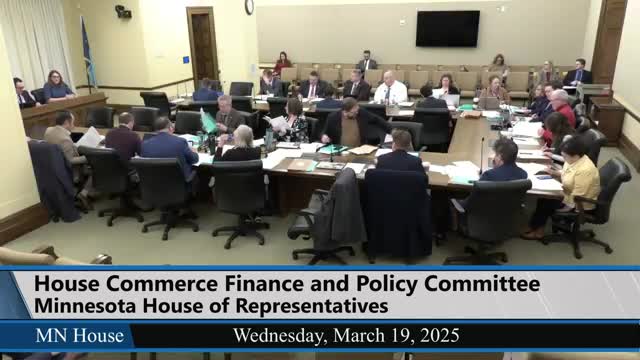
Summary
Representative Lee Finke presented House File 2389, the Department of Commerce insurance policy bill, which clarifies how the department handles targeted data calls, authorizes limited long-term-care products, and allows the state auto plan to issue policies directly.
Representative Lee Finke presented House File 2389 on March 19, carrying the Minnesota Department of Commerce’s insurance policy bill. The bill contains three principal components: clarified treatment of department "data calls," adoption of NAIC model provisions to allow limited long-term-care insurance products, and a change enabling the state's auto insurer of last resort to issue policies on its own paper rather than through a fronting carrier.
Peter Brickwitty, senior director at the Department of Commerce, testified that sections 1–3 clarify how information collected from carriers for targeted projects is classified and held, and that the proposal does not expand the department’s authority to require new data. "We are not expanding the department's authority to ask for new or different information," Brickwitty said. He described the change as intended to make regulatory work faster and provide companies greater clarity about confidentiality and public summary disclosures.
Section 4 implements an NAIC model law to permit limited long-term-care products with shorter benefit periods and modified coverage; Brickwitty said the change aims to give consumers lower-cost options and to strengthen the long-term care market. Committee members asked specifics about the benefit design (daily benefit levels, length of coverage and activities-of-daily-living triggers); Brickwitty said those product details would be determined by companies and regulators and that the department would follow up with the committee on particular design questions.
Sections 5–11 address the auto insurance plan that serves as Minnesota's insurer of last resort. The bill would allow APSO (the auto plan operator) to write policies directly on its own paper. Brickwitty said other states have adopted similar approaches and the change is designed to improve operational efficiency and policyholder transparency.
The committee considered and incorporated an A3 amendment offered by Representative Finke and accepted an oral technical amendment. Representative Finke then moved to re-refer HF2389, as amended, to the Judiciary and Civil Law Committee; the chair called the voice vote and the motion prevailed. No public witnesses spoke in opposition during the Commerce hearing. Committee members also asked detailed questions about long-term-care product designs, data-call confidentiality, and the size and clientele of the auto plan; Brickwitty and department staff agreed to provide follow-up information to members.