Get Full Government Meeting Transcripts, Videos, & Alerts Forever!
Get email alerts on the Philly 311 topic
No spam. Unsubscribe anytime.
Philadelphia council reviews Philly 3-1-1 operations as callers report unresolved cases and app failures
Summary
A City Council committee hearing on March 19 examined Philly 3-1-1’s performance, call volumes, service-level tracking and interagency coordination after residents and council members described long waits, “unfounded” closures and a malfunctioning mobile app.
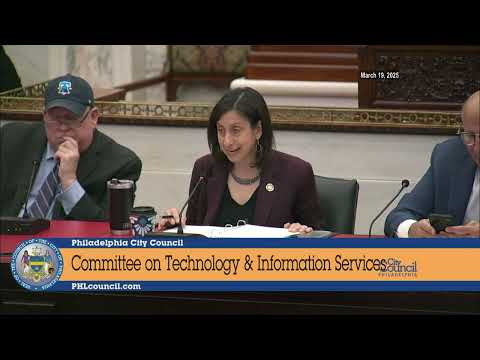
Councilmember Rue Landau, chair of the Committee on Technology and Information Services, opened a March 19 public hearing on Resolution 250059 aimed at evaluating the operation of Philadelphia’s Philly 3-1-1 nonemergency hotline and its engagement with city departments.
“A responsive and reliable 3 1 1 system is essential to a well run city, allowing residents to report problems, seek information, and see their daily lives and the environment around them improve,” Landau said as she framed the committee’s goals.
The hearing featured testimony from Jocelyn Jones, executive director of Philly 3-1-1; Christina McDonald, a senior operations/knowledge-base lead; department representatives from Streets and Licenses & Inspections; a deputy managing director; and public comment from residents. Jones told the committee that Philly 3-1-1 “responds to an average of 1,600 calls a day, managing more than 60 types of service requests across 8 city departments,” and that the center also processes roughly 800 additional noncall cases daily submitted via the mobile app and web portal.
Why this matters: Council members said the service should be a single, reliable entry point for quality-of-life problems, and they pressed for clearer tracking of whether servicing departments meet published service-level agreements (SLAs), better closing notes on cases, and improved communication back to callers — especially residents who lack email.
Key points from the hearing
- Volume and channels: Jones said Philly 3-1-1 handled 20,862 calls related to the 2024 presidential election over a three-week period and that the call center averages 1,600 telephone calls and about 2,400 total cases per day when app and web submissions are included. Jones described recent infrastructure upgrades including automatic routing, a soft-phone telephony system and improved IVR prompts.
- Customer satisfaction and quality control: Jones said the center recently added an end-of-call customer satisfaction survey and that supervisors review low-rated calls. She reported a roughly 91–93% satisfaction rate from the new survey, and said supervisors coach or discipline agents when systemic issues are identified.
- App and access problems: Multiple council members and a public commenter noted app instability and limited access for residents who do not provide email addresses. Nefertari Rayner, a resident who testified during public comment, said, “The 3 0 1 app crashes all the time,” and described repeated unresolved neighborhood requests that nonetheless appear as “closed” in the system.
- “Unfounded” and closure practices: Ralph DiPietro, deputy commissioner for Licenses & Inspections (L&I), explained L&I’s workflow: 3-1-1 complaints feed into L&I’s Eclipse system and inspectors record four status checkpoints (review, assignment, investigation/action, and closure). DiPietro said about one-third of L&I complaints are determined to be “unfounded” for reasons including no code violation on inspection.
- Department responses and tracking: Richard Montanez (Deputy Commissioner of Streets) said Streets uses SLAs for specific request types — for example, pothole repairs are on a three-day SLA — and that the department’s crews are routed daily from a generated work log. Montanez and Ralph DiPietro confirmed there are technical interfaces between their internal work-order systems (Cityworks, Eclipse) and 3-1-1’s Salesforce instance, and they hold regular coordination meetings with 3-1-1.
Committee concerns and directions
Committee members pressed for: clearer, standardized closure notes from servicing departments (so “unfounded” is not a single opaque label); routine interagency reviews of SLAs and real-world averages; improved transparency so constituents receive a concrete account of what was done when a case is closed; and better options for residents without email (e.g., texts). Council members also suggested exploring in-field technology for crews to time-stamp completed work and immediately update case status.
Administration-level coordination
Aubrey Powers, Deputy Managing Director for Community Services, told the committee the managing director’s office and the mayor’s PhillyStat/PhillyStat 360 team are working with 3-1-1 and departments to explore mechanisms to improve coordination and ticket closure for urgent nonemergency services.
Public comment
Resident Nefertari Rayner described persistent trash, abandoned vehicles and potholes around her Hunting Park neighborhood and urged easier, faster feedback for callers. “We have a place in the app where we can add images. But the app crashes,” she said.
No formal votes or policy changes were adopted at the hearing. Committee members asked 3-1-1 and the servicing departments to return with more detailed data, including case-closure timing by department and clearer categorical reasons for “unfounded” and closed statuses.
What’s next
Councilmembers and department representatives repeatedly noted this is a budget-season moment to identify resources and priorities. The committee directed 3-1-1 and departments to pursue clearer SLA reporting and to work with PhillyStat and the managing director’s office on tracking improvements; the committee did not set a formal deadline during the hearing.
Ending note
The hearing produced specific operational requests — standardized closure language, SLA reviews, better app reliability and alternative notification methods for residents without email — and highlighted the gap between the city’s intention for a single point of contact and residents’ experience when cases appear closed but remain unresolved.