Get Full Government Meeting Transcripts, Videos, & Alerts Forever!
Get email alerts on the Ways And Means Committee Bills Roundup topic
No spam. Unsubscribe anytime.
Ways and Means Committee hears pitched bills on school training, restorative practices, civic engagement and family programs
Summary
The Ways and Means Committee received presentations on a group of education and family-focused bills, including measures on anti-bias training for county school board members, restorative practices, a civic-excellence student credential, family literacy recordings by incarcerated people, and MSDE changes to first-aid/CPR staffing ratios; presenters asked for favorable reports but the transcript records no committee votes.
The Ways and Means Committee received presentations on a series of education and family-focused bills during a committee hearing; presenters asked for favorable reports but no committee votes were recorded at the session.
Committee members heard brief presentations and requests for favorable reports on at least nine separate Senate bills covering county board anti-bias training, restorative practices in schools, a civic excellence student credential, student member compensation, a family literacy recording program for incarcerated people, a change in statutory language for emergency-use epinephrine, funding for children’s programs, conformity and effective-date changes to workforce-related legislation, and an amendment to first-aid and CPR staffing ratios for school-age care programs.
SB 293: County Board Member Anti-Bias Training Act Gifty Ochre, an intern in the office of Senator Brian Feldman, presented Senate Bill 293 on behalf of Senator Feldman. Ochre told the committee that “SB 293 requires that each member of a county board of education is required to complete anti-bias training at least once during their term,” and urged “a favorable report.” The presentation was brief and no committee action occurred during the hearing.
SB 68: Restorative practices comprehensive plan A presenter for SB 68 described three core objectives: replacing the statutory term “restorative approaches” with “restorative practices,” directing the Maryland State Department of Education (MSDE) to develop a comprehensive plan, and making implementation a decision for local school boards that would use state-established guidance. The presenter described the bill as a cross-file of a House measure and requested a favorable report.
SB 8: Civic excellence seal and graduation cord Senator Cheryl Kagan presented a proposal creating an optional civic-excellence credential for students. Kagan said the program would allow schools to offer a seal or cord at graduation for students who complete civic coursework and civic projects, and would require at least 30 of a student’s 75 required student service-learning hours be devoted to a civic project. Kagan described the credential as voluntary and intended to encourage civic engagement among students.
SB 307: Student-member compensation (Anne Arundel County) Carol Contina presented for Senator Simon Ayre to explain that SB 307 is identical to House Bill 402 and would increase the stipend or compensation for the student member of the Anne Arundel County Board of Education. Contina asked the committee for a favorable report; the hearing included no committee vote.
SB 378: Family literacy recordings for incarcerated people Cassandra Washington’s chief of staff presented SB 378 on behalf of Senator Washington. The bill would establish a family literacy program to allow certain incarcerated individuals to record themselves reading aloud to children or grandchildren. The presenter said the program is intended to strengthen family relationships and improve literacy for both children and incarcerated readers, noting a cited statistic that “70 percent of incarcerated individuals have fourth-grade or below reading levels.” The committee took no final action at the hearing.
SB 459: Change in statutory term for auto-injectable epinephrine Senator Don Guile (presenting) asked for a favorable report on SB 459, which would change the statutory term “auto-injectable epinephrine” to “emergency-use epinephrine” to reflect newer products that can deliver epinephrine intranasally or sublingually as well as by injection.
SB 359 and SB 451: Funding and workforce-related changes Patty Horton presented on behalf of Senator King for two bills. She said SB 359, as amended, provides full funding for specified children’s programs for fiscal years 2027–29 and that the Senate passed the amendment unanimously; she urged the committee to provide full funding. Horton also presented SB 451, explaining that the senator would offer an amendment to make the Senate language conform to a House bill and that the Senate had amended the effective date from Oct. 1 to July 1, 2025, after consultation with the Department of Labor.
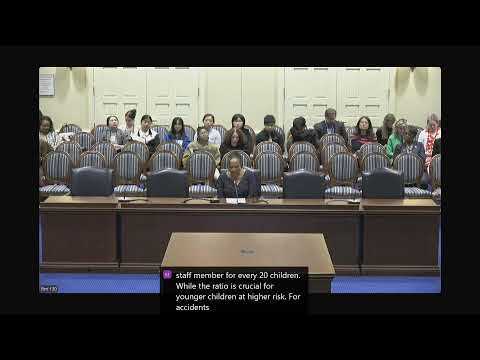
SB 252: First-aid and CPR requirements for school-age programs (MSDE) Tara Phillips of the Maryland State Department of Education’s Division of Early Childhood presented SB 252 (cross-file HB 150). Phillips said the bill would remove a fixed statutory requirement that one staff member be first-aid/CPR certified for every 20 children and instead allow MSDE to set age-appropriate certification ratios by regulation. She said the work group that recommended the change concluded that the 1:20 ratio is critical for infants, toddlers and preschoolers but creates operational challenges for school-age programs; the bill would preserve 1:20 for younger children and shift to a 1:30 expectation for school-age programs, set in regulation rather than statute.
Committee procedure and next steps Presenters repeatedly asked for favorable reports, but the hearing transcript shows no recorded committee votes during the session. Several presenters said their measures were cross-filed with identical House bills that already had committee consideration. Committee leadership closed the hearing after the final presentation and reminded members about a subcommittee meeting the following morning.
Notes and context All descriptions above are drawn from testimony to the Ways and Means Committee; where presenters characterized a bill as identical to a House cross-file, the article reports that description rather than independently verifying statutory text. Timing, fiscal analyses, and final committee dispositions were not recorded in the provided transcript and are not reported here.