Get Full Government Meeting Transcripts, Videos, & Alerts Forever!
Get email alerts on the Financial Management topic
No spam. Unsubscribe anytime.
Santa Rosa staff outline four financial policies to formalize reserves and capital planning
Summary
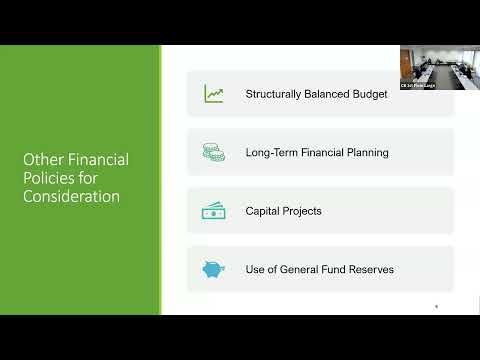
City finance staff told a subcommittee they will draft four written policies — a structurally balanced budget, long-term financial planning, capital projects policy and formal rules for reserves — to convert existing practices into codified guidance and return to the subcommittee for direction.
Alan, staff member, told the Santa Rosa City finance subcommittee that the city already follows many best practices but lacks written policy for several areas and proposed formalizing four policies.
"Financial policies are central to a strategic and long term approach to our financial management," Alan said, framing the presentation around the Government Finance Officers Association (GFOA) best-practice list and noting the city currently lacks written policy in four areas.
The presentation identified four policy topics staff propose to draft: a structurally balanced budget that distinguishes ongoing from one-time revenues; formal long-term financial planning with multi-year forecasting; a capital projects policy covering asset life-cycle, project scoping, budgeting and operations costs; and an expanded reserves policy spelling out the use of fiscal stability reserves and rules for amounts above the city’s minimum target.
Alan said the city already applies many of these practices informally — for example, a fiscal stability reserve was created after one-time PG&E funds became available — but that codifying them would "institutionalize good financial management practices" and support bond ratings and lower borrowing costs.
Scott Wagner, deputy director of finance, summarized the city’s three reserve categories: a mandated reserve (about 17% of annual expenditures), available reserves (amounts above the mandate) and a third informal fiscal stability reserve set aside to cover budget deficits. Wagner said the fiscal stability reserve has a defined purpose and is being drawn down in recent years to cover operating shortfalls.
Committee members raised implementation and tradeoff questions. Members asked how specific policies should be to avoid over-reserving for projects that later prove more expensive, and whether capital budgeting rules can realistically capture future staffing, maintenance and utility costs. Alan and Wagner acknowledged those trade-offs and recommended drafting policies that provide guidance without excessively restricting future councils.
The subcommittee agreed that staff should draft the proposed policies and return to the subcommittee with written proposals; the committee did not take a formal vote on adoption at the meeting.
The staff presentation referenced examples from other jurisdictions and GFOA guidance; Alan recommended bringing policy drafts back to the subcommittee for refinement and then, if approved by the subcommittee, forwarding them to the full City Council for study session or report items.
The subcommittee closed the item with agreement to have staff return with draft policies.
Ending: Staff will draft formal policies on a structurally balanced budget, long-term financial planning, capital projects, and reserve use, then return to the subcommittee for further direction before any action by the full City Council.