Get Full Government Meeting Transcripts, Videos, & Alerts Forever!
Get email alerts on the State Budget topic
No spam. Unsubscribe anytime.
Wisconsin Counties Association outlines state budget priorities in Eau Claire County briefing
Summary
Lobbyists from the Wisconsin Counties Association told the Eau Claire County Board the governor’s budget contains significant proposals for courts, transportation, mental health and conservation staff — but many details and legislative votes remain unresolved as the Joint Finance Committee begins public hearings in April.
Marcy Rainbolt, a lobbyist with the Wisconsin Counties Association, told the Eau Claire County Board on March 18 that Gov. Tony Evers’ biennial budget proposal contains a mix of county priorities and large new spending items that will face partisan negotiation in Madison.
Rainbolt said the state’s projected surplus is about $4.6 billion and the rainy day fund stands at a record roughly $1.9 billion, but cautioned that the Legislative Fiscal Bureau’s plain-language analysis — not yet released at the time of the presentation — will clarify which parts of the governor’s proposal are likely to survive the process. “There’s still a state surplus. It’s about $4,600,000,000,” Rainbolt said, and “we obviously have picked out some things that we’re gonna talk to you guys about tonight.”
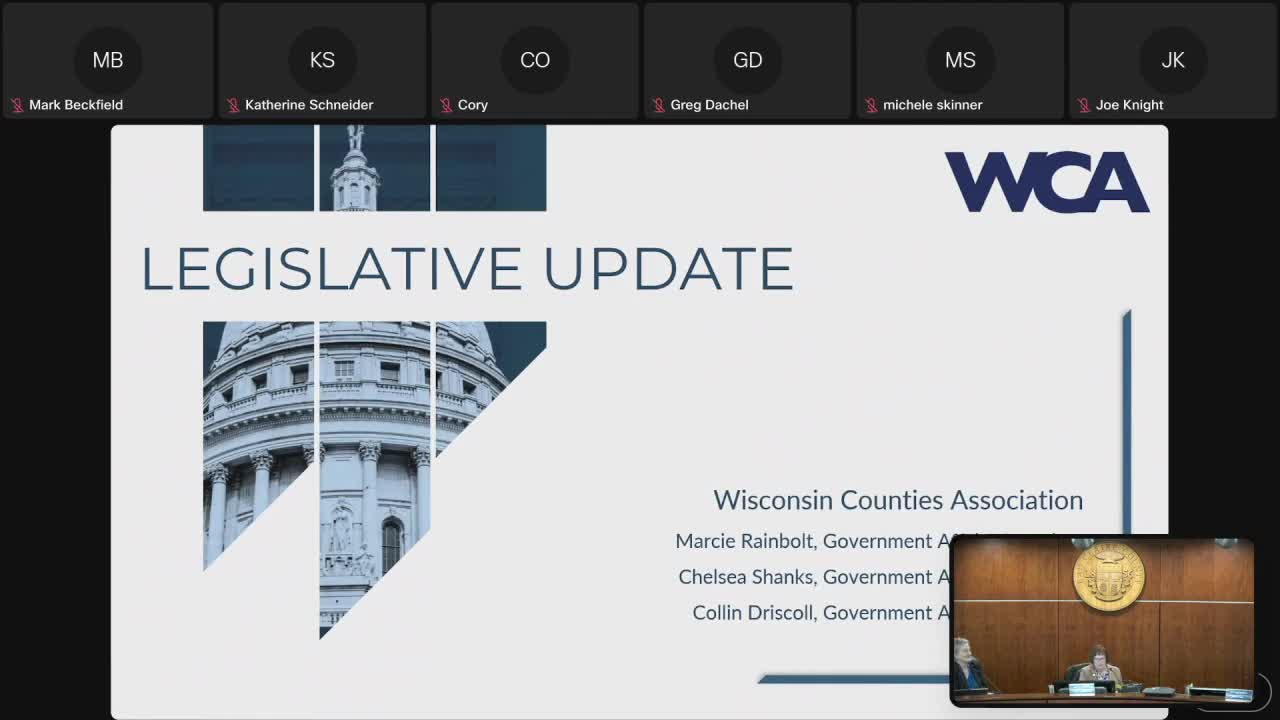
The presentation, delivered by Rainbolt with colleagues Colin Driscoll and Chelsea Shanks, walked supervisors through the governor’s priorities and the Wisconsin Counties Association’s (WCA) asks. WCA highlighted funding requests and administrative changes the association has prioritized after collecting county input through steering committees and its membership process.
Why it matters: the governor’s plan would change funding formulas and create new programs that affect county budgets and services. Several provisions that WCA supports — including additional money for county-run circuit courts and for county conservation staffing — are included in the governor’s proposal but are subject to change once the Joint Committee on Finance (JCF) begins work.
Key points from the WCA briefing
- Courts and public safety: Rainbolt said Gov. Evers included $24.5 million in the first year and $70 million in the second year in his budget to expand state support for circuit court costs, conditioned on counties having a TAD program in place to qualify. WCA’s broader ask is $70 million to help move the state–county cost split toward roughly 50/50 for circuit court costs; the association said that would raise the appropriation to about $98 million.
- Human services and mental health: Chelsea Shanks said the governor’s budget includes a major move on community support programs (CSP) by paying the 40% non‑federal share of Medicaid-reimbursable services. She described this as a substantial change from current practice, where counties cover a larger share. WCA is also asking for $21 million for crisis services and about $20 million for CSP in its legislative request to achieve that 40% non‑federal share statewide.
- Juvenile corrections and other human services: the governor proposed $28 million for juvenile corrections rate increases and $21.7 million for home‑delivered meals, Shanks said. WCA said it will press to preserve those amounts through the budget process.
- Transportation and infrastructure: Colin Driscoll said the governor proposed increasing general transportation aids (GTA) by 3% in each year of the biennium, $20 million for routine maintenance agreements (raising routine maintenance support closer to 60% of previously requested levels) and another $100 million for the Local Roads Improvement Program (LRIP). Driscoll also noted the state’s recent inventory of 6–20 foot bridge structures and an estimate of roughly $150,000 per structure to replace those in dire condition.
- Conservation and agriculture: WCA requested $20.2 million in base funding for county conservation staffing. The governor proposed $15 million in the first year, $15.5 million in the second — an increase WCA said helps but does not reach the full statutory funding goal.
- Tax and finance proposals: Rainbolt and colleagues reviewed the governor’s suggested new top individual tax bracket (9.8% on taxable income above $1 million), elimination of sales tax on cash tips, and proposals to freeze property taxes while providing a new state aid equal to a 3% increase to existing levies. The presenters said WCA and counties remain unclear about how that 3% aid would work after the two‑year budget period.
- Local options and election costs: the governor’s proposal would allow counties (excluding Milwaukee) to seek a 0.5% additional sales tax by referendum; the presenters said it would require voter approval and that the policy details in the fiscal memo would need clarification. The budget also includes reimbursement for some special-election costs and a provision allowing early canvassing of absentee ballots on the day prior to an election.
Questions from supervisors and clarifications
Supervisors asked about PFAS and other previously approved funding that has been caught up in legal disputes and vetoes. Rainbolt said she was not optimistic the HSHS hospital settlement funds would be spent before the June 30 fiscal year cutoff and that those amounts may lapse; she said PFAS funds placed in a trust fund might remain available but required confirmation.
Other supervisors asked about potential federal cuts that could affect counties; WCA staff said they were monitoring federal actions and holding weekly briefings with county officials and national partners but did not have definitive lists of cuts at the time of the meeting.
WCA’s process and next steps
Rainbolt explained that WCA’s priorities were developed from member county input, subject-matter steering committees and an annual business meeting where the platform and priorities are approved. The Joint Committee on Finance announced a series of public “road show” hearings that WCA encouraged counties to attend: early April dates in Kaukauna, West De Pere, Hayward and Wausau.
The joint finance committee will deliberate on the governor’s introduced budget (Assembly Bill 50 / Senate Bill 45) and determine what remains in the final bill. The presenters repeatedly noted that many policy items are likely to be stripped or amended early in the JCF process and urged county-level advocacy to preserve priority items.
What the presentation did not resolve
WCA staff clarified numbers and program details where possible but repeatedly declined to speculate on which items the legislature will retain. Several items are conditional or require additional rulemaking or legislative language (for example, how the 3% property tax state aid would be maintained after the budget period or what qualifies as “serious cases” for the state public defender private‑bar rate increase).
Ending
WCA provided county contact information and asked supervisors to connect with association staff for technical questions or follow-up. The association said its next steps include pressing for circuit court funding, conservation staffing increases, transportation aids, and human services funding in the upcoming JCF deliberations.