Get Full Government Meeting Transcripts, Videos, & Alerts Forever!
Get email alerts on the Signature Curing Vote By Mail topic
No spam. Unsubscribe anytime.
Senate committee examines California vote-by-mail signature "cure" process amid disparities and county variation
Summary
At a January 2025 informational hearing, the California State Senate Committee on Elections and Constitutional Amendments reviewed how counties identify, notify and accept corrected signatures for vote-by-mail ballots, hearing data on low overall rejection rates but significant subgroup disparities and inconsistent county practices.
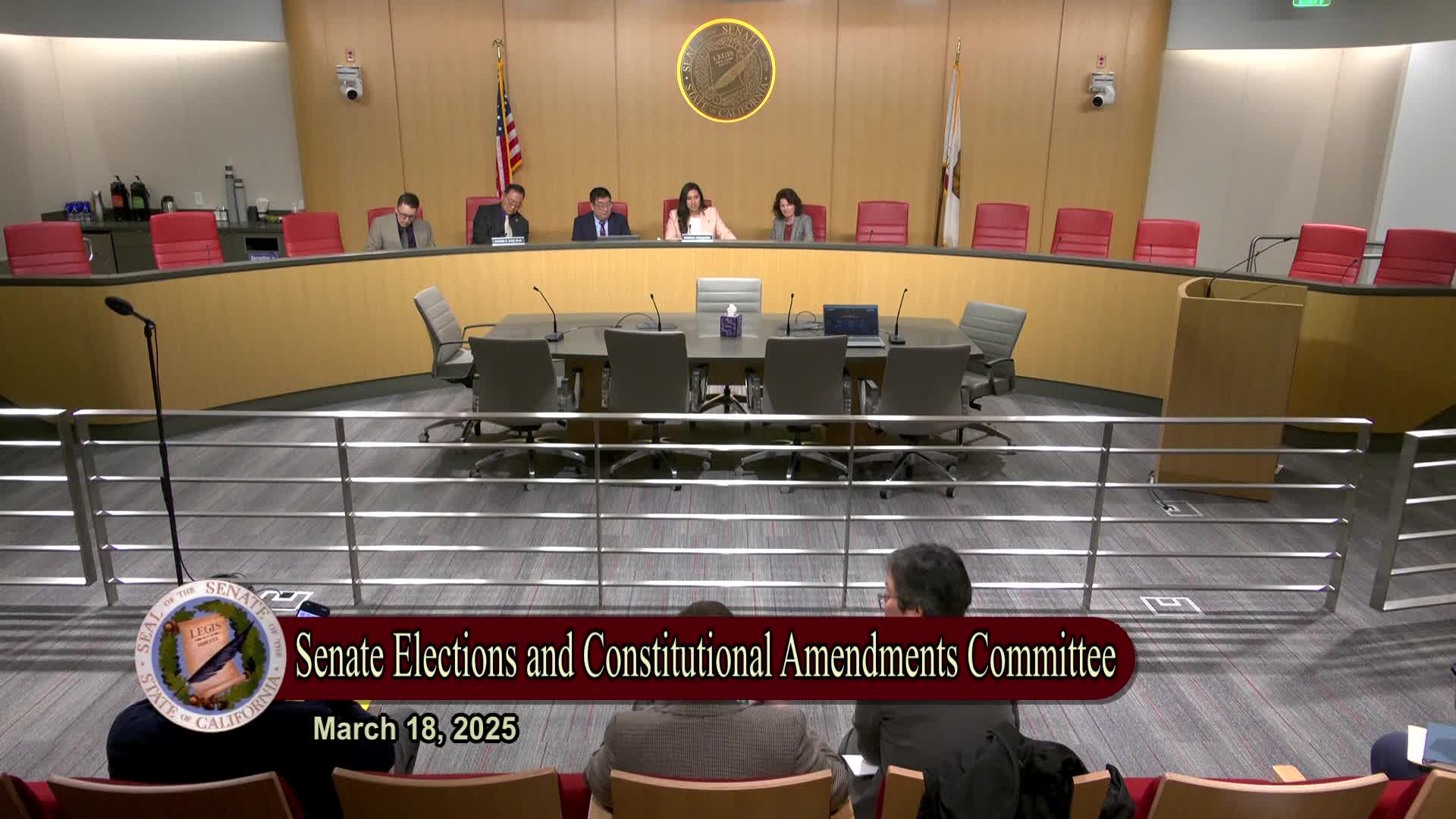
The California State Senate Committee on Elections and Constitutional Amendments held an informational hearing in early 2025 to review the state's process for notifying voters and "curing" vote-by-mail envelopes when signatures do not match records.
The hearing, led by Chair Cervantes, drew testimony from the Secretary of State's elections division, registrars from Contra Costa and Orange counties, academic researchers, voting-rights and disability advocates and political party attorneys. Witnesses described widely shared goals'preserving access while guarding election integrity'and highlighted differences in county practice, data on who is most affected and proposals to reduce needless rejections and speed final counts.
"The secretary of state is the chief election officer of the state of California," Janaline Lien, chief of the elections division for Secretary of State Shirley Weber, told the committee, summarizing the office's role in issuing model cure forms, translations and guidance. Lien explained the statutory deadlines that require county officials to notify voters by mail and that voters may have until 5 p.m. two days before certification to verify a signature. She added that "if the signatures does not compare, the vote by mail ballot envelope shall not be opened, and the ballot shall not be counted."
Why it matters: California's heavy use of vote-by-mail makes the signature review process consequential. Witnesses agreed the statewide share of ballots ultimately rejected is small relative to turnout, but the raw counts are substantial and concentrated in particular demographic groups and counties. Mindy Romero of the USC Center for Inclusive Democracy told the committee that an estimated 0.9% of vote-by-mail ballots were rejected in November 2024, a rate that translated into roughly 117,000 rejected ballots statewide in that election. Romero and others stressed that rejection rates are higher for younger voters, Latino and Asian-American voters and limited-English communities.
County practitioners described how the process works on the ground and how local procedures affect outcomes. Kristen Braun Connolly, Contra Costa County clerk-recorder and registrar of voters, said her office mailed 5,464 cure notices in the November 2024 general election and that 2,523 of those were "ultimately cured," a 46% cure rate for challenged signatures. Connolly described a multi-step, human review process: she said signature review is done by staff, often with second- and third-level checks before a ballot is deemed uncurable, and that when a signature is accepted the county uploads the substitute signature to the voter's record for future comparisons.
Orange County Registrar Bob Page said county timing and outreach affect cure rates. He told the committee the county saw higher cure rates for notices mailed on or before Election Day (about 59%) than for notices mailed after Election Day (about 38%). He also highlighted that additional days to cure produce more accepted ballots: in November 2024, Orange County had roughly 850 voters who cured their ballots after what would have been an earlier E+20 deadline but before the later date required by state law changes.
Observers and data users raised concerns about inconsistent county practices and reporting. Attorneys who work with parties and campaigns said counties differ on how and when they mark and publish lists of challenged ballots and how they interpret deadline rules (for example, whether a statutory deadline that falls on a weekend extends to the next business day). Several panelists urged a uniform form, clearer statewide training and consistent data publication so campaigns and community groups can know whether a voter has already returned a cure and avoid repeated, unnecessary contact.
Advocates, academics and disability-rights groups emphasized disparities and outreach gaps. Romero presented subgroup data showing higher rejection rates for Latino and Asian-American voters and very high rejection shares for young voters: for the 18-to-24 cohort she reported a 3.3% rejection rate in 2024 and said that when younger voters' ballots are rejected the reason is most often a nonmatching signature. Deanna Katamara of the Asian Law Caucus described language- and handwriting-related causes and said, "we will always see signature inconsistencies, but that doesn't mean they aren't the voter." Disability Rights California and others argued the cure process is necessary to avoid disenfranchising voters with disabilities but asked the state to standardize training and materials.
Proposals and trade-offs discussed by witnesses included: - A uniform statewide cure form and required Secretary of State guidance and training for county staff; several speakers called for mandatory, consistent training materials and calibration of any automated tools. - Expanded voter education and funding for community-based outreach so voters understand how to complete envelopes and how to respond to cure notices; multiple witnesses recommended greater state investment rather than leaving costs to counties. - Operational changes to speed trustworthy results such as earlier mailing of cure notices, expanded early in-person options that avoid signature review, adoption of secure electronic cure-submission channels and use of ballot-tracking notifications to alert voters immediately. - Longer uniform cure deadlines versus faster certification trade-offs: county officials and registrars emphasized that extending cure windows increases the number of ballots that can be salvaged, while others noted that increased turnout of vote-by-mail ballots and postmark allowances make California's count naturally take longer than smaller states.
On technology and identification, viewpoints differed. Some speakers encouraged piloting automated or AI-assisted tools for signature work and ballot processing but warned about mismatches caused by low-resolution DMV electronic signatures. Richard Rios, general counsel to the California Republican Party (speaking for himself), proposed considering objective identification methods (for example, ID numbers) in lieu of or alongside signatures; county registrars and advocates said that would raise legal and logistical issues and urged caution.
What the committee heard on numbers and process: panelists supplied county-level examples and statewide context. Contra Costa described a practice of scanning accepted cure signatures to the voter file; Orange County reported mailing more than 12,000 follow-up "signature update" letters after the election to try to reduce future challenges; and the Secretary of State's office noted it provides model forms, translations and instructions to counties and publishes post-election ballot-rejection reports.
The hearing did not include any formal votes. Committee members signaled interest in possible legislative or budget actions to standardize forms, fund statewide voter-education efforts, require consistent training, and consider uniform deadlines that balance timely results with enfranchisement.
"There is no tangible evidence in any way in California of voter fraud," Romero told the committee while urging focus on prevention, education and consistent county practice rather than policy driven by fraud concerns.
The hearing closed with Chair Cervantes stressing the committee's aim "to both ensure that every valid vote is counted while upholding the integrity of our election system." The committee said it would use the testimony and data to inform potential follow-up legislation and requests for state support to counties.
Sources and next steps: the committee heard testimony from the Secretary of State's elections division, Contra Costa and Orange county registrars, academics and nonprofit legal advocates. Members asked staff to return with additional data and implementation options; witnesses urged the committee to pair any statutory changes with dedicated funding for county implementation and voter outreach.