Get Full Government Meeting Transcripts, Videos, & Alerts Forever!
Get email alerts on the Mega Tax Credits topic
No spam. Unsubscribe anytime.
House subcommittee hears MEDC briefing on MEGA tax credits, questions on transparency and oversight
Summary
The House Oversight Subcommittee received an overview from the Michigan Economic Development Corporation on the state's MEGA tax credit program, its history, compliance procedures and remaining liabilities; lawmakers pressed MEDC and a manufacturers' trade group on transparency, program costs and how retained jobs are verified.
The House Oversight Subcommittee on Corporate Subsidy and State Investments heard a briefing Oct. 27 from the Michigan Economic Development Corporation on the state's MEGA tax credit program, including program history, compliance procedures and financial estimates for remaining tax-credit liability.
The MEGA program, created in 1995 and administered through certificates issued by the Michigan Strategic Fund, provided refundable tax credits tied to job creation, capital investment and wages. Josh Hunt, with the MEDC, told the committee the program stopped issuing new agreements after 2011 and that credits are refundable'meaning the credit can reduce a company's tax liability below zero and result in a refund from the Department of Treasury.
Committee members pressed MEDC officials on program scale, the verification process and remaining liabilities. Kristen Armstrong, senior vice president for business development programs and execution at MEDC, described the agency's compliance unit and its audit routines, including a random-sample review of employee records to verify job counts, wages and, where applicable, employer-paid health benefits.
MEDC told the subcommittee it has certified that the program supported more than 63,000 new jobs and 184,000 retained jobs and that projects receiving MEGA credits secured more than $52 billion in capital investment; MEDC also said certificate values issued since the program began total about $6.3 billion. The agency provided a list of 10 companies that still hold certificated credits, including Dow Inc., Ford Motor Company, General Motors, Stellantis (filed as FCA US LLC), Hyundai Kia America Technical Center and others.
Lawmakers repeatedly asked for more transparency about how much tax revenue companies actually pay under the old Michigan Business Tax (MBT) compared with the corporate income tax. MEDC officials said Treasury handles companies'tax filings and that state law limits public disclosure of certain tax information; MEDC offered to provide statutory citations and to supply the committee copies of tax-credit agreements and other reports it produces under the MEGA Act and related statutes.
On compliance, Armstrong said MEDC selects a random 15% sample from the populations of base, new and retained jobs submitted by a company and audits payroll records, W-2s, employer identification numbers and hire dates to confirm eligibility. Armstrong said the Office of the Auditor General reviewed the MEGA program in 2017 and found the MEDC's procedures sufficient for issuing certificates.
Several committee members raised substantive concerns. Minority Vice Chair Rep. James Wigela questioned whether the 15% sample and MEDC's process are sufficient to ensure credits match actual wages and jobs; MEDC officials said they expand sampling when irregularities are found and that the Auditor General has access to full files during reviews. Rep. Crimson Green and others asked whether the program's structure allowed companies to "cherry-pick" which positions count toward credits; MEDC said credits are issued only for jobs and wages that meet the written agreement terms and that companies are reimbursed only for the counts specified in their contracts.
Committee members also discussed recent amendments and terminations. MEDC said Dow Inc. agreed to a mutual termination effective tax year 2025 as part of a separate grant agreement and that MEDC will execute termination of the MEGA certificate coincident with finalizing that agreement. MEDC said some historic amendments after 2011 changed headcount or payment timing for existing agreements; however, no new MEGA agreements have been approved since 2011.
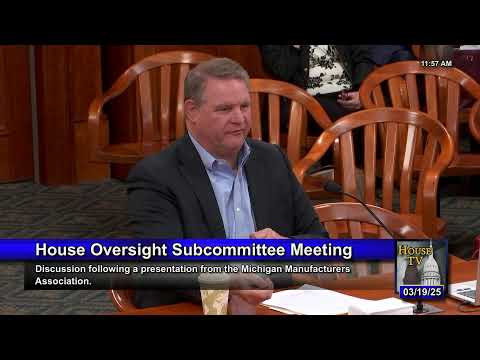
The Michigan Manufacturers Association, represented by Mike Johnston, executive vice president for government affairs and workforce development, testified after MEDC and urged continued use of incentives as a competitive tool, arguing that manufacturing has a high economic multiplier and that other states compete aggressively for the same projects.
Johnston characterized MEGA and other incentive tools as one part of a broader economic strategy to retain and attract investment and said incentives are often the deciding factor when out-of-state competitors offer lower costs. He offered to provide the committee with a Center for Automotive Research study cited during his testimony on the auto-sector multiplier.
What the subcommittee asked for and what MEDC said it will provide: copies of the annual MEGA reports the agency files under the statute, the statutory citation limiting disclosure of tax information, copies of individual tax-credit agreements on request and the certificate-of-credit report that lists the value of issued certificates. MEDC reiterated that it does not have access to companies'complete tax return details and that Treasury enforces statutes governing disclosure of tax information.
The hearing produced no formal votes beyond routine approval of the minutes from the committee's March 12 meeting, which Minority Vice Chair Wigela moved and the committee approved without objection. Members indicated they may request additional documents from Treasury and MEDC to resolve outstanding transparency questions.
The committee adjourned after testimony and questioning of the Michigan Manufacturers Association and MEDC representatives.