Get Full Government Meeting Transcripts, Videos, & Alerts Forever!
Get email alerts on the State Tax Policy topic
No spam. Unsubscribe anytime.
Minnesota tax committee hears governor—s tax proposal; sales-tax expansion, R&D credit, AIS and forest-payments draw concern
Summary
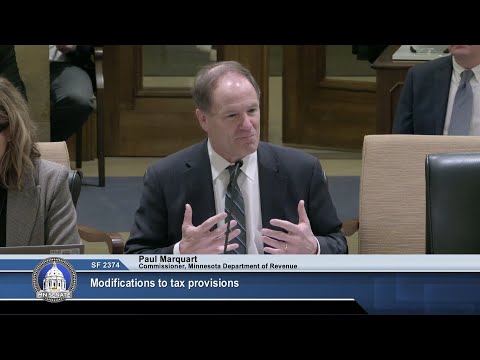
At a Minnesota Senate Taxes Committee hearing, Department of Revenue Commissioner Paul Marquardt presented the tax portions of Governor Tim Walz—s budget proposal (Senate File 2374) and answered senators— questions while stakeholders testified about likely local impacts.
At a Minnesota Senate Taxes Committee hearing, Department of Revenue Commissioner Paul Marquardt presented the tax portions of Governor Tim Walz—s budget proposal (Senate File 2374) and answered senators— questions while stakeholders testified about likely local impacts.
Marquardt, joined by Joanna Baers, legislative director, described the bill as seeking "a more fair and more stable tax system" and said the proposal—s mix of rate and base changes aims to address roughly half of a stated structural budget imbalance. "I am Paul Marquardt, a commissioner of the Department of Revenue," he said as he opened the presentation.
The bill covers multiple areas. Key provisions Marquardt outlined include: a sales-tax rate reduction paired with an expansion of taxable services (Article 3); a refundable expansion of the research-and-development credit (refundable up to 25 percent of excess credits); additions to sustainable aviation fuel policy and credits (Article 1); an adjustment and decoupling of the airline flight property tax to set a fixed levy for the state airport fund (Article 2); and a mix of program reductions and statutory changes in Articles 2 and 4 that would affect aquatic invasive-species (AIS) aid, sustainable-forest incentive payments and local cannabis aid.
On the sales-tax proposal, Marquardt said the administration is combining a narrower rate and a broader base: a cut of 0.075 percentage points in the statewide rate (the presentation referenced the existing legacy 0.375 share) alongside adding many consumer-facing services to the tax base. He summarized modeled impacts: an estimated $99 million reduction in FY27 from the rate cut, a roughly $215 million increase in FY27 from base expansion (netting about $185 million over two years in the administration—s figures), and an effective date for taxed purchases after Sept. 30, 2025. Marquardt said modeling from fiscal staff showed an "average household" would see about a $32 tax cut overall and that most households would be net beneficiaries, while some who use particular services (notably legal services) could pay more.
Marquardt emphasized the administration—s choice to exclude business-to-business transactions from the expansion and said the package would not impose sales tax on services that are used to produce other taxable goods or services. He also noted several explicit exclusions in the bill—s current language: tax preparation for those claiming certain credits, some pension management fees, legal aid services and specified banking fees among others.
On business incentives, Marquardt described changes that would expand and partially refund the state R&D credit, saying the change is meant to keep Minnesota competitive for innovation. He said the change would cost about $20 million per year in reduced tax receipts and that it would benefit roughly 500 corporations and about 100 pass-through entities, with an average per-entity tax reduction figure cited in committee materials.
Other technical and program items Marquardt covered: an amendment mirroring Senate File 1312 on sustainable aviation fuel that includes a supplemental 2-cent-per-gallon credit tied to carbon reduction thresholds; allowing short-line-railroad reconstruction tax credits to be transferred more quickly; setting an $8,050,000 fixed levy portion for the state airport fund; and removing the small assignment option for the K–12 education credit that previously allowed less than 1 percent of claimants to assign up to $1,500 to a lender.
Committee members pressed administration officials about the fiscal and distributional effects of several provisions. Senators raised concerns that some of the administration—s revenue changes amount to shifting costs to counties and local governments rather than state spending reductions. Marquardt acknowledged he had seen county-provided estimates that the county share of the proposed changes could be "north of $100,000,000" but said he had not yet obtained an official consolidated figure from Minnesota Management and Budget for the hearing.
Stakeholder testimony focused heavily on several program changes contained in the bill. Shane Drift, identified as a district representative and acting chairman for Bois Forte Band of Chippewa, told the committee that a proposed 30 percent reduction to payments under a sustainable-forest or land-restoration program (testimony referenced the program—s binding contracts of up to 50 years) would "severely harm our band's ability to repay debt" and called the funding "crucial to the band's financial stability." Rick Horton of Minnesota Forest Industries pointed to language in statute added after litigation that had limited year-to-year payment variability to 10 percent; he said the bill—s change to allow deeper reductions "undermines agreements that land owners make with the state government."
Multiple local officials and conservation groups testified about cuts to aquatic invasive-species prevention aid. Paul McDonald, a St. Louis County commissioner, said the governor—s proposed 50 percent reduction to AIS prevention funding would cost St. Louis County about $350,000 in 2026-27 and jeopardize inspections and protections at dozens of boat landings. Jeff Forster, executive director of Minnesota Lakes and Rivers, told the committee that the County AIS Prevention Aid enacted in 2014 "bent the trend line on new infestations" and called the program "an impact amplifier" that leverages volunteer and local resources.
Banks and community lenders also testified about the sales-tax expansion—s possible effects on financial services. Gail Mikolic, chief operating officer for Northeast Bank and a representative of the Minnesota Bankers Association, warned that treating bank fees as taxable could have unintended consequences for lower-income households and would require significant systems changes for banks to collect and remit the tax. "This is not a tax on the wealthy. It is a tax on nearly every Minnesotan because banking is an essential service," she said.
Committee members acknowledged the breadth of issues and indicated more hearings and testimony time would be scheduled; the chair said testimony would continue on a subsequent day to accommodate out-of-town witnesses and tribal leaders. The committee adjourned after hearing the first set of witnesses.
Next steps: the Taxes Committee held the presentation and public testimony as part of its review of Senate File 2374; the committee signaled it will take additional testimony and request more detailed fiscal information from the administration, including county-level estimates from MMB, before taking further action.